Department of Physiology, Medical College of Georgia at Augusta University, Augusta, Georgia, USA.
Vascular Biology Center, Medical College of Georgia at Augusta University, Augusta, Georgia, USA.
Clin Transl Med. 2022 Apr;12(4):e736. doi: 10.1002/ctm2.736.
Heart failure (HF) is one of the leading causes of death worldwide and is associated with cardiac metabolic perturbations. Human Type 2 Berardinelli-Seip Congenital Lipodystrophy (BSCL2) disease is caused by mutations in the BSCL2 gene. Global lipodystrophic Bscl2 mice exhibit hypertrophic cardiomyopathy with reduced cardiac steatosis. Whether BSCL2 plays a direct role in regulating cardiac substrate metabolism and/or contractile function remains unknown.
We generated mice with cardiomyocyte-specific deletion of Bscl2 (Bscl2 ) and studied their cardiac substrate utilisation, bioenergetics, lipidomics and contractile function under baseline or after either a treatment regimen using fatty acid oxidation (FAO) inhibitor trimetazidine (TMZ) or a prevention regimen with high-fat diet (HFD) feeding. Mice with partial ATGL deletion and cardiac-specific deletion of Bscl2 were also generated followed by cardiac phenotyping.
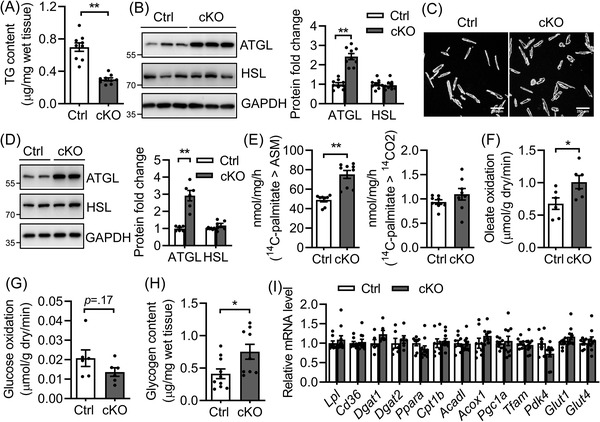
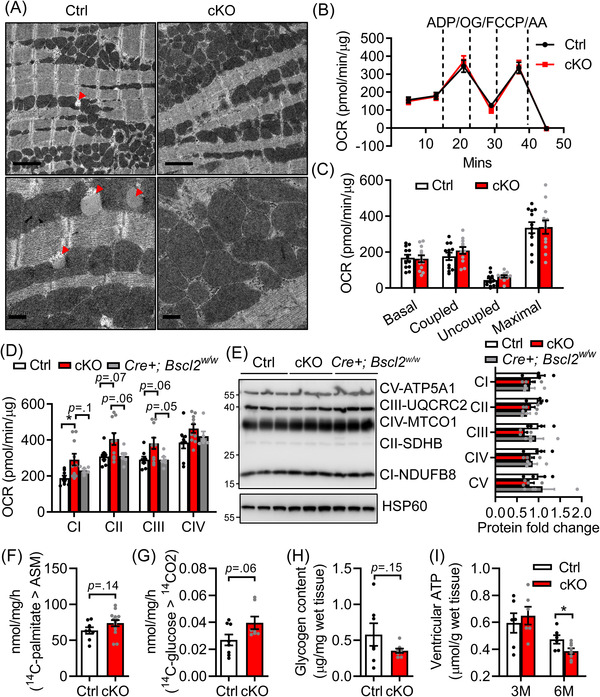
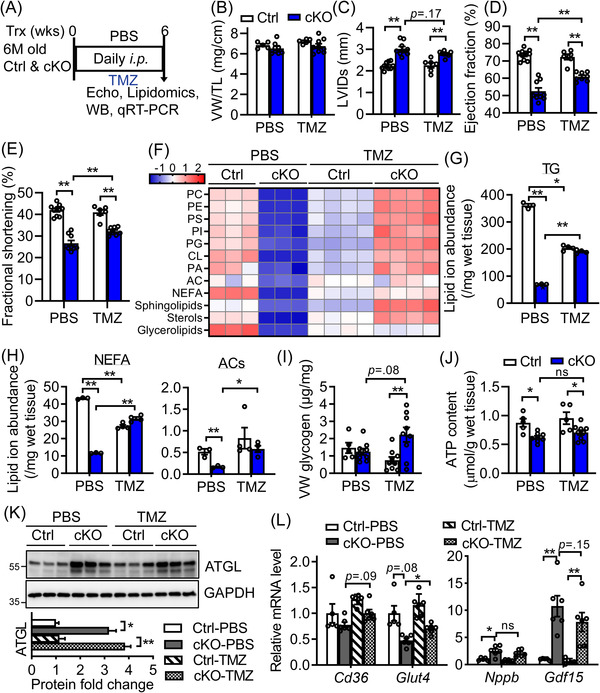
Different from hypertrophic cardiomyopathy in Bscl2 mice, mice with cardiac-specific deletion of Bscl2 developed systolic dysfunction with dilation. Myocardial BSCL2 deletion led to elevated ATGL expression and FAO along with reduced cardiac lipid contents. Cardiac dysfunction in Bscl2 mice was independent of mitochondrial dysfunction and oxidative stress, but associated with decreased metabolic reserve and ATP levels. Importantly, cardiac dysfunction in Bscl2 mice could be partially reversed by FAO inhibitor TMZ, or prevented by genetic abolishment of one ATGL allele or HFD feeding. Lipidomic analysis further identified markedly reduced glycerolipids, glycerophospholipids, NEFA and acylcarnitines in Bscl2 hearts, which were partially normalised by TMZ or HFD.
We identified a new form of cardiac dysfunction with excessive lipid utilisation which ultimately causes cardiac substrate depletion and bioenergetics failure. Our findings also uncover a crucial role of BSCL2 in controlling cardiac lipid catabolism and contractile function and provide novel insights into metabolically treating energy-starved HF using FAO inhibitor or HFD.
心力衰竭(HF)是全球主要死亡原因之一,与心脏代谢紊乱有关。人类 2 型 Berardinelli-Seip 先天性脂肪营养不良(BSCL2)疾病是由 BSCL2 基因突变引起的。全身性脂肪营养不良的 Bscl2 小鼠表现出肥厚型心肌病,心脏脂肪变性减少。BSCL2 是否直接调节心脏底物代谢和/或收缩功能仍不清楚。
我们生成了心肌细胞特异性 Bscl2 缺失(Bscl2 )的小鼠,并研究了它们在基础状态下或在用脂肪酸氧化(FAO)抑制剂曲美他嗪(TMZ)治疗方案或高脂肪饮食(HFD)喂养预防方案后心脏底物利用、生物能学、脂质组学和收缩功能。还生成了部分 ATGL 缺失和心肌特异性 Bscl2 缺失的小鼠,并进行了心脏表型分析。
与 Bscl2 小鼠的肥厚型心肌病不同,心肌特异性 Bscl2 缺失的小鼠出现扩张性收缩功能障碍。心肌 BSCL2 缺失导致 ATGL 表达和 FAO 升高,同时心脏脂质含量降低。BSCL2 小鼠的心脏功能障碍与线粒体功能障碍和氧化应激无关,但与代谢储备和 ATP 水平降低有关。重要的是,FAO 抑制剂 TMZ 可部分逆转 Bscl2 小鼠的心脏功能障碍,或通过遗传消除一个 ATGL 等位基因或 HFD 喂养来预防。脂质组学分析进一步鉴定出 Bscl2 心脏中的甘油酯、甘油磷脂、NEFA 和酰基辅酶 A 显著减少,TMZ 或 HFD 可部分恢复正常。
我们发现了一种新形式的心脏功能障碍,其特征是过度利用脂质,最终导致心脏底物耗竭和生物能学衰竭。我们的发现还揭示了 BSCL2 在控制心脏脂质分解代谢和收缩功能中的关键作用,并为使用 FAO 抑制剂或 HFD 对能量饥饿性 HF 进行代谢治疗提供了新的见解。