Department of Nutrition and Food Science, Faculty of Veterinary Sciences, University Complutense of Madrid, Madrid, Spain.
Department of Animal Production and Public Health, Faculty of Veterinary and Experimental Sciences, Catholic University of Valencia, Valencia, Spain.
Microb Ecol. 2023 May;85(4):1541-1551. doi: 10.1007/s00248-022-02002-y. Epub 2022 Apr 7.
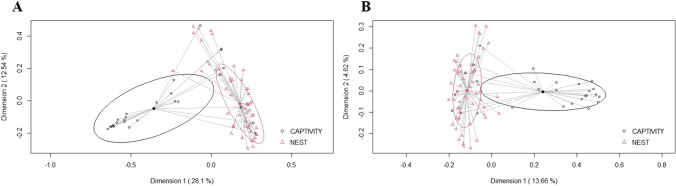
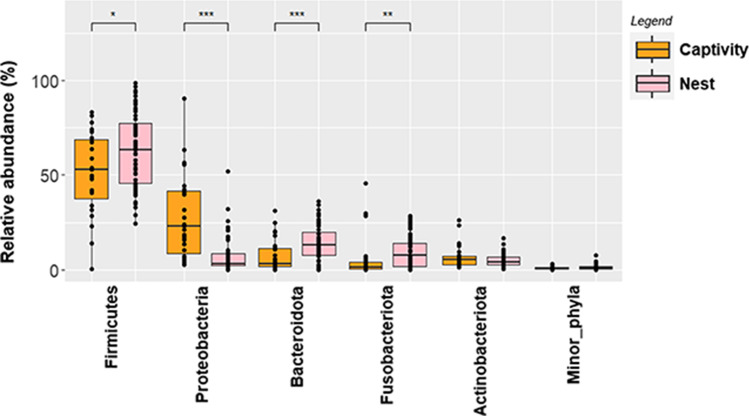
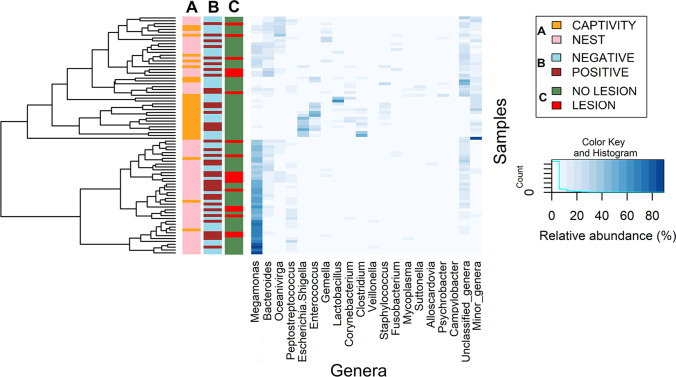
Bonelli's eagle (Aquila fasciata) is an endangered raptor species in Europe, and trichomonosis is one of the menaces affecting chicks at nest. In this paper, we attempt to describe the oral microbiome of Bonelli's eagle nestlings and evaluate the influence of several factors, such as captivity breeding, Trichomonas gallinae infection, and the presence of lesions at the oropharynx. The core oral microbiome of Bonelli's eagle is composed of Firmicutes, Bacteroidota, Fusobacteria and Proteobacteria as the most abundant phyla, and Megamonas and Bacteroides as the most abundant genera. None of the factors analysed showed a significant influence on alfa diversity, but beta diversity was affected for some of them. Captivity breeding exerted a high influence on the composition of the oral microbiome, with significant differences in the four most abundant phyla, with a relative increase of Proteobacteria and a decrease of the other three phyla in comparison with chicks bred at nest. Some genera were more abundant in captivity bred chicks, such as Escherichia-Shigella, Enterococcus, Lactobacillus, Corynebacterium, Clostridium and Staphylococcus, while Bacteroides, Oceanivirga, Peptostreptococcus, Gemella, Veillonella, Mycoplasma, Suttonella, Alloscardovia, Varibaculum and Campylobacter were more abundant in nest raised chicks. T. gallinae infection slightly influenced the composition of the microbiome, but chicks displaying trichomonosis lesions had a higher relative abundance of Bacteroides and Gemella, being the last one an opportunistic pathogen of abscess complications in humans. Raptor's microbiomes are scarcely studied. This is the first study on the factors that influence the oral microbiome of Bonelli's eagle.
欧洲雕鸮(Aquila fasciata)是一种濒危猛禽,雏鸟在巢中受到滴虫病的威胁。本文试图描述雕鸮雏鸟的口腔微生物组,并评估圈养繁殖、感染滴虫和口咽部病变等因素的影响。雕鸮核心口腔微生物组由厚壁菌门、拟杆菌门、梭杆菌门和变形菌门组成,其中最丰富的菌门是厚壁菌门、拟杆菌门、梭杆菌门和变形菌门,最丰富的菌属是 Megamonas 和 Bacteroides。分析的因素均未对α多样性产生显著影响,但对某些因素的β多样性有影响。圈养繁殖对口腔微生物组的组成有很大影响,四个最丰富的菌门存在显著差异,与在巢中繁殖的雏鸟相比,变形菌门相对增加,其他三个菌门减少。一些菌属在圈养繁殖的雏鸟中更为丰富,如 Escherichia-Shigella、Enterococcus、Lactobacillus、Corynebacterium、Clostridium 和 Staphylococcus,而 Bacteroides、Oceanivirga、Peptostreptococcus、Gemella、Veillonella、Mycoplasma、Suttonella、Alloscardovia、Varibaculum 和 Campylobacter 在在巢中繁殖的雏鸟中更为丰富。滴虫感染稍微影响了微生物组的组成,但患有滴虫病病变的雏鸟中 Bacteroides 和 Gemella 的相对丰度较高,后者是人类脓肿并发症的机会性病原体。猛禽的微生物组研究甚少。这是首次研究影响雕鸮口腔微生物组的因素。