Shedd Kyle R, Lescak Emily A, Habicht Christopher, Knudsen E Eric, Dann Tyler H, Hoyt Heather A, Prince Daniel J, Templin William D
Alaska Department of Fish & Game Anchorage Alaska USA.
Prince William Sound Science Center (PWSSC) Cordova Alaska USA.
Evol Appl. 2022 Mar 15;15(3):429-446. doi: 10.1111/eva.13356. eCollection 2022 Mar.
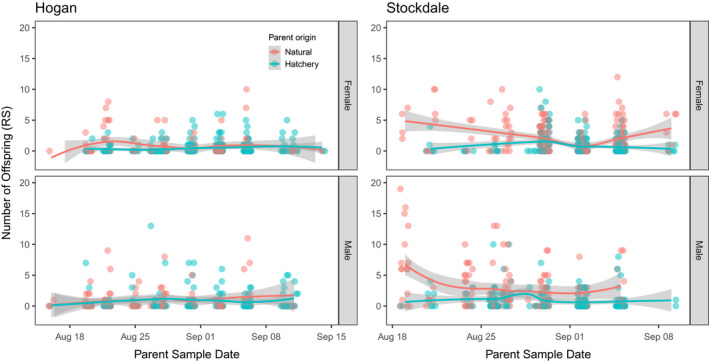
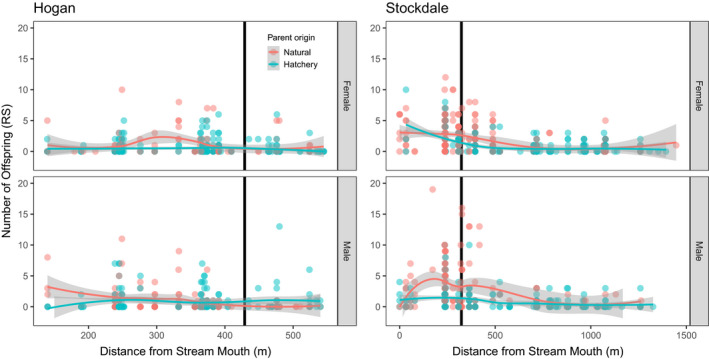
Previous studies generally report that hatchery-origin Pacific Salmon ( spp.) have lower relative reproductive success (RRS) than their natural-origin counterparts. We estimated the RRS of Pink Salmon (. ) in Prince William Sound (PWS), Alaska using incomplete pedigrees. In contrast to other RRS studies, Pink Salmon have a short freshwater life history, freshwater habitats in PWS are largely unaltered by development, and sampling was conducted without the aid of dams or weirs resulting in incomplete sampling of spawning individuals. Pink Salmon released from large-scale hatchery programs in PWS have interacted with wild populations for more than 15 generations. Hatchery populations were established from PWS populations but have subsequently been managed as separate broodstocks. Gene flow is primarily directional, from hatchery strays to wild populations. We used genetic-based parentage analysis to estimate the RRS of a single generation of stray hatchery-origin Pink Salmon in two streams, and across the odd- and even-year lineages. Despite incomplete sampling, we assigned 1745 offspring to at least one parent. Reproductive success (RS), measured as sampled adult offspring that returned to their natal stream, was significantly lower for hatchery- vs. natural-origin parents in both lineages, with RRS ranging from 0.03 to 0.47 for females and 0.05 to 0.86 for males. Generalized linear modeling for the even-year lineage indicated that RRS was lower for hatchery-origin fish, ranging from 0.42 to 0.60, after accounting for sample date (run timing), sample location within the stream, and fish length. Our results strongly suggest that hatchery-origin strays have lower fitness in the wild. The consequences of reduced RRS on wild productivity depend on whether the mechanisms underlying reduced RRS are environmentally driven, and likely ephemeral, or genetically driven, and likely persistent across generations.
以往的研究普遍报告称,养殖来源的太平洋鲑鱼(某些品种)的相对繁殖成功率(RRS)低于自然来源的同类。我们利用不完整的谱系估计了阿拉斯加威廉王子湾(PWS)粉鲑(Oncorhynchus gorbuscha)的RRS。与其他RRS研究不同的是,粉鲑有短暂的淡水生活史,PWS的淡水栖息地在很大程度上未因开发而改变,且采样是在没有水坝或堰的帮助下进行的,导致对产卵个体的采样不完整。从PWS大规模养殖项目中放流的粉鲑已与野生种群相互作用了超过15代。养殖种群是从PWS种群中建立的,但随后作为单独的亲鱼群体进行管理。基因流动主要是单向的,从养殖逃逸个体流向野生种群。我们利用基于基因的亲权分析来估计两条溪流中一代养殖来源的粉鲑逃逸个体以及奇数年和偶数年谱系的RRS。尽管采样不完整,我们仍将1745个后代至少归为一个亲本。以回到其出生溪流的成年后代作为衡量标准的繁殖成功率(RS),在两个谱系中,养殖来源亲本的均显著低于自然来源亲本,雌性的RRS范围为0.03至0.47,雄性为0.05至0.86。对偶数年谱系的广义线性模型分析表明,在考虑采样日期(洄游时间)、溪流内的采样位置和鱼的长度后,养殖来源的鱼的RRS较低,范围为0.42至0.60。我们的结果有力地表明,养殖来源的逃逸个体在野外的适应性较低。RRS降低对野生种群生产力的影响取决于RRS降低的潜在机制是由环境驱动的,可能是短暂的,还是由基因驱动的,可能会跨代持续存在。