Wada-Hiraike Osamu, Yamada Shozo, Osuga Yutaka
Department of Obstetrics and Gynecology, The University of Tokyo Hospital, Tokyo, Japan.
Hypothalamic & Pituitary Center, Moriyama Neurological Center Hospital, Tokyo, Japan.
F S Rep. 2022 Feb 3;3(1):79-83. doi: 10.1016/j.xfre.2022.01.006. eCollection 2022 Mar.
To report a case of pituitary functioning gonadotroph microadenoma accompanied by ovarian hyperstimulation syndrome (OHSS) in a woman of reproductive age.
A case report.
Tertiary care unit of a university hospital.
A 42-year-old parous woman with bilateral ovarian enlargement presumed to be secondary to a functioning gonadotroph pituitary microadenoma.
Oral contraceptives and endoscopic transsphenoidal surgery for adenoma that initially could not be visualized on a magnetic resonance imaging (MRI) scan.
Medical and radiographic assessment of endogenously induced OHSS and its resolution after treatment.
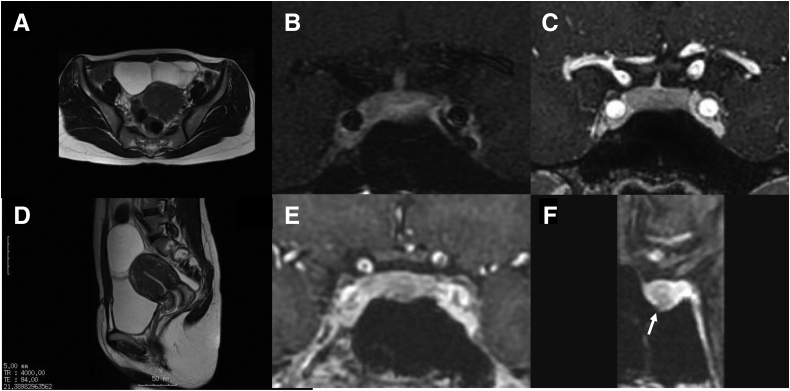
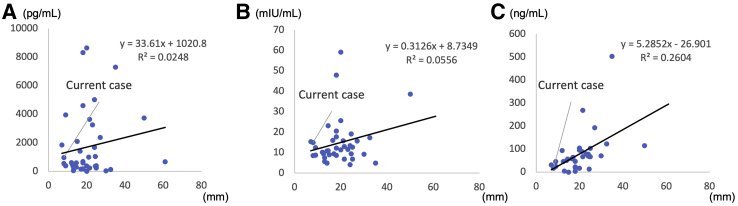
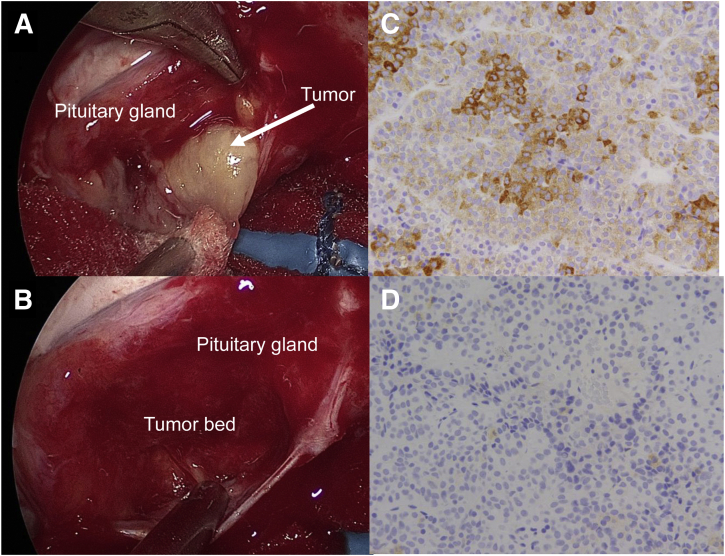
The patient was diagnosed with OHSS secondary to elevations in endogenous levels of follicle-stimulating hormone (FSH). The cranial contrast-enhanced MRI scan did not show any apparent tumor in the pituitary gland. She was, therefore, treated with oral contraceptives, which resulted in a modest resolution of ovarian enlargement; however, this treatment became ineffective 3 years later. A small pituitary adenoma (maximum diameter of 8 mm) was suspected on repeated MRI (2 years after the first MRI). Selective adenomectomy was performed, which resulted in normalization of the ovarian size and resumption of regular menstrual cycles.
We report a case of a functional pituitary microadenoma secreting FSH in quantities significant enough to result in OHSS. The excessive FSH production was resistant to medical therapy; however, surgical treatment was ultimately successful.
报告一例育龄期女性垂体促性腺激素功能性微腺瘤伴卵巢过度刺激综合征(OHSS)的病例。
病例报告。
大学医院的三级护理单元。
一名42岁经产妇,双侧卵巢肿大,推测继发于垂体促性腺激素功能性微腺瘤。
口服避孕药及对最初在磁共振成像(MRI)扫描中未显影的腺瘤进行内镜经蝶窦手术。
对内源性诱导的OHSS进行医学和影像学评估及其治疗后的缓解情况。
患者被诊断为继发于内源性促卵泡激素(FSH)水平升高的OHSS。头颅增强MRI扫描未显示垂体有任何明显肿瘤。因此,她接受了口服避孕药治疗,卵巢肿大略有缓解;然而,3年后这种治疗失效。在重复MRI检查(首次MRI检查2年后)时怀疑有一个小的垂体腺瘤(最大直径8mm)。进行了选择性腺瘤切除术,结果卵巢大小恢复正常,月经周期恢复规律。
我们报告了一例功能性垂体微腺瘤分泌足够量FSH导致OHSS的病例。过量的FSH分泌对药物治疗有抵抗性;然而,手术治疗最终取得成功。