Division of Nephrology and Transplantation, Department of Internal Medicine, University Medical Center Rotterdam, Rotterdam, Netherlands.
Erasmus MC Transplant Institute, University Medical Center Rotterdam, Rotterdam, Netherlands.
Transpl Int. 2022 Mar 21;35:10122. doi: 10.3389/ti.2022.10122. eCollection 2022.
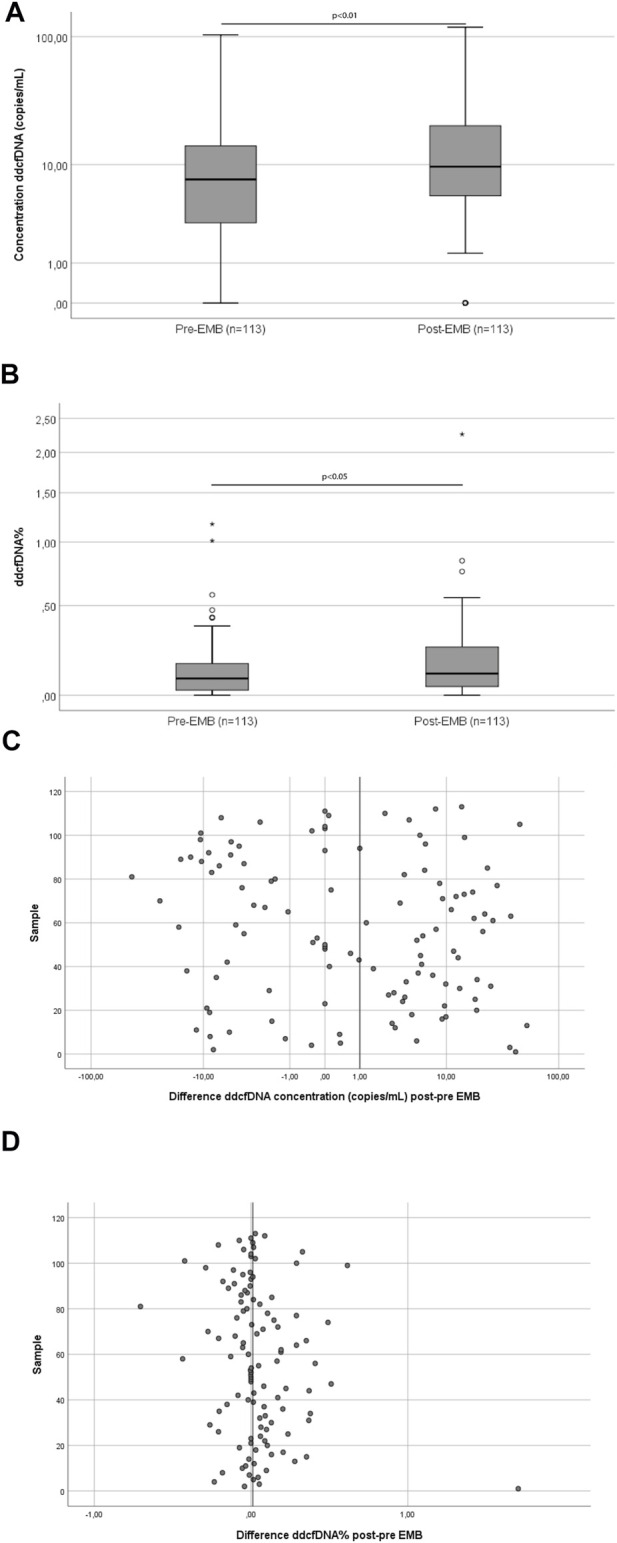
In heart transplant recipients, donor-derived cell-free DNA (ddcfDNA) is a potential biomarker for acute rejection (AR), in that increased values may indicate rejection. For the assessment of ddcfDNA as new biomarker for rejection, blood plasma sampling around the endomyocardial biopsy (EMB) seems a practical approach. To evaluate the effect of the EMB procedure on ddcfDNA values, ddcfDNA values before the EMB were pairwise compared to ddcfDNA values after the EMB. We aimed at evaluating whether it matters whether the ddcfDNA sampling is done before or after the EMB-procedure. Plasma samples from heart transplant recipients were obtained pre-EMB and post-EMB. A droplet digital PCR method was used for measuring ddcfDNA, making use of single-nucleotide polymorphisms that allowed both relative quantification, as well as absolute quantification of ddcfDNA. Pairwise comparison of ddcfDNA values pre-EMB with post-EMB samples ( = 113) showed significantly increased ddcfDNA concentrations and ddcfDNA% in post-EMB samples: an average 1.28-fold increase in ddcfDNA concentrations and a 1.31-fold increase in ddcfDNA% was observed ( = 0.007 and = 0.03, respectively). The EMB procedure causes iatrogenic injury to the allograft that results in an increase in ddcfDNA% and ddcfDNA concentrations. For the assessment of ddcfDNA as marker for AR, collection of plasma samples before the EMB procedure is therefore essential.
在心脏移植受者中,供体游离 DNA(ddcfDNA)是急性排斥反应(AR)的潜在生物标志物,因为其浓度升高可能表明发生了排斥反应。为了评估 ddcfDNA 作为排斥反应的新型生物标志物,在心肌活检(EMB)前后采集血样似乎是一种实用的方法。为了评估 EMB 程序对 ddcfDNA 值的影响,我们将 EMB 前的 ddcfDNA 值与 EMB 后的 ddcfDNA 值进行了配对比较。我们旨在评估在 EMB 程序前后进行 ddcfDNA 采样是否重要。
从心脏移植受者中获得 EMB 前和 EMB 后血样。采用液滴数字 PCR 方法测量 ddcfDNA,利用允许相对定量以及绝对定量 ddcfDNA 的单核苷酸多态性。EMB 前和 EMB 后样本(= 113)的 ddcfDNA 值的配对比较显示,EMB 后样本的 ddcfDNA 浓度和 ddcfDNA%显著增加:ddcfDNA 浓度平均增加 1.28 倍,ddcfDNA%增加 1.31 倍(= 0.007 和= 0.03,分别)。
EMB 程序会对移植物造成医源性损伤,导致 ddcfDNA%和 ddcfDNA 浓度增加。因此,为了评估 ddcfDNA 作为 AR 标志物,在 EMB 程序前采集血样至关重要。