School of Life Sciences, Division of Life Sciences and Medicine, University of Science and Technology of China, 230026, Hefei, China.
National Laboratory of Biomacromolecules, CAS Center for Excellence in Biomacromolecules, Institute of Biophysics, Chinese Academy of Sciences, 100101, Beijing, China.
Commun Biol. 2022 Apr 6;5(1):321. doi: 10.1038/s42003-022-03284-1.
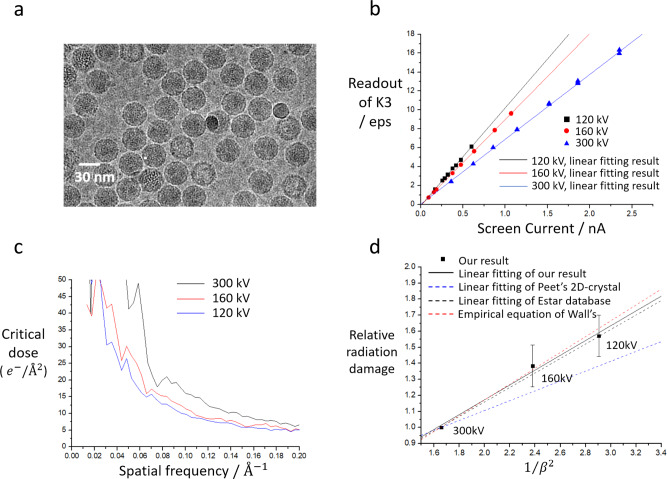
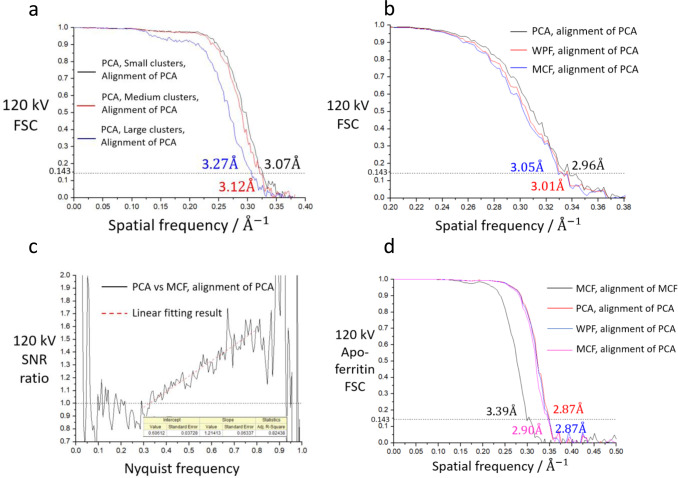
Relative to the 300-kV accelerating field, electrons accelerated under lower voltages are potentially scattered more strongly. Lowering the accelerate voltage has been suggested to enhance the signal-to-noise ratio (SNR) of cryo-electron microscopy (cryo-EM) images of small-molecular-weight proteins (<100 kD). However, the detection efficient of current Direct Detection Devices (DDDs) and temporal coherence of cryo-EM decrease at lower voltage, leading to loss of SNR. Here, we present an electron counting algorithm to improve the detection of low-energy electrons. The counting algorithm increased the SNR of 120-kV and 200-kV cryo-EM image from a Falcon III camera by 8%, 20% at half the Nyquist frequency and 21%, 80% at Nyquist frequency, respectively, resulting in a considerable improvement in resolution of 3D reconstructions. Our results indicate that with further improved temporal coherence and a dedicated designed camera, a 120-kV cryo-electron microscope has potential to match the 300-kV microscope at imaging small proteins.
与 300kV 的加速场相比,在较低电压下加速的电子可能会受到更强的散射。降低加速电压被认为可以提高小分子量蛋白质(<100kD)的低温电子显微镜(cryo-EM)图像的信噪比(SNR)。然而,目前的直接检测设备(DDD)的检测效率和 cryo-EM 的时间相干性在较低电压下会降低,导致 SNR 的损失。在这里,我们提出了一种电子计数算法来提高对低能电子的检测。该计数算法将 Falcon III 相机拍摄的 120kV 和 200kV cryo-EM 图像的 SNR 分别提高了 8%和 20%,在半奈奎斯特频率下提高了 21%和 80%,在奈奎斯特频率下提高了分辨率,3D 重建的分辨率有了显著提高。我们的结果表明,随着时间相干性的进一步提高和专门设计的相机,120kV 的 cryo-EM 显微镜有可能在成像小蛋白质方面与 300kV 的显微镜相媲美。