Schwaiger D, Zanvettor A, Neumayr A, Baubin M
Universitätsklinik für Anästhesie und Intensivmedizin, Medizinische Universität Innsbruck, Anichstraße 35, 6020, Innsbruck, Österreich.
Anaesthesiologie. 2022 Oct;71(10):750-757. doi: 10.1007/s00101-022-01112-z. Epub 2022 Apr 7.
The study goals were to analyze the course and compare it with patients who were only resuscitated manually as well as to record the influencing factors in patients in whom the mechanical chest compression aid LUCAS2™ was used as an add-on treatment at the NEF Innsbruck.
Retrospective history data analysis of patients in the study period from 01.01.2014 to 31.12.2019 of the NEF Innsbruck from the German Resuscitation Register (GRR), in which LUCAS2™ was used as an add-on treatment according to an emergency doctor's order.
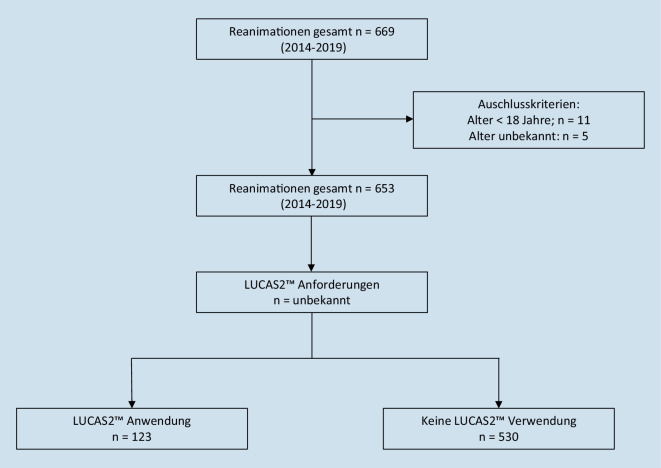
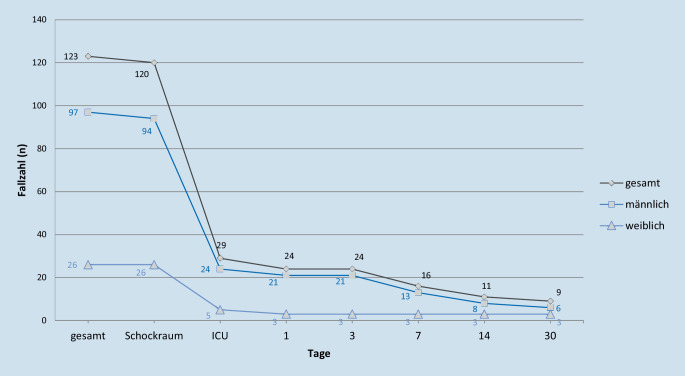
A total of 123 add-on LUCAS2™ applications (18.8%) were performed in 653 resuscitations. Of all patients 16.2% survived the first 30 days. By using add-on-LUCAS2 application 7.3% (9/123) of all add-on LUCAS2 resuscitations and 1.4% (n = 9) of all CPR survived. Cardiac arrest was observed in 8/9 add-on LUCAS2™ 30-day survivors and bystander CPR was performed and 8/9 showed ventricular fibrillation as the primary rhythm. Compared to manual CPR alone, add-on LUCAS2™ resuscitation was used highly significantly (p < 0.001) more frequently in younger, male patients, in public, in shockable initial rhythms and during transport, and significantly more frequently in observed cardiac arrest (p < 0.05). The 30-day mortality with additive lysis treatment was 100%.
By using add-on LUCAS2™ CPR a percentage increase in survival rate can be achieved and thus appears advantageous (1.4% in our study). This means that high-quality CPR can be carried out on patients with favorable prognostic factors, even with technically complex rescue operations (turntable ladder, staircase, transport in an ambulance) and thus transport can be made possible; however, there is a higher admission rate under CPR and thus the treatment target decision is shifted to the shock room.
本研究的目标是分析病程,并将其与仅接受手动复苏的患者进行比较,同时记录在因斯布鲁克东北急救站将机械胸外按压辅助设备LUCAS2™用作附加治疗的患者中的影响因素。
对因斯布鲁克东北急救站2014年1月1日至2019年12月31日研究期间的患者进行回顾性病史数据分析,这些数据来自德国复苏登记册(GRR),其中LUCAS2™根据急诊医生的医嘱用作附加治疗。
在653次复苏中,共进行了123次LUCAS2™附加应用(18.8%)。所有患者中,16.2%在最初30天内存活。通过使用LUCAS2附加应用,所有LUCAS2附加复苏中有7.3%(9/123)以及所有心肺复苏中有1.4%(n = 9)存活。在9例LUCAS2™附加应用30天存活者中有8例观察到心脏骤停,且进行了旁观者心肺复苏,其中8/9显示心室颤动为主要心律。与单独的手动心肺复苏相比,LUCAS2™附加复苏在年轻男性患者、公共场所、可电击的初始心律以及转运过程中使用频率显著更高(p < 0.001),在观察到的心脏骤停中使用频率也显著更高(p < 0.05)。附加溶栓治疗的30天死亡率为100%。
通过使用LUCAS2™附加心肺复苏,可以提高生存率,因此似乎具有优势(在我们的研究中为1.4%)。这意味着即使在技术复杂的救援行动(云梯消防车、楼梯、救护车转运)中,也可以对具有良好预后因素的患者进行高质量的心肺复苏,从而实现转运;然而,心肺复苏下的入院率更高,因此治疗目标决策转向了休克室。