Sivananthan Arun, Gueroult Aurelien, Zijlstra Geiske, Martin Guy, Baheerathan Aravindhan, Pratt Philip, Darzi Ara, Patel Nisha, Kinross James
Institute of Global Health Innovation, Imperial College London, London, United Kingdom.
Department of Gastroenterology and Hepatology, Imperial College Healthcare NHS Trust, London, United Kingdom.
JMIR Form Res. 2022 May 17;6(5):e35674. doi: 10.2196/35674.
COVID-19 has had a catastrophic impact in terms of human lives lost. Medical education has also been impacted as appropriately stringent infection control policies precluded medical trainees from attending clinical teaching. Lecture-based education has been easily transferred to a digital platform, but bedside teaching has not.
This study aims to assess the feasibility of using a mixed reality (MR) headset to deliver remote bedside teaching.
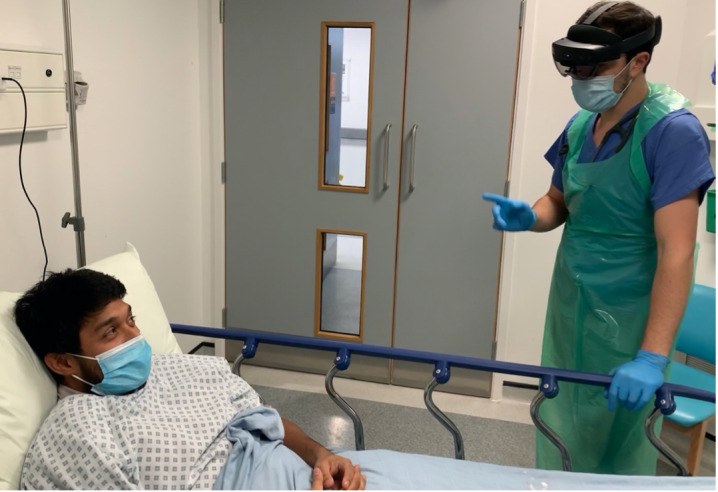
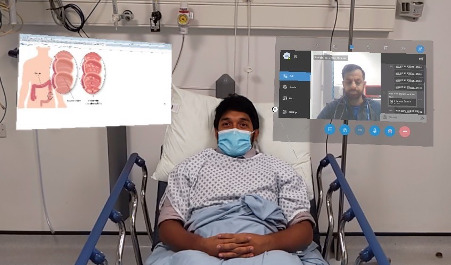
Two MR sessions were led by senior doctors wearing the HoloLens headset. The trainers selected patients requiring their specialist input. The headset allowed bidirectional audiovisual communication between the trainer and trainee doctors. Trainee doctor conceptions of bedside teaching, impact of the COVID-19 pandemic on bedside teaching, and the MR sessions were evaluated using pre- and postround questionnaires, using Likert scales. Data related to clinician exposure to at-risk patients and use of personal protective equipment (PPE) were collected.
Prequestionnaire respondents (n=24) strongly agreed that bedside teaching is key to educating clinicians (median 7, IQR 6-7). Postsession questionnaires showed that, overall, users subjectively agreed the MR session was helpful to their learning (median 6, IQR 5.25-7) and that it was worthwhile (median 6, IQR 5.25-7). Mixed reality versus in-person teaching led to a 79.5% reduction in cumulative clinician exposure time and 83.3% reduction in PPE use.
This study is proof of principle that HoloLens can be used effectively to deliver clinical bedside teaching. This novel format confers significant advantages in terms of minimizing exposure of trainees to COVID-19, reducing PPE use, enabling larger attendance, and delivering convenient and accessible real-time clinical training.
新冠疫情在生命损失方面造成了灾难性影响。医学教育也受到了冲击,因为适当严格的感染控制政策使医学实习生无法参加临床教学。基于讲座的教育很容易转移到数字平台,但床边教学却并非如此。
本研究旨在评估使用混合现实(MR)头显进行远程床边教学的可行性。
由佩戴HoloLens头显的资深医生主持两场MR教学课程。培训师挑选需要其专业指导的患者。该头显允许培训师与实习医生进行双向视听通信。使用李克特量表通过课前和课后问卷对实习医生对床边教学的看法、新冠疫情对床边教学的影响以及MR课程进行评估。收集与临床医生接触高危患者和使用个人防护装备(PPE)相关的数据。
课前问卷的受访者(n = 24)强烈认同床边教学是培养临床医生的关键(中位数为7,四分位间距为6 - 7)。课后问卷显示,总体而言,用户主观上认为MR课程对他们的学习有帮助(中位数为6,四分位间距为5.25 - 7)且值得(中位数为6,四分位间距为5.25 - 7)。与面对面教学相比,混合现实教学使临床医生的累计接触时间减少了79.5%,PPE使用减少了83.3%。
本研究证明了HoloLens可有效用于提供临床床边教学这一原理。这种新颖的形式在最大程度减少实习生接触新冠病毒、减少PPE使用、允许更多人参与以及提供便捷实时临床培训方面具有显著优势。