The Daffodil Centre, The University of Sydney, a joint venture with Cancer Council NSW, Sydney, Australia.
Faculty of Medicine and Health, Prince of Wales Clinical School, UNSW Sydney, Sydney, Australia.
Support Care Cancer. 2022 Jul;30(7):5965-5974. doi: 10.1007/s00520-022-07024-3. Epub 2022 Apr 8.
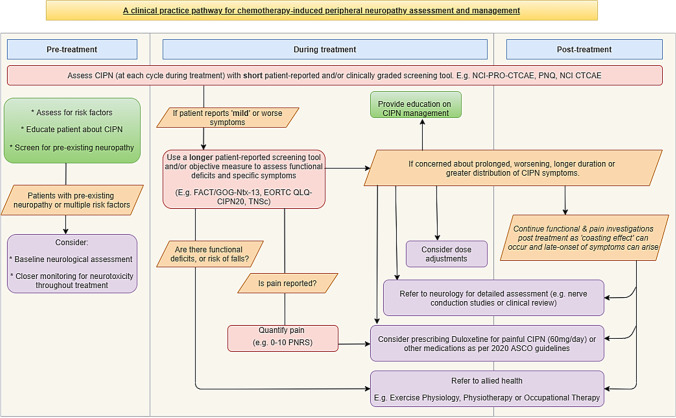
Cancer patients treated with neurotoxic chemotherapy are at risk of developing neurological symptoms that can impact functional capacity and quality of life. However, there are no standardised pathways to assess and manage chemotherapy-induced peripheral neurotoxicity (CIPN). This study aimed to determine consensus on statements regarding a CIPN assessment and management clinical pathway.
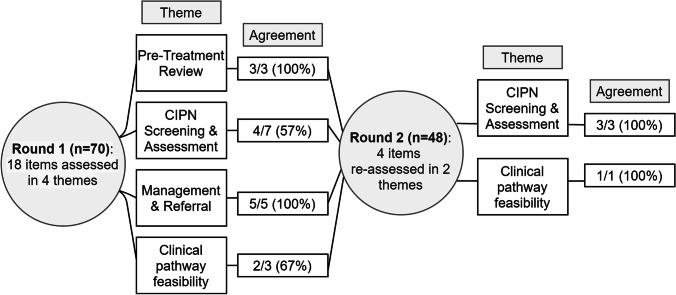
A CIPN clinical pathway (CIPN-path) was developed and reviewed by an expert multi-disciplinary panel and consumers. Agreement with 18 statements regarding four content themes (pretreatment review, screening and assessment, management and referral, and CIPN-path feasibility) were assessed by 70 Australian respondents (68 health professionals, 2 consumers), using a 2-stage Delphi survey process to reach consensus. Respondents rated statements using a 5-point Likert scale to determine the level of agreement, with consensus defined as ≥ 80% of respondents agreeing with each statement.
The consensus was reached for 14 of 18 items after stage 1 and all items after stage 2. Feedback was obtained for all items to refine the CIPN-path. There was an agreement on important characteristics of the CIPN-path, including pretreatment screening, regular patient-reported assessment, and a stepped-care approach to investigating and managing symptom burden. There was a lack of agreement on who should oversee CIPN assessment, which may differ according to the structure and resources of each site.
There was an overall agreement concerning the CIPN-path to assess and manage CIPN, which may be adapted accordingly to the resources of each clinic. The CIPN-path may assist teams across different health services in identifying CIPN symptoms, aiding decision-making, and reducing morbidity from CIPN.
接受神经毒性化疗的癌症患者有出现影响其功能能力和生活质量的神经症状的风险。然而,目前尚无评估和管理化疗引起的周围神经毒性(CIPN)的标准化方法。本研究旨在就 CIPN 评估和管理临床路径的相关陈述达成共识。
由多学科专家小组和消费者共同制定和审查 CIPN 临床路径(CIPN-path)。澳大利亚 70 名受访者(68 名卫生专业人员,2 名消费者)通过 2 阶段 Delphi 调查过程对 4 个内容主题(治疗前审查、筛查和评估、管理和转诊、以及 CIPN-path 的可行性)的 18 个陈述的共识进行评估。受访者使用 5 分李克特量表对陈述进行评分,以确定同意程度,共识定义为≥80%的受访者同意每个陈述。
第 1 阶段后 18 项中的 14 项和第 2 阶段后所有 18 项均达成共识。为完善 CIPN-path 收集了所有项目的反馈意见。对于 CIPN-path 的重要特征,包括治疗前筛查、定期患者报告评估以及对症状负担进行分级护理的方法,达成了一致意见。对于谁应该监督 CIPN 评估存在分歧,这可能因每个地点的结构和资源而异。
对于评估和管理 CIPN 的 CIPN-path 达成了总体共识,这可能会根据每个诊所的资源进行相应调整。CIPN-path 可以帮助不同医疗服务团队识别 CIPN 症状,辅助决策,并降低 CIPN 的发病率。