Department of Agroecology, Aarhus University, Blichers Allé 20, 8830, Tjele, Denmark.
iCLIMATE Interdisciplinary Centre for Climate Change, Aarhus University, Frederiksborgvej 399, 4000, Roskilde, Denmark.
Sci Rep. 2022 Apr 8;12(1):5952. doi: 10.1038/s41598-022-09737-1.
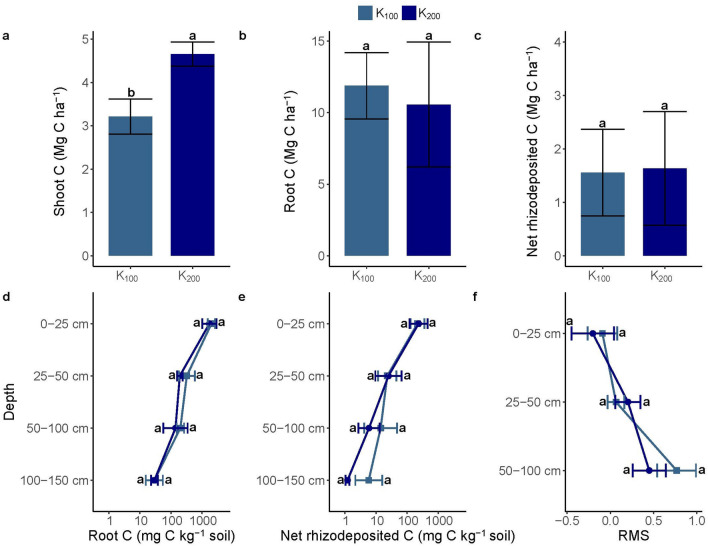
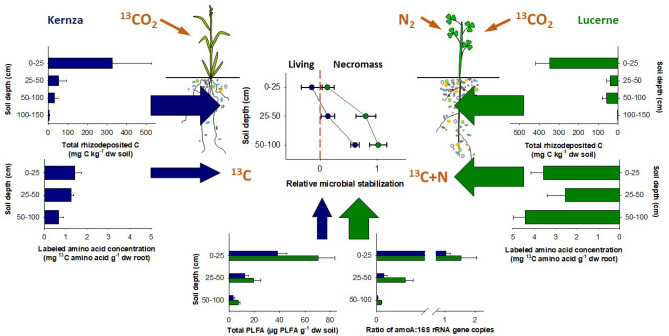
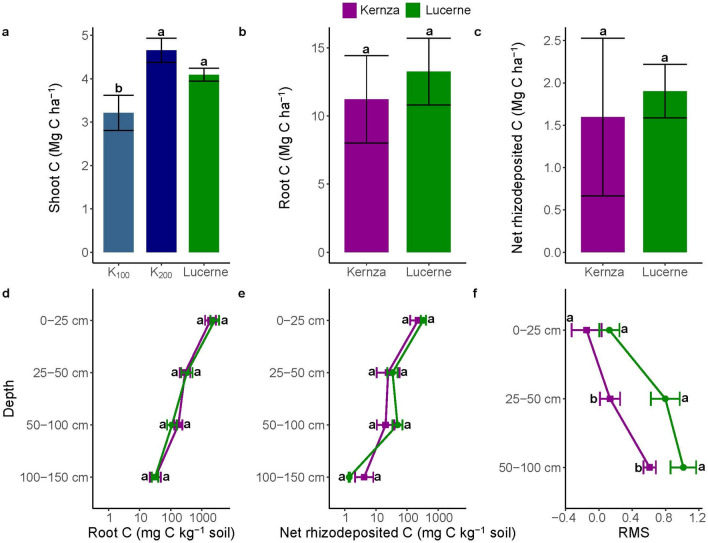
Comprehensive climate change mitigation necessitates soil carbon (C) storage in cultivated terrestrial ecosystems. Deep-rooted perennial crops may help to turn agricultural soils into efficient C sinks, especially in deeper soil layers. Here, we compared C allocation and potential stabilization to 150 cm depth from two functionally distinct deep-rooted perennials, i.e., lucerne (Medicago sativa L.) and intermediate wheatgrass (kernza; Thinopyrum intermedium), representing legume and non-legume crops, respectively. Belowground C input and stabilization was decoupled from nitrogen (N) fertilizer rate in kernza (100 and 200 kg mineral N ha), with no direct link between increasing mineral N fertilization, rhizodeposited C, and microbial C stabilization. Further, both crops displayed a high ability to bring C to deeper soil layers and remarkably, the N-fixing lucerne showed greater potential to induce microbial C stabilization than the non-legume kernza. Lucerne stimulated greater microbial biomass and abundance of N cycling genes in rhizosphere soil, likely linked to greater amino acid rhizodeposition, hence underlining the importance of coupled C and N for microbial C stabilization efficiency. Inclusion of legumes in perennial cropping systems is not only key for improved productivity at low fertilizer N inputs, but also appears critical for enhancing soil C stabilization, in particular in N limited deep subsoils.
综合气候变化缓解需要在耕地生态系统中储存土壤碳 (C)。深根多年生作物可能有助于将农业土壤转化为高效的 C 汇,尤其是在更深的土壤层中。在这里,我们比较了两种功能不同的深根多年生植物,即紫花苜蓿(Medicago sativa L.)和中间冰草(kernza;Thinopyrum intermedium),从两个方面来比较 C 分配和潜在稳定到 150 厘米的深度,分别代表豆科和非豆科作物。在 kernza 中(100 和 200 kg 矿质 N ha),地下 C 输入和稳定与氮 (N) 肥料率脱钩,矿质 N 施肥、根分泌物 C 和微生物 C 稳定之间没有直接联系。此外,这两种作物都具有将 C 带到更深土壤层的高能力,值得注意的是,固氮紫花苜蓿比非豆科 kernza 更有潜力诱导微生物 C 稳定。紫花苜蓿刺激根际土壤中微生物生物量和氮循环基因的丰度增加,可能与更多氨基酸根分泌物有关,因此强调了 C 和 N 的耦合对于微生物 C 稳定效率的重要性。在多年生作物系统中包含豆科植物不仅对低氮肥料投入下提高生产力很关键,而且对于增强土壤 C 稳定也很关键,特别是在氮限制的深层底土中。