Englewood, CO, USA.
Washington, DC, USA.
Lancet Glob Health. 2022 Jun;10(6):e840-e849. doi: 10.1016/S2214-109X(22)00099-7. Epub 2022 Apr 6.
An alarming number of public health-care facilities in low-income and middle-income countries lack basic water, sanitation, hygiene (WASH), and waste management services. This study estimates the costs of achieving full coverage of basic WASH and waste services in existing public health facilities in the 46 UN designated least-developed countries (LDCs).
In this modelling study, in-need facilities were quantified by combining published counts of public facilities with estimated basic WASH and waste service coverage. Country-specific per-facility capital and recurrent costs to deliver basic services were collected via survey of country WASH experts and officials between Sept 24 and Dec 24, 2020. Baseline cost estimates were modelled and discounted by 5% per year. Key assumptions were adjusted to produce lower and upper estimates, including adjusting the discount rate to 8% and 3% per year, respectively.
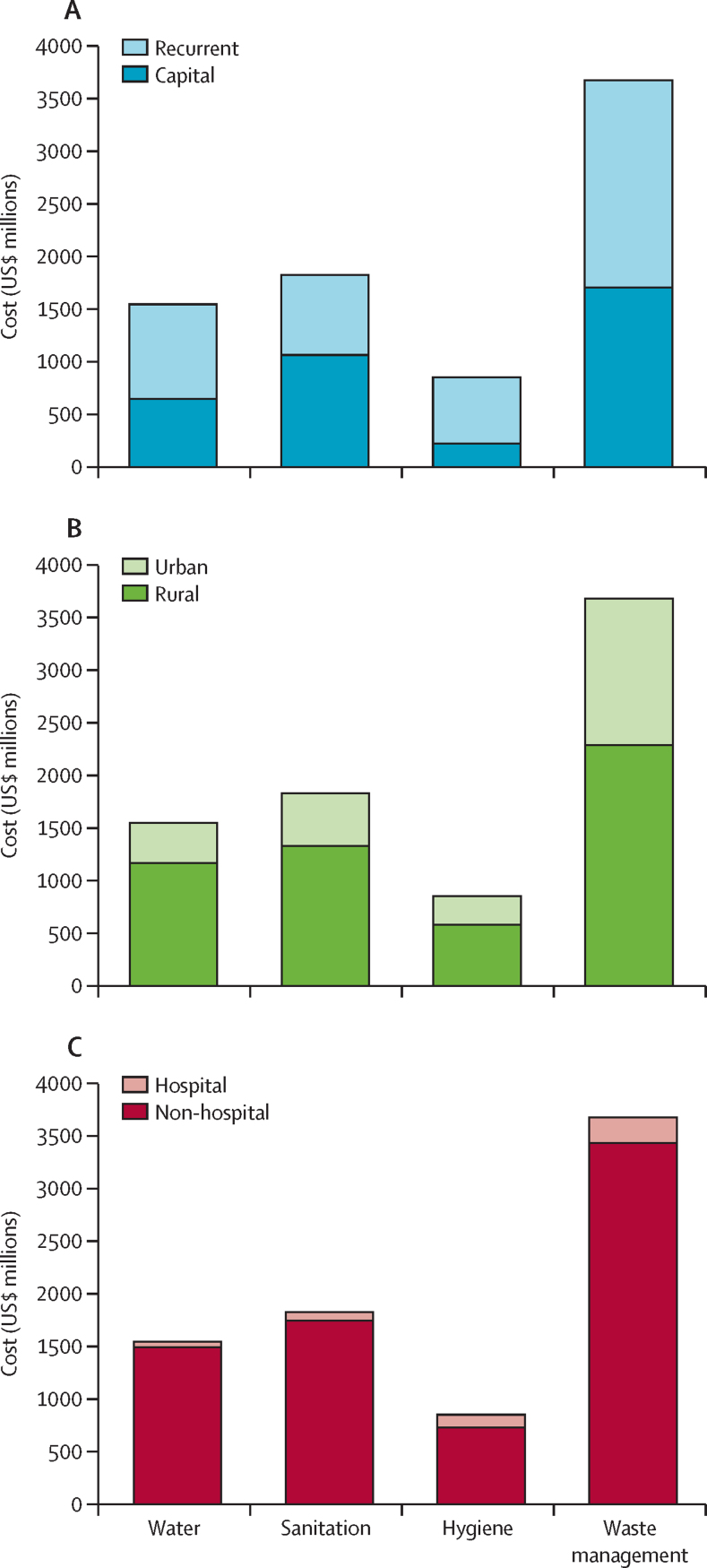
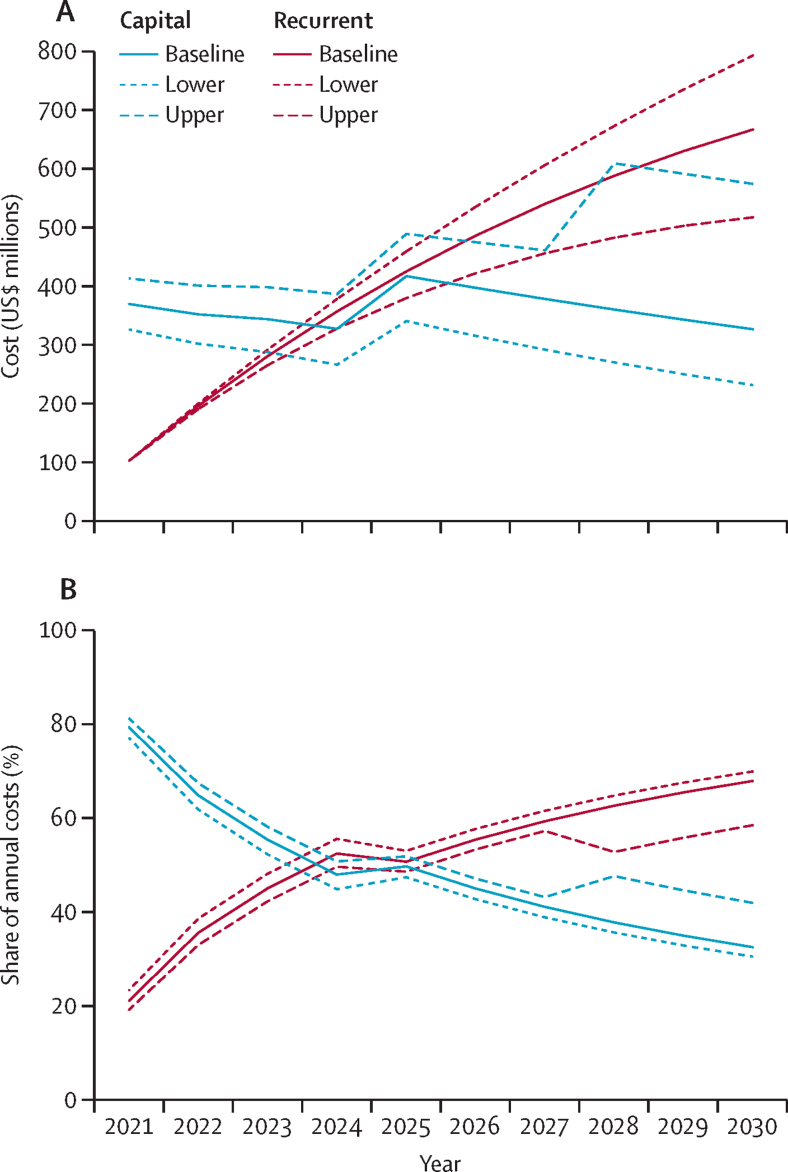
An estimated US$6·5 billion to $9·6 billion from 2021 to 2030 is needed to achieve full coverage of basic WASH and waste services in public health facilities in LDCs. Capital costs are $2·9 billion to $4·8 billion and recurrent costs are $3·6 billion to $4·8 billion over this time period. A mean of $0·24-0·40 per capita in capital investment is needed each year, and annual operations and maintenance costs are expected to increase from $0·10 in 2021 to $0·39-0·60 in 2030. Waste management accounts for the greatest share of costs, requiring $3·7 billion (46·6% of the total) in the baseline estimates, followed by $1·8 billion (23·1%) for sanitation, $1·5 billion (19·5%) for water, and $845 million (10·7%) for hygiene. Needs are greatest for non-hospital facilities ($7·4 billion [94%] of $7·9 billion) and for facilities in rural areas ($5·3 billion [68%]).
Investment will need to increase to reach full coverage of basic WASH and waste services in public health facilities. Financial needs are modest compared with current overall health and WASH spending, and better service coverage will yield substantial health benefits. To sustain services and prevent degradation and early replacement, countries will need to routinely budget for operations and maintenance of WASH and waste management assets.
WHO (including underlying grants from the governments of Japan, the Netherlands, and the UK), World Bank (including an underlying grant from the Global Water Security and Sanitation Partnership), and UNICEF.
For the Arabic, French and Portuguese translations of the abstract see Supplementary Materials section.
在低收入和中等收入国家,相当数量的公共卫生保健设施缺乏基本的水、环境卫生、个人卫生和废物管理服务。本研究旨在估算在联合国指定的 46 个最不发达国家现有的公共卫生设施中实现基本环境卫生和废物服务全覆盖所需的成本。
在这项建模研究中,通过结合已发表的公共设施数量和对基本环境卫生和废物服务的估计覆盖率,对有需要的设施进行量化。通过在 2020 年 9 月 24 日至 12 月 24 日期间对各国环境卫生专家和官员进行调查,收集了提供基本服务的每设施的特定国家资本和经常性成本。对基线成本估算进行了 5%的年度贴现。对关键假设进行了调整,以产生较低和较高的估算值,包括将贴现率分别调整为每年 8%和 3%。
在 2021 年至 2030 年期间,实现最不发达国家公共卫生设施基本环境卫生和废物服务全覆盖需要 65 亿至 96 亿美元。在此期间,资本成本为 29 亿至 48 亿美元,经常性成本为 36 亿至 48 亿美元。每年需要人均投资 0.24 至 0.40 美元的资本投资,预计运营和维护成本将从 2021 年的 0.10 美元增加到 2030 年的 0.39 至 0.60 美元。废物管理占成本的最大份额,在基线估算中需要 37 亿美元(占总数的 46.6%),其次是 18 亿美元(23.1%)用于卫生,15 亿美元(19.5%)用于供水,8.45 亿美元(10.7%)用于个人卫生。非医院设施(79 亿美元[94%])和农村地区设施(53 亿美元[68%])的需求最大。
需要增加投资才能实现公共卫生设施基本环境卫生和废物服务的全覆盖。与当前的整体卫生和环境卫生支出相比,资金需求不大,更好的服务覆盖将带来巨大的健康益处。为了维持服务并防止服务退化和早期更换,各国需要定期为环境卫生和废物管理资产的运营和维护预算。
世卫组织(包括日本、荷兰和英国政府的基础赠款)、世界银行(包括全球水安全和环境卫生伙伴关系的基础赠款)和儿基会。