Pu Yeong-Shiau, Ahn Hanjong, Han Weiqing, Huang Shu-Pin, Wu Hsi-Chin, Ma Lulin, Yamada Shunsuke, Suga Kazutaka, Xie Li-Ping
National Taiwan University Hospital, Taipei, Taiwan.
Asan Medical Center, University of Ulsan, Seoul, South Korea.
Adv Ther. 2022 Jun;39(6):2641-2656. doi: 10.1007/s12325-022-02140-2. Epub 2022 Apr 10.
Enzalutamide significantly improved clinical outcomes compared with placebo in patients with chemotherapy-naïve metastatic castration-resistant prostate cancer (mCRPC) with disease progression despite androgen deprivation therapy (ADT) in the PREVAIL study. However, few patients from Asia were enrolled. Our study (NCT02294461) aimed to evaluate the safety and efficacy of enzalutamide in this disease setting in patients in mainland China, Korea, Taiwan, and Hong Kong.
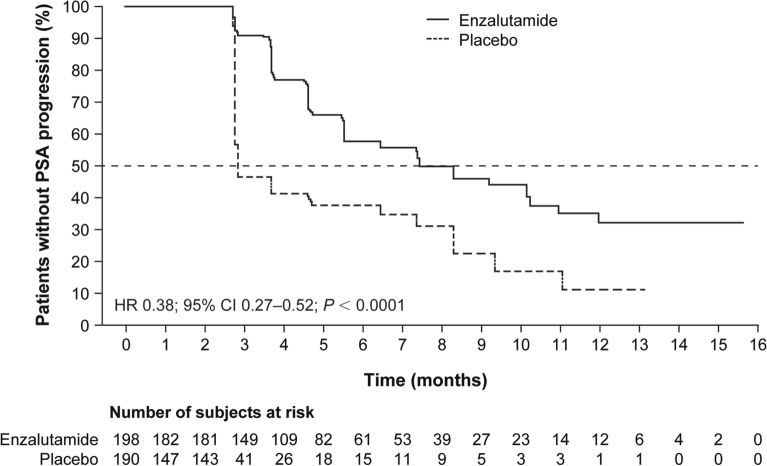
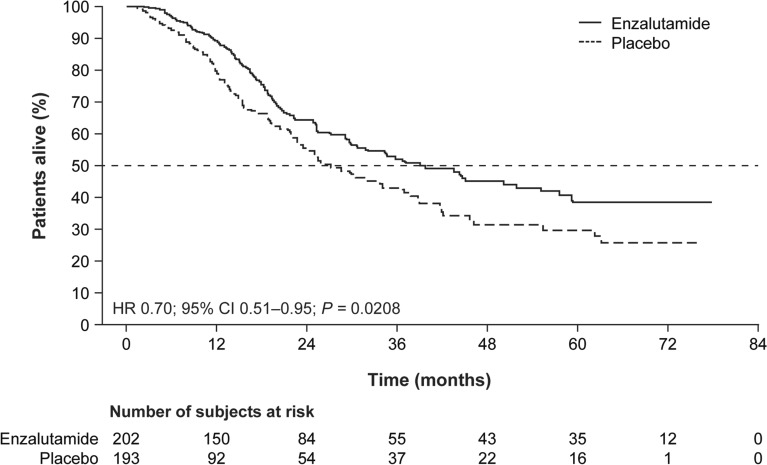
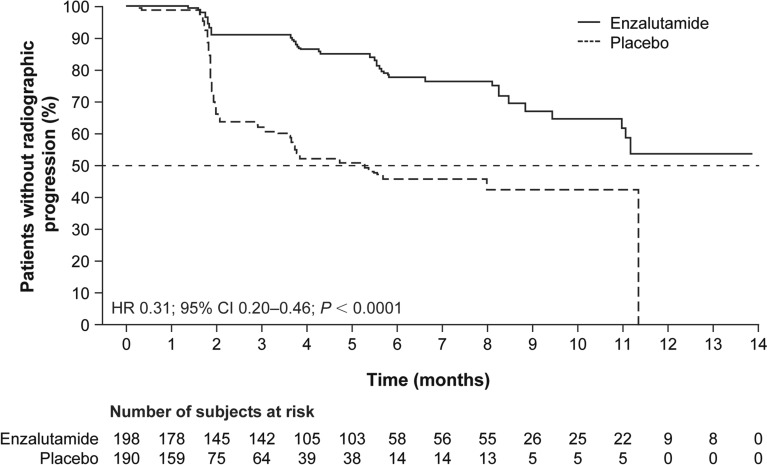
In this double-blind, phase III study, patients with asymptomatic/mildly symptomatic metastatic prostate cancer and disease progression despite ADT were randomized to enzalutamide (160 mg/day) or placebo. The primary endpoint was time to prostate-specific antigen (PSA) progression. Secondary endpoints included overall survival, radiographic progression-free survival, time to first skeletal-related event (SRE), time to initiation of cytotoxic chemotherapy, PSA response ≥ 50%, best overall soft-tissue response, and safety. Pre-planned interim analysis was scheduled following approximately 175 PSA-progression events (67% of targeted total of 261 events). An additional 5-year landmark analysis of overall survival, time to antineoplastic therapy, and safety was performed.
The double-blind study period was stopped after interim analysis owing to the benefit of enzalutamide over placebo. Overall, 388 patients were randomized (enzalutamide, n = 198; placebo, n = 190). Baseline characteristics were balanced between treatment groups. Enzalutamide significantly reduced risk of PSA progression vs placebo (hazard ratio 0.38; 95% CI 0.27-0.52; P < 0.0001). Median time to PSA progression was 8.31 months with enzalutamide and 2.86 months with placebo. Secondary endpoints, including 5-year overall survival, were significantly improved with enzalutamide, except time to first SRE. Adverse-event incidence was similar between enzalutamide and placebo. Fatigue was the most common drug-related adverse event in both treatment groups.
Enzalutamide significantly reduced risk of PSA progression, improved secondary efficacy endpoints, and was well tolerated in chemotherapy-naïve Asian patients with mCRPC with disease progression despite ADT.
www.
gov NCT02294461.
在PREVAIL研究中,对于既往未接受过化疗、转移性去势抵抗性前列腺癌(mCRPC)且尽管接受了雄激素剥夺治疗(ADT)但疾病仍进展的患者,恩杂鲁胺与安慰剂相比显著改善了临床结局。然而,入组的亚洲患者很少。我们的研究(NCT02294461)旨在评估恩杂鲁胺在中国大陆、韩国、台湾和香港地区此类疾病患者中的安全性和疗效。
在这项双盲III期研究中,将无症状/轻度症状性转移性前列腺癌且尽管接受了ADT但疾病仍进展的患者随机分为恩杂鲁胺组(160mg/天)或安慰剂组。主要终点为前列腺特异性抗原(PSA)进展时间。次要终点包括总生存期、影像学无进展生存期、首次骨相关事件(SRE)发生时间、开始细胞毒性化疗的时间、PSA应答≥50%、最佳总体软组织应答以及安全性。在发生约175例PSA进展事件(目标总数261例事件的67%)后计划进行预先设定的中期分析。还对总生存期、抗肿瘤治疗时间和安全性进行了额外的5年标志性分析。
由于恩杂鲁胺优于安慰剂,中期分析后双盲研究期提前终止。总体而言,388例患者被随机分组(恩杂鲁胺组,n = 198;安慰剂组,n = 190)。治疗组之间基线特征均衡。与安慰剂相比,恩杂鲁胺显著降低了PSA进展风险(风险比0.38;95%CI 0.27 - 0.52;P < 0.0001)。恩杂鲁胺组的PSA进展中位时间为8.31个月,安慰剂组为2.86个月。除首次SRE发生时间外,恩杂鲁胺显著改善了包括5年总生存期在内的次要终点。恩杂鲁胺组和安慰剂组的不良事件发生率相似。疲劳是两个治疗组中最常见的与药物相关的不良事件。
恩杂鲁胺显著降低了PSA进展风险,改善了次要疗效终点,并且在既往未接受过化疗、疾病进展且尽管接受了ADT的亚洲mCRPC患者中耐受性良好。
www.
gov NCT02294461。