Division of Rheumatology, Allergy, and Immunology, Department of Medicine, Massachusetts General Hospital, Boston, Mass; Massachusetts General Physicians Organization, Massachusetts General Hospital, Boston, Mass; Harvard Medical School, Boston, Mass; Edward P. Lawrence Center for Quality and Safety, Massachusetts General Hospital and Massachusetts General Physicians Organization, Boston, Mass.
Harvard Medical School, Boston, Mass; Division of Allergy and Clinical Immunology, Department of Medicine, Brigham and Women's Hospital, Boston, Mass.
J Allergy Clin Immunol Pract. 2022 Jul;10(7):1844-1855.e3. doi: 10.1016/j.jaip.2022.03.026. Epub 2022 Apr 8.
Allergy safety requires understanding the operational processes that expose patients to their known allergens, including how and when such processes fail.
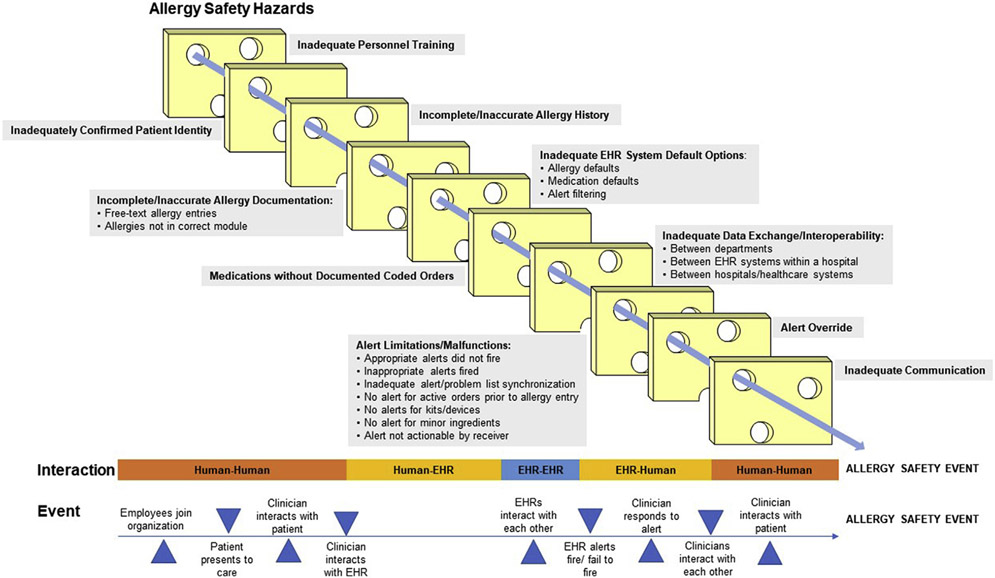
To improve health care safety for patients with allergies, we developed and assessed an allergy safety event classification schema to describe failures resulting in allergy-related safety events.
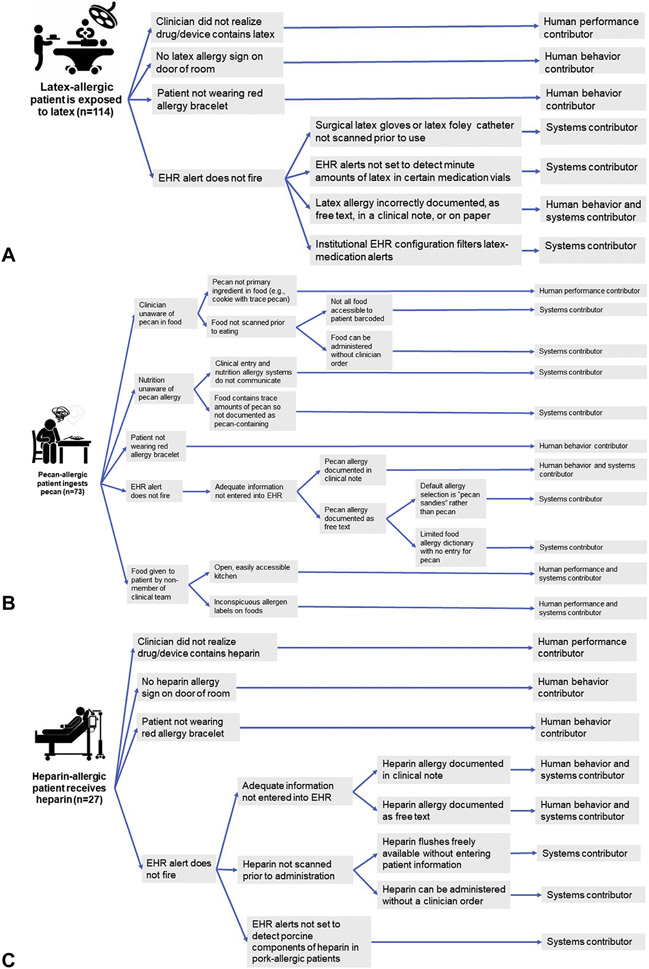
Using keyword searches followed by expert manual review of 299,031 voluntarily-filed safety event reports at 2 large academic medical centers, we identified and classified allergy-related safety events from 5 years of safety reports. We used driver diagrams to elucidate root causes for commonly observed allergy safety events in health care settings.
From 299,031 safety reports, 1922 (0.6%) were extracted with keywords and 744 (0.2%) were manually confirmed as allergy-related safety events. Safety failures were due to incomplete/inaccurate electronic health record documentation (n = 375, 50.4%), human factors (n = 175, 23.5%), allergy alert limitation and/or malfunction (n = 127, 17.1%), data exchange and interoperability failures (n = 92, 12.4%), and electronic health record system default options (n = 30, 4.0%). Safety failures resulted in known allergen exposures to drugs (n = 537), including heparin (n = 27) and topical anesthetics such as lidocaine (n = 8); latex (n = 114); food allergens (n = 73); and adhesive (n = 23).
We identified 744 allergy-related safety events to inform a novel safety failure classification schema as an important step toward a safer health care environment for patients with allergies. Improved systems are required to address safety issues with certain food and drug allergens.
过敏安全需要了解使患者接触到已知过敏原的操作流程,包括此类流程出现故障的方式和时间。
为提高过敏患者的医疗保健安全性,我们开发并评估了一种过敏安全事件分类方案,以描述导致与过敏相关的安全事件的故障。
我们使用关键字搜索,然后由两名专家对 2 家大型学术医疗中心的 299031 份自愿提交的安全事件报告进行手动审查,从 5 年的安全报告中识别和分类与过敏相关的安全事件。我们使用驾驶员图阐明了医疗保健环境中常见的过敏安全事件的根本原因。
从 299031 份安全报告中,通过关键字提取了 1922 份(0.6%),并通过手动确认了 744 份(0.2%)为与过敏相关的安全事件。安全故障是由于电子病历文档不完整/不准确(n=375,50.4%)、人为因素(n=175,23.5%)、过敏警报限制和/或故障(n=127,17.1%)、数据交换和互操作性故障(n=92,12.4%)以及电子病历系统默认选项(n=30,4.0%)造成的。安全故障导致了药物中已知过敏原的暴露(n=537),包括肝素(n=27)和局部麻醉剂如利多卡因(n=8);乳胶(n=114);食物过敏原(n=73);和粘合剂(n=23)。
我们确定了 744 例与过敏相关的安全事件,为一种新型安全故障分类方案提供了信息,这是为过敏患者创造更安全医疗保健环境的重要步骤。需要改进系统以解决某些食物和药物过敏原的安全问题。