Miao Jing, Guo Liying, Cui Huantian, Wang Li, Zhu Bo, Lei Jinyan, Li Peng, Jia Jianwei, Zhang Zhaiyi
Tianjin Second People's Hospital, Tianjin, China.
Shandong Provincial Key Laboratory of Animal Cell and Developmental Biology, School of Life Sciences, Shandong University, Qingdao, China.
Evid Based Complement Alternat Med. 2022 Mar 31;2022:6221340. doi: 10.1155/2022/6221340. eCollection 2022.
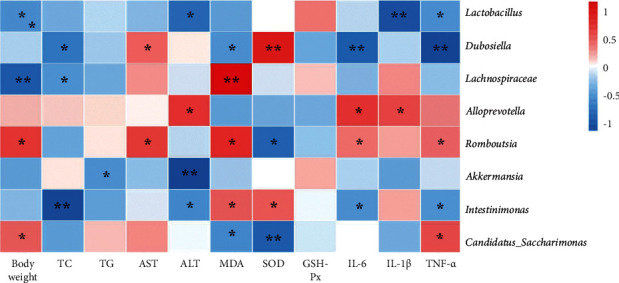
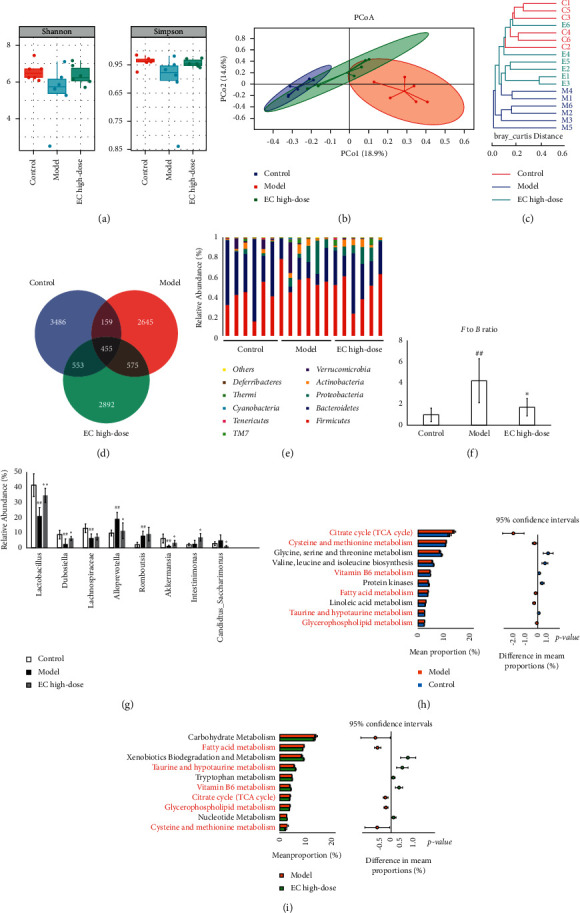
Many studies have found that the dysfunction in gut microbiota and the metabolic dysfunction can promote nonalcoholic fatty liver disease (NAFLD) development. Er-Chen decoction (EC) can be used in the treatment of NAFLD. However, the mechanism of this hepatoprotection is still unknown. In this study, we constructed a rat model with NAFLD fed with high-fat chow and administered EC treatment. The therapeutic effects of EC on NAFLD were evaluated by measuring transaminases, blood lipid levels, and pathological changes in the liver. In addition, we measured the effects of EC on liver inflammatory response and oxidative stress. The changes in gut microbiota after EC treatment were studied using 16S rRNA sequencing. Serum untargeted metabolomics analysis was also used to study the metabolic regulatory mechanisms of EC on NAFLD. The results showed that EC decreased the serum transaminases and lipid levels and improved the pathological changes in NAFLD rats. Furthermore, EC enhanced the activities of SOD and GSH-Px and decreased MDA level in the liver. EC treatment also decreased the gene and protein levels of IL-6, IL-1, and TNF- in the liver and serum. The 16S rRNA sequencing and untargeted metabolomics indicated that EC treatment affected the gut microbiota and regulated serum metabolism. Correlation analysis showed that the effects of EC on taurine and hypotaurine metabolism, cysteine and methionine metabolism, and vitamin B6 metabolism pathways were associated with affecting in the abundance of , , , and in the gut. In conclusion, our study confirmed the protective effect of EC on NAFLD. EC could treat NAFLD by inhibiting oxidative stress, reducing inflammatory responses, and improving the dysbiosis of gut microbiota and the modulation of the taurine and hypotaurine metabolism, cysteine and methionine metabolism, and vitamin B6 metabolism pathways in serum.
许多研究发现,肠道微生物群功能障碍和代谢功能障碍可促进非酒精性脂肪性肝病(NAFLD)的发展。二陈汤(EC)可用于治疗NAFLD。然而,这种肝脏保护作用的机制仍不清楚。在本研究中,我们构建了高脂饮食喂养的NAFLD大鼠模型并给予EC治疗。通过测量转氨酶、血脂水平和肝脏病理变化来评估EC对NAFLD的治疗效果。此外,我们还测量了EC对肝脏炎症反应和氧化应激的影响。利用16S rRNA测序研究EC治疗后肠道微生物群的变化。血清非靶向代谢组学分析也用于研究EC对NAFLD的代谢调控机制。结果表明,EC降低了NAFLD大鼠的血清转氨酶和血脂水平,并改善了其病理变化。此外,EC增强了肝脏中SOD和GSH-Px的活性,并降低了MDA水平。EC治疗还降低了肝脏和血清中IL-6、IL-1和TNF-的基因和蛋白水平。16S rRNA测序和非靶向代谢组学表明,EC治疗影响肠道微生物群并调节血清代谢。相关性分析表明,EC对牛磺酸和低牛磺酸代谢、半胱氨酸和蛋氨酸代谢以及维生素B6代谢途径的影响与影响肠道中、、和的丰度有关。总之,我们的研究证实了EC对NAFLD的保护作用。EC可通过抑制氧化应激、减轻炎症反应、改善肠道微生物群失调以及调节血清中牛磺酸和低牛磺酸代谢、半胱氨酸和蛋氨酸代谢以及维生素B6代谢途径来治疗NAFLD。