Yu Wanli, Chen Weifu, Jiang Yongxiang, Ma Mincai, Zhang Wei, Zhang Xiaolin, Cheng Yuan
Department of Neurosurgery, The Second Affiliated Hospital of Chongqing Medical University, Chongqing, China.
Front Pharmacol. 2022 Mar 17;13:845386. doi: 10.3389/fphar.2022.845386. eCollection 2022.
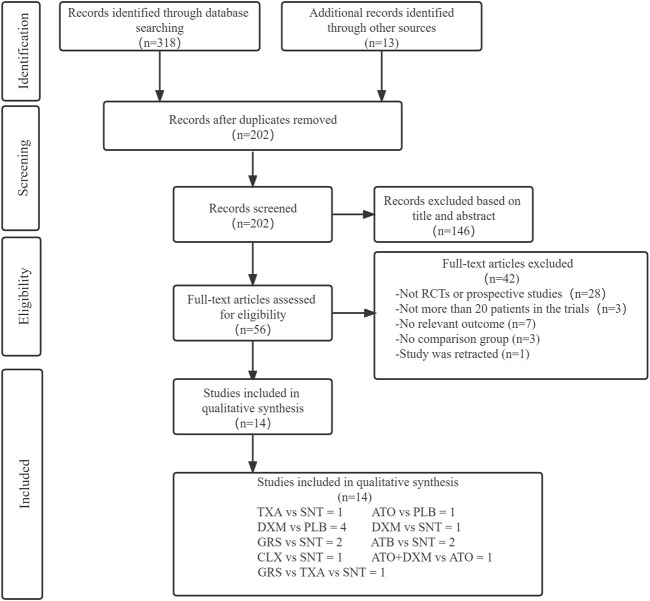
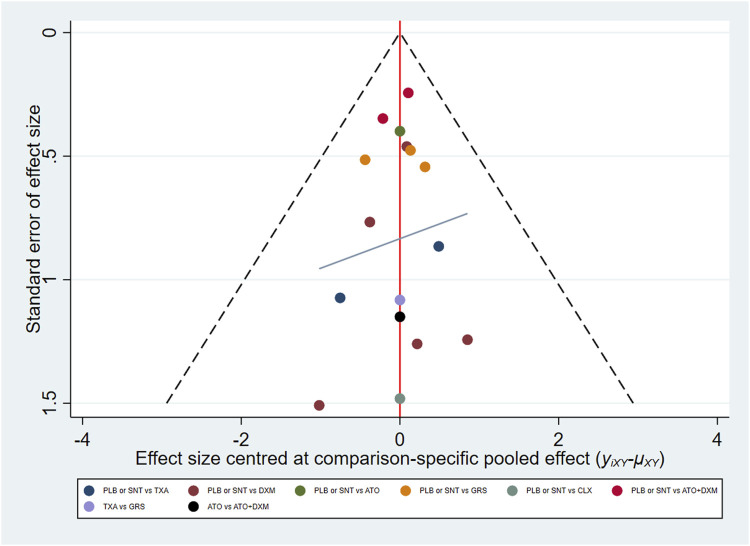
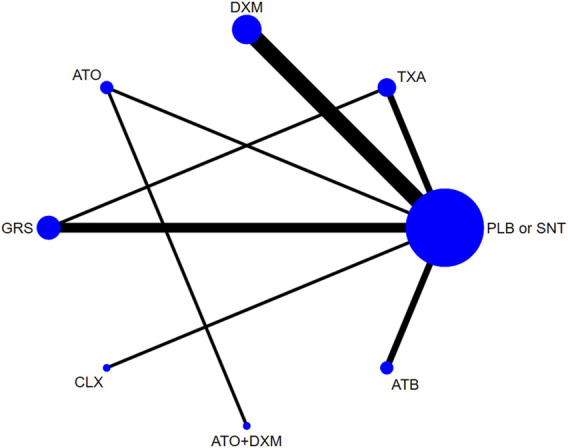
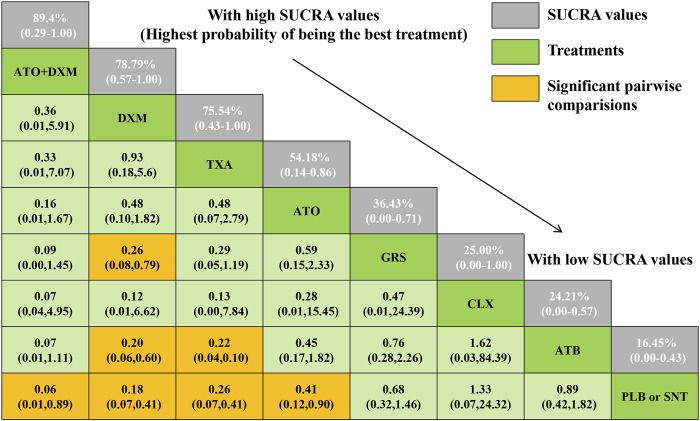
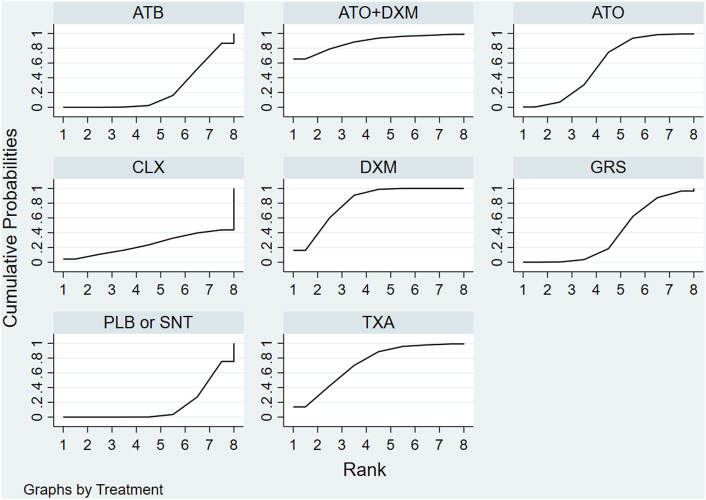
We aim to compare the effectiveness of different drug treatments in improving recurrence in patients with chronic subdural hematoma (CSDH). Eligible randomized controlled trials (RCTs) and prospective trials were searched in PubMed, Cochrane Library, and Embase, from database inception to December 2021. After the available studies following inclusion and exclusion criteria were screened, the main outcome measures were strictly extracted. Taking the random-effects model, dichotomous data were determined and extracted by odds ratio (OR) with 95% credible interval (CrI), and a surface under the cumulative ranking curve (SUCRA) was generated to calculate the ranking probability of comparative effectiveness among each drug intervention. Moreover, we used the node-splitting model to evaluate inconsistency between direct and indirect comparisons of our network meta-analysis (NMA). Funnel plots were used to evaluate publication bias. From the 318 articles found during initial citation screening, 11 RCTs and 3 prospective trials ( = 3,456 participants) were ultimately included in our study. Our NMA results illustrated that atorvastatin + dexamethasone (ATO+DXM) (OR = 0.06, 95% CrI 0.01, 0.89) was the most effective intervention to improve recurrence in patients with CSDH (SUCRA = 89.40%, 95% CrI 0.29, 1.00). Four drug interventions [ATO+DXM (OR = 0.06, 95% CrI 0.01, 0.89), DXM (OR = 0.18, 95% CrI 0.07, 0.41), tranexamic acid (TXA) (OR = 0.26, 95% CrI 0.07, 0.41), and ATO (OR = 0.41, 95% CrI 0.12, 0.90)] achieved statistical significance in improving recurrence in CSDH patients compared with the placebo (PLB) or standard neurosurgical treatment (SNT) group. Our NMA showed that ATO+DXM, DXM, ATO, and TXA had definite efficacy in improving recurrence in CSDH patients. Among them, ATO+DXM is the best intervention for improving recurrence in patients with CSDH in this particular population. Multicenter rigorous designed prospective randomized trials are still needed to evaluate the role of various drug interventions in improving neurological function or outcome. (https://www.crd.york.ac.uk/prospero/display_record.php?RecordID=299491), identifier (CRD 42022299491).
我们旨在比较不同药物治疗对改善慢性硬膜下血肿(CSDH)患者复发情况的有效性。从数据库建立至2021年12月,我们在PubMed、Cochrane图书馆和Embase中检索了符合条件的随机对照试验(RCT)和前瞻性试验。在筛选出符合纳入和排除标准的现有研究后,严格提取主要结局指标。采用随机效应模型,通过比值比(OR)及95%可信区间(CrI)确定并提取二分类数据,并生成累积排序曲线下面积(SUCRA)以计算各药物干预之间比较有效性的排序概率。此外,我们使用节点拆分模型评估网络荟萃分析(NMA)中直接和间接比较之间的不一致性。采用漏斗图评估发表偏倚。在初步文献筛选中找到的318篇文章中,最终有11项RCT和3项前瞻性试验(n = 3456名参与者)纳入我们的研究。我们的NMA结果表明,阿托伐他汀+地塞米松(ATO+DXM)(OR = 0.06,95% CrI 0.01,0.89)是改善CSDH患者复发最有效的干预措施(SUCRA = 89.40%,95% CrI 0.29,1.00)。与安慰剂(PLB)或标准神经外科治疗(SNT)组相比,四种药物干预措施[ATO+DXM(OR = 0.06,95% CrI 0.01,0.89)、地塞米松(DXM)(OR = 0.18,95% CrI 0.07,0.41)、氨甲环酸(TXA)(OR = 0.26,95% CrI 0.07,0.41)和阿托伐他汀(ATO)(OR = 0.41,95% CrI 0.12,0.90)]在改善CSDH患者复发方面具有统计学意义。我们的NMA表明,ATO+DXM、DXM、ATO和TXA在改善CSDH患者复发方面具有确切疗效。其中,ATO+DXM是该特定人群中改善CSDH患者复发的最佳干预措施。仍需要多中心严格设计的前瞻性随机试验来评估各种药物干预在改善神经功能或结局方面的作用。(https://www.crd.york.ac.uk/prospero/display_record.php?RecordID=299491),标识符(CRD 42022299491)