Zhang Anyi, Liu Lin, Chang Suhua, Shi Le, Li Peng, Shi Jie, Lu Lin, Bao Yanping, Liu Jiajia
Peking University Sixth Hospital, Peking University Institute of Mental Health, NHC Key Laboratory of Mental Health (Peking University), National Clinical Research Center for Mental Disorders (Peking University Sixth Hospital), Peking University, Beijing, China.
National Institute on Drug Dependence and Beijing Key Laboratory on Drug Dependence Research, Peking University, Beijing, China.
Front Psychiatry. 2022 Mar 25;13:874090. doi: 10.3389/fpsyt.2022.874090. eCollection 2022.
Autism spectrum disorder (ASD) is a lifelong condition. Autistic symptoms can persist into adulthood. Studies have reported that autistic symptoms generally improved in adulthood, especially restricted and repetitive behaviors and interests (RRBIs). We explored brain networks that are related to differences in RRBIs in individuals with ASDs among different ages.
We enrolled 147 ASD patients from the Autism Brain Imaging Data Exchange II (ABIDEII) database. The participants were divided into four age groups: children (6-9 years old), younger adolescents (10-14 years old), older adolescents (15-19 years old), and adults (≥20 years old). RRBIs were evaluated using the Repetitive Behaviors Scale-Revised 6. We first explored differences in RRBIs between age groups using the Kruskal-Wallis test. Associations between improvements in RRBIs and age were analyzed using a general linear model. We then analyzed RRBIs associated functional connectivity (FC) links using the network-based statistic method by adjusting covariates. The association of the identified FC with age group, and mediation function of the FC on the association of age-group and RRBI were further analyzed.
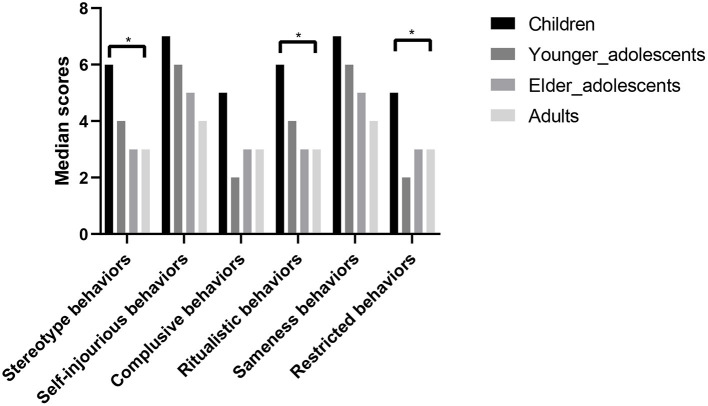
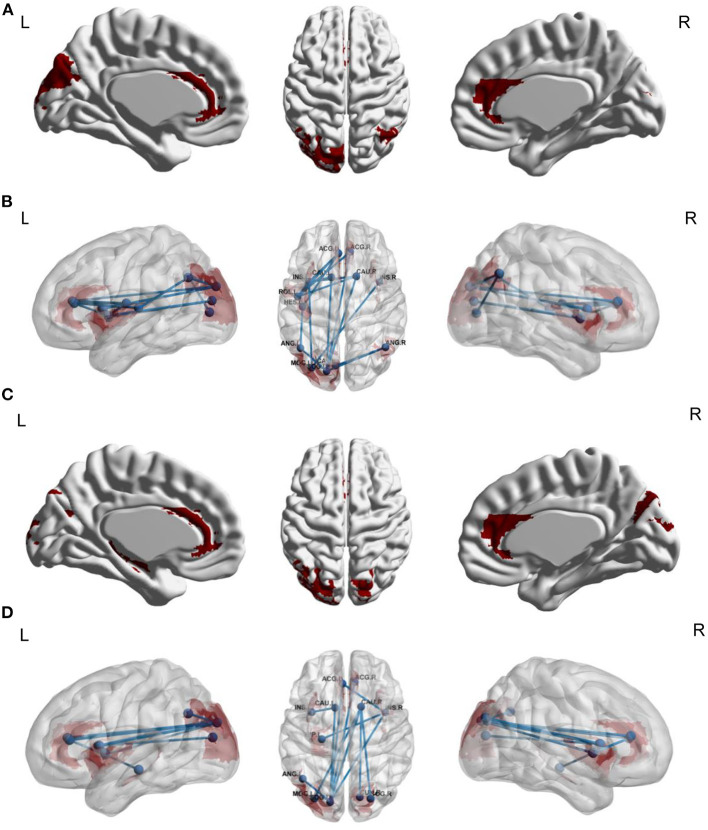
Most subtypes of RRBIs improved with age, especially stereotyped behaviors, ritualistic behaviors, and restricted behaviors ( = 0.012, 0.014, and 0.012, respectively). Results showed that 12 FC links were closely related to overall RRBIs, 17 FC links were related to stereotyped behaviors. Among the identified 29 FC links, 15 were negatively related to age-groups. The mostly reported core brain regions included superior occipital gyrus, insula, rolandic operculum, angular, caudate, and cingulum. The decrease in FC between the left superior occipital lobe and right angular (effect = -0.125 and -0.693, respectively) and between the left insula and left caudate (effect = -0.116 and -0.664, respectively) might contribute to improvements in multiple RRBIs with age.
We identified improvements in RRBIs with age in ASD patients, especially stereotyped behaviors, ritualistic behaviors, and restricted behaviors. The decrease in FC between left superior occipital lobe and right angular and between left insula and left caudate might contribute to these improvements. Our findings improve our understanding of the pathogenesis of RRBIs and suggest potential intervention targets to improve prognosis in adulthood.
自闭症谱系障碍(ASD)是一种终身疾病。自闭症症状可持续至成年期。研究报告称,自闭症症状在成年期通常会有所改善,尤其是受限的重复行为和兴趣(RRBIs)。我们探究了与不同年龄的自闭症谱系障碍个体RRBIs差异相关的脑网络。
我们从自闭症脑成像数据交换II(ABIDEII)数据库中招募了147名自闭症谱系障碍患者。参与者被分为四个年龄组:儿童(6 - 9岁)、青少年(10 - 14岁)、青年(15 - 19岁)和成年人(≥20岁)。使用重复行为量表修订版6评估RRBIs。我们首先使用Kruskal - Wallis检验探究年龄组之间RRBIs的差异。使用一般线性模型分析RRBIs改善与年龄之间的关联。然后,我们通过调整协变量,使用基于网络的统计方法分析与RRBIs相关的功能连接(FC)链接。进一步分析所确定的FC与年龄组的关联,以及FC在年龄组与RRBI关联中的中介作用。
RRBIs的大多数亚型随年龄改善,尤其是刻板行为、仪式行为和受限行为(分别为 = 0.012、0.014和0.012)。结果显示,12个FC链接与总体RRBIs密切相关,17个FC链接与刻板行为相关。在所确定的29个FC链接中,15个与年龄组呈负相关。最常报告的核心脑区包括枕上回、脑岛、中央沟盖、角回、尾状核和扣带回。左枕叶上部与右角回之间以及左脑岛与左尾状核之间的FC降低(效应分别为 - 0.125和 - 0.693,以及 - 0.116和 - 0.664)可能有助于多种RRBIs随年龄改善。
我们发现自闭症谱系障碍患者的RRBIs随年龄改善,尤其是刻板行为、仪式行为和受限行为。左枕叶上部与右角回之间以及左脑岛与左尾状核之间的FC降低可能有助于这些改善。我们的研究结果增进了我们对RRBIs发病机制的理解,并提出了改善成年期预后的潜在干预靶点。