Marsili Luca, Duque Kevin R, Bode Rachel L, Kauffman Marcelo A, Espay Alberto J
James J. and Joan A. Gardner Center for Parkinson's Disease and Movement Disorders, Department of Neurology, University of Cincinnati, Cincinnati, OH, United States.
Consultorio y Laboratorio de Neurogenética, Centro Universitario de Neurología José María Ramos Mejía, Buenos Aires, Argentina.
Front Neurol. 2022 Mar 23;13:821189. doi: 10.3389/fneur.2022.821189. eCollection 2022.
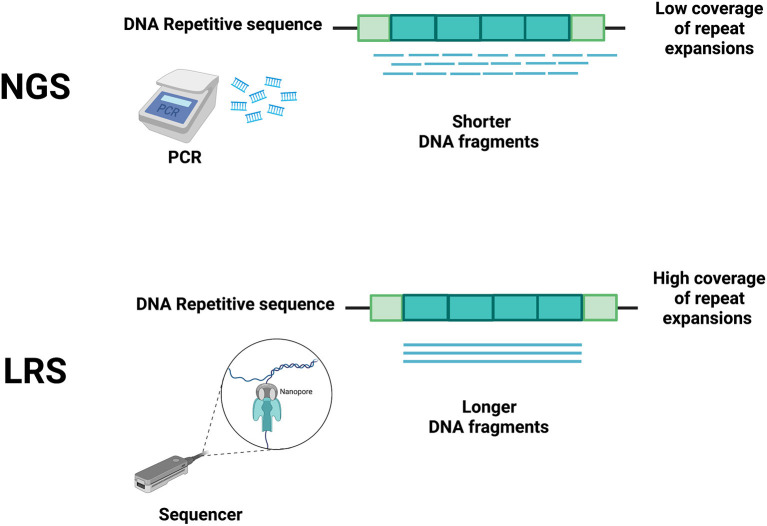
Long-read sequencing (LRS) technologies have been recently introduced to overcome intrinsic limitations of widely-used next-generation sequencing (NGS) technologies, namely the sequencing limited to short-read fragments (150-300 base pairs). Since its introduction, LRS has permitted many successes in unraveling hidden mutational mechanisms. One area in clinical neurology in need of rethinking as it applies to genetic mechanisms is essential tremor (ET). This disorder, among the most common in neurology, is a syndrome often exhibiting an autosomal dominant pattern of inheritance whose large phenotypic spectrum suggest a multitude of genetic etiologies. Exome sequencing has revealed the genetic etiology only in rare ET families (, and ). We hypothesize that a reason for this shortcoming may be non-classical genetic mechanism(s) underpinning ET, among them trinucleotide, tetranucleotide, or pentanucleotide repeat disorders. In support of this hypothesis, trinucleotide (e.g., GGC repeats in ) and pentanucleotide repeat disorders (e.g., ATTTC repeats in ) have been revealed as pathogenic in patients with a past history of what has come to be referred to as "ET plus," bilateral hand tremor associated with epilepsy and/or leukoencephalopathy. A systematic review of LRS in neurodegenerative disorders showed that 10 of the 22 (45%) genetic etiologies ascertained by LRS include tremor in their phenotypic spectrum, suggesting that future clinical applications of LRS for tremor disorders may uncover genetic subtypes of familial ET that have eluded NGS, particularly those with associated leukoencephalopathy or family history of epilepsy. LRS provides a pathway for potentially uncovering novel genes and genetic mechanisms, helping narrow the large proportion of "idiopathic" ET.
长读长测序(LRS)技术最近被引入,以克服广泛使用的下一代测序(NGS)技术的固有局限性,即测序仅限于短读长片段(150 - 300个碱基对)。自引入以来,LRS在揭示隐藏的突变机制方面取得了许多成功。临床神经病学中需要重新思考其遗传机制的一个领域是特发性震颤(ET)。这种疾病是神经病学中最常见的疾病之一,是一种常表现为常染色体显性遗传模式的综合征,其广泛的表型谱提示多种遗传病因。外显子组测序仅在罕见的ET家族中揭示了遗传病因(,和)。我们假设,这一缺陷的一个原因可能是ET潜在的非经典遗传机制,其中包括三核苷酸、四核苷酸或五核苷酸重复障碍。支持这一假设的是,三核苷酸(例如,中的GGC重复)和五核苷酸重复障碍(例如,中的ATTTC重复)已被揭示为有“ET加”病史患者的致病因素,“ET加”是指与癫痫和/或白质脑病相关的双侧手部震颤。一项对神经退行性疾病中LRS的系统评价表明,LRS确定的22种(45%)遗传病因中有10种在其表型谱中包括震颤,这表明LRS未来在震颤疾病中的临床应用可能会发现NGS未发现的家族性ET的遗传亚型,特别是那些伴有白质脑病或癫痫家族史的亚型。LRS为潜在发现新基因和遗传机制提供了一条途径,有助于缩小大部分“特发性”ET的范围。