Geng Chang, Tong Yuanren, Zhang Siwen, Ling Chao, Wu Xin, Wang Depeng, Dai Yi
Department of Neurology, Peking Union Medical College Hospital, Chinese Academy of Medical Sciences, Beijing, China.
GrandOmics Biosciences, Beijing, China.
Front Genet. 2021 Apr 30;12:638220. doi: 10.3389/fgene.2021.638220. eCollection 2021.
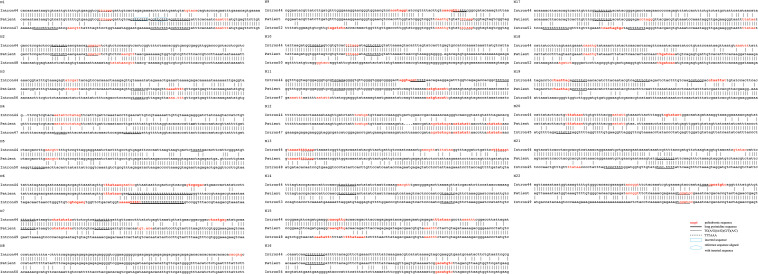
Exon deletions make up to 80% of mutations in the DMD gene, which cause Duchenne and Becker muscular dystrophy. Exon 45-55 regions were reported as deletion hotspots and intron 44 harbored more than 25% of deletion start points. We aimed to investigate the fine structures of breakpoints in intron 44 to find potential mechanisms of large deletions in intron 44. Twenty-two dystrophinopathy patients whose deletion started in intron 44 were sequenced using long-read sequencing of a gene capture panel. Sequence homology, palindromic sequences, and polypyrimidine sequences were searched at the breakpoint junctions. RepeatMasker was used to analyze repetitive elements and Mfold was applied to predict secondary DNA structure. With a designed capture panel, 22 samples achieved 2.25 gigabases and 1.28 million reads on average. Average depth was 308× and 99.98% bases were covered at least 1×. The deletion breakpoints in intron 44 were scattered and no breakpoints clustered in any region less than 500 bp. A total of 72.7% of breakpoints located in distal 100 kb of intron 44 and more repetitive elements were found in this region. Microhomologies of 0-1 bp were found in 36.4% (8/22) of patients, which corresponded with non-homologous end-joining. Microhomologies of 2-20 bp were found in 59.1% (13/22) of patients, which corresponded with microhomology-mediated end-joining. Moreover, a 7 bp insertion was found in one patient, which might be evidence of aberrant replication origin firing. Palindromic sequences, polypyrimidine sequences, and small hairpin loops were found near several breakpoint junctions. No evidence of large hairpin loop formation in deletion root sequences was observed. This study was the first to explore possible mechanisms underlying exon deletions starting from intron 44 of the gene based on long-read sequencing. Diverse mechanisms might be associated with deletions in the gene.
外显子缺失占杜氏肌营养不良症(DMD)基因中突变的80%,这些突变会导致杜兴氏和贝克氏肌营养不良症。据报道,外显子45 - 55区域是缺失热点,内含子44包含超过25%的缺失起始点。我们旨在研究内含子44中断点的精细结构,以寻找内含子44中大片段缺失的潜在机制。使用基因捕获面板的长读长测序对22名缺失起始于内含子44的肌营养不良症患者进行测序。在断点连接处搜索序列同源性、回文序列和多嘧啶序列。使用RepeatMasker分析重复元件,并应用Mfold预测二级DNA结构。使用设计的捕获面板,22个样本平均获得2.25千兆碱基和128万个读数。平均深度为308×,99.98%的碱基至少被覆盖1次。内含子44中的缺失断点分散,在任何小于500 bp的区域都没有断点聚集。总共72.7%的断点位于内含子44远端100 kb,且该区域发现了更多的重复元件。在36.4%(8/22)的患者中发现了0 - 1 bp的微同源性,这与非同源末端连接相对应。在59.1%(13/22)的患者中发现了2 - 20 bp的微同源性,这与微同源性介导的末端连接相对应。此外,在一名患者中发现了一个7 bp的插入,这可能是异常复制起点激活的证据。在几个断点连接处附近发现了回文序列、多嘧啶序列和小发夹环。在缺失根序列中未观察到形成大的发夹环的证据。本研究首次基于长读长测序探索了从该基因内含子44起始的外显子缺失的潜在机制。多种机制可能与该基因的缺失有关。