He Jia-Kai, Jia Bao-Hui, Wang Yu, Li Shao-Yuan, Zhao Bin, Zhou Zeng-Guang, Bi Yan-Zhi, Wu Mo-Zheng, Li Liang, Zhang Jin-Ling, Fang Ji-Liang, Rong Pei-Jing
Department of Physiology, Institute of Acupuncture and Moxibustion, China Academy of Chinese Medical Sciences, Beijing, China.
Department of Acupuncture, China Academy of Chinese Medical Sciences Guang'anmen Hospital, Beijing, China.
Front Neurol. 2022 Mar 24;13:827749. doi: 10.3389/fneur.2022.827749. eCollection 2022.
Transcutaneous auricular vagus nerve stimulation (taVNS) has been reported to be effective for chronic insomnia (CI). However, the appropriate population for taVNS to treat insomnia is unclear.
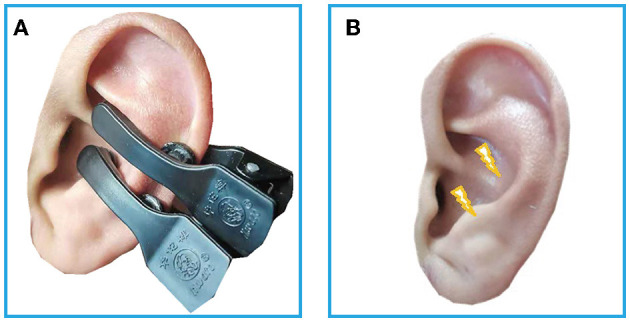
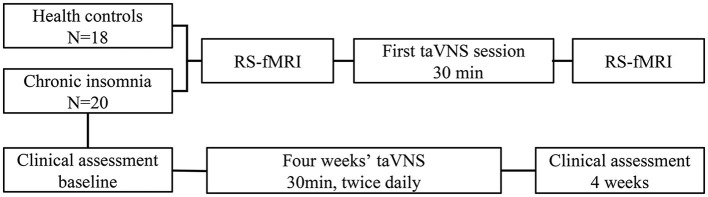
Total twenty-four patients with CI and eighteen health controls (HC) were recruited. Rest-state functional magnetic resonance imaging (Rs-fMRI) was performed before and after 30 min' taVNS at baseline. The activated and deactivated brain regions were revealed by different voxel-based analyses, then the seed-voxel functional connectivity analysis was calculated. In the CI group, 30 min of taVNS were applied twice daily for 4 weeks. Pittsburgh Sleep Quality Index (PSQI) and Flinders Fatigue Scale (FFS) were also assessed before and after 4 weeks of treatment in the CI group. The HC group did not receive any treatment. The correlations were estimated between the clinical scales' score and the brain changes.
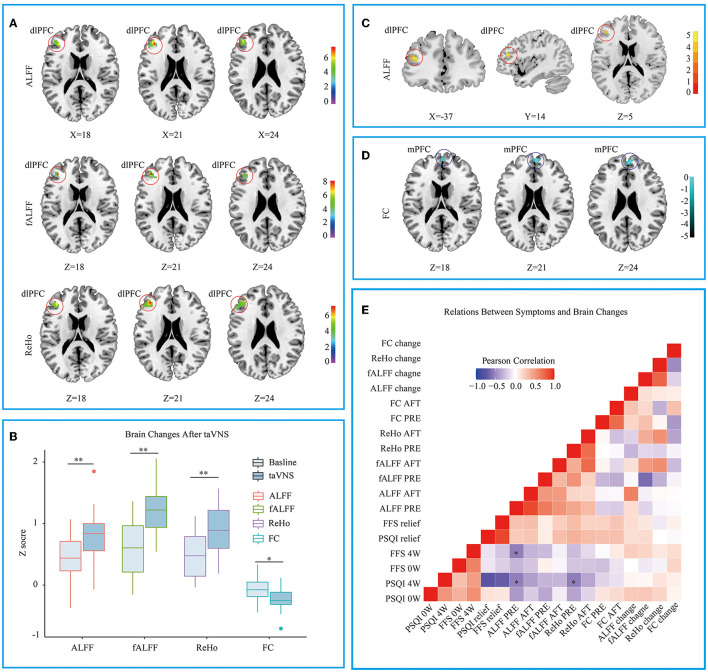
The scores of PSQI ( < 0.01) and FFS ( < 0.05) decreased after 4 weeks in the CI group. Compared to the HC group, the first taVNS session up-regulated left dorsolateral prefrontal cortex (dlPFC) and decreased the functional connectivity (FCs) between dlPFC and bilateral medial prefrontal cortex in the CI group. The CI groups' baseline voxel wised fMRI value in the dlPFC were negatively correlated to the PSQI and the FFS score after 4 weeks treatment.
It manifests that taVNS has a modulatory effect on the prefrontal cortex in patients with CI. The initial state of dlPFC may predict the efficacy for taVNS on CI.
经皮耳迷走神经刺激(taVNS)已被报道对慢性失眠(CI)有效。然而,taVNS治疗失眠的合适人群尚不清楚。
招募了24例CI患者和18名健康对照者(HC)。在基线时进行30分钟taVNS前后分别进行静息态功能磁共振成像(Rs-fMRI)。通过不同的基于体素的分析揭示激活和失活的脑区,然后计算种子体素功能连接分析。在CI组中,每天进行两次30分钟的taVNS,持续4周。CI组在治疗4周前后还评估了匹兹堡睡眠质量指数(PSQI)和弗林德斯疲劳量表(FFS)。HC组未接受任何治疗。估计临床量表评分与脑变化之间的相关性。
CI组4周后PSQI评分(<0.01)和FFS评分(<0.05)降低。与HC组相比,CI组第一次taVNS治疗上调了左侧背外侧前额叶皮质(dlPFC),并降低了dlPFC与双侧内侧前额叶皮质之间的功能连接(FCs)。CI组dlPFC的基线体素明智fMRI值与治疗4周后的PSQI和FFS评分呈负相关。
表明taVNS对CI患者的前额叶皮质有调节作用。dlPFC的初始状态可能预测taVNS对CI的疗效。