Walter Brendel Center of Experimental Medicine (WBex), Ludwig Maximilians University München (LMU), Munich, Germany.
Department of Anaesthesiology and Intensive Care Medicine, Research Unit Molecular Medicine, LMU University Hospital, Ludwig Maximilians University München (LMU), Munich, Germany.
Front Immunol. 2022 Mar 24;13:826047. doi: 10.3389/fimmu.2022.826047. eCollection 2022.
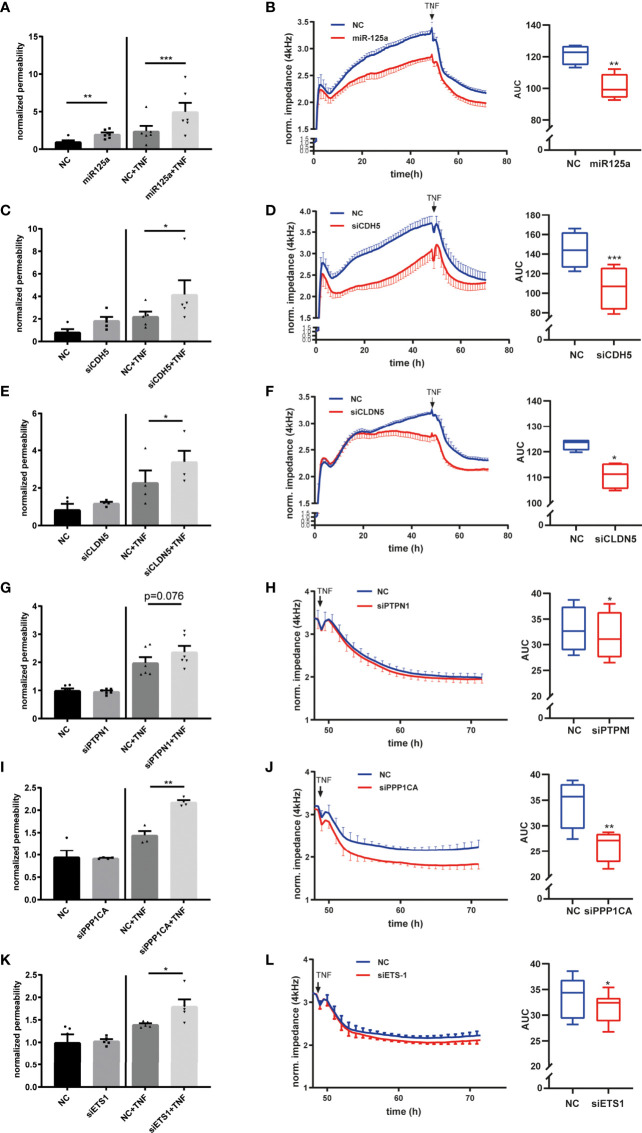
Opening of the endothelial barrier and targeted infiltration of leukocytes into the affected tissue are hallmarks of the inflammatory response. The molecular mechanisms regulating these processes are still widely elusive. In this study, we elucidate a novel regulatory network, in which miR-125a acts as a central hub that regulates and synchronizes both endothelial barrier permeability and monocyte migration. We found that inflammatory stimulation of endothelial cells induces miR-125a expression, which consecutively inhibits a regulatory network consisting of the two adhesion molecules VE-Cadherin (CDH5) and Claudin-5 (CLDN5), two regulatory tyrosine phosphatases (PTPN1, PPP1CA) and the transcription factor ETS1 eventually leading to the opening of the endothelial barrier. Moreover, under the influence of miR-125a, endothelial expression of the chemokine CCL2, the most predominant ligand for the monocytic chemokine receptor CCR2, was strongly enhanced. In monocytes, on the other hand, we detected markedly repressed expression levels of miR-125a upon inflammatory stimulation. This induced a forced expression of its direct target gene CCR2, entailing a strongly enhanced monocyte chemotaxis. Collectively, cell-type-specific differential expression of miR-125a forms a synergistic functional network controlling monocyte trafficking across the endothelial barrier towards the site of inflammation. In addition to the known mechanism of miRNAs being shuttled between cells extracellular vesicles, our study uncovers a novel dimension of miRNA function: One miRNA, although disparately regulated in the cells involved, directs a biologic process in a synergistic and mutually reinforcing manner. These findings provide important new insights into the regulation of the inflammatory cascade and may be of great use for future clinical applications.
内皮屏障的开放和白细胞靶向浸润到受影响的组织是炎症反应的标志。调节这些过程的分子机制仍然广泛难以捉摸。在这项研究中,我们阐明了一个新的调控网络,其中 miR-125a 作为一个中心枢纽,调节和同步内皮屏障通透性和单核细胞迁移。我们发现,内皮细胞的炎症刺激诱导 miR-125a 的表达,随后抑制由两个粘附分子 VE-钙粘蛋白(CDH5)和 Claudin-5(CLDN5)、两个调节酪氨酸磷酸酶(PTPN1、PPP1CA)和转录因子 ETS1 组成的调控网络,最终导致内皮屏障的开放。此外,在 miR-125a 的影响下,内皮细胞表达趋化因子 CCL2 的水平显著增强,CCL2 是单核细胞趋化因子受体 CCR2 的最主要配体。另一方面,在单核细胞中,我们检测到炎症刺激后 miR-125a 的表达水平明显受到抑制。这诱导其直接靶基因 CCR2 的强制表达,导致单核细胞化学趋化作用显著增强。总之,miR-125a 在细胞类型特异性差异表达形成协同功能网络,控制单核细胞穿过内皮屏障向炎症部位迁移。除了已知的 miRNA 在细胞之间穿梭的机制外,我们的研究揭示了 miRNA 功能的一个新维度:一种 miRNA,尽管在涉及的细胞中差异调节,但以协同和相互增强的方式指导一个生物学过程。这些发现为炎症级联反应的调控提供了重要的新见解,并可能对未来的临床应用有很大的帮助。