Emergency Department, Cangzhou Central Hospital, Cangzhou, China.
Laboratory Department, Cangzhou People Hospital, Cangzhou, China.
J Clin Lab Anal. 2020 Mar;34(3):e23098. doi: 10.1002/jcla.23098. Epub 2020 Jan 22.
This study was conducted to explore the association of microRNA (miR)-125a and miR-125b with acute respiratory distress syndrome (ARDS) risk and to investigate their correlation with clinical characteristics and prognosis in sepsis patients.
Totally 150 sepsis patients admitted to our hospital were consecutively enrolled and another 150 healthy subjects were enrolled as healthy controls (HCs). Their blood samples were collected for miR-125a and miR-125b detection by real-time quantitative polymerase chain reaction. Besides, ARDS occurrence and 28-day mortality were documented in all sepsis patients.
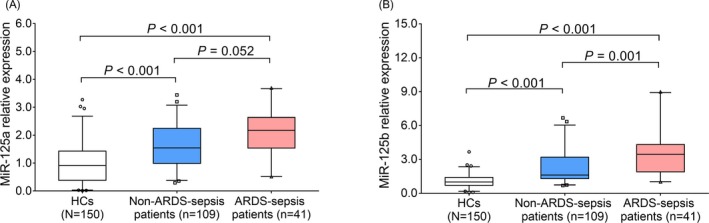
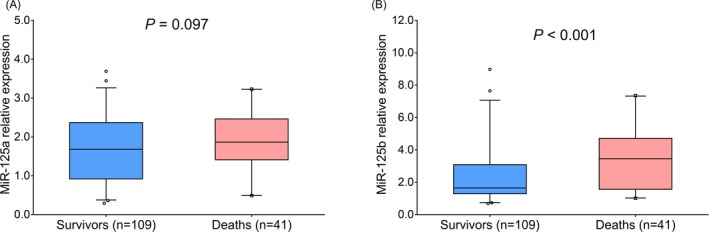
MiR-125a and miR-125b relative expressions were increased in ARDS-sepsis patients/non-ARDS-sepsis patients compared with HCs, while only miR-125b but not miR-125a was elevated in ARDS-sepsis patients compared with non-ARDS-sepsis patients. Receiver operating characteristic (ROC) curve presented that miR-125a (AUC: 0.650, 95%CI: 0.549-0.750) and miR-125b (AUC: 0.739, 95%CI: 0.653-0.823) could differentiate ARDS-sepsis patients from non-ARDS-sepsis patients, and miR-125b was of increased predictive value compared with miR-125a numerically. In sepsis patients, miR-125a relative expression was positively associated with serum creatinine (Scr), chronic health evaluation (APACHE) II score, sequential organ failure assessment (SOFA) score, and miR-125b was positively associated with Scr, C-reactive protein (CRP), APACHE II score, SOFA score, and chronic obstructive pulmonary disease. All sepsis patients were categorized into survivors and deaths according to 28-day mortality, and miR-125b but not miR-125a was upregulated in deaths compared with survivors.
Both of miR-125a and miR-125b predict ARDS risk, while only miR-125b is of value in prognosis prediction in sepsis patients.
本研究旨在探讨 microRNA (miR)-125a 和 miR-125b 与急性呼吸窘迫综合征 (ARDS) 风险的关联,并探讨其与脓毒症患者临床特征和预后的相关性。
连续纳入我院收治的 150 例脓毒症患者和 150 例健康对照者(HCs),采用实时定量聚合酶链反应检测 miR-125a 和 miR-125b 的表达。记录所有脓毒症患者的 ARDS 发生和 28 天死亡率。
与 HCs 相比,ARDS 脓毒症患者/非 ARDS 脓毒症患者的 miR-125a 和 miR-125b 相对表达量升高,而仅 miR-125b 而非 miR-125a 在 ARDS 脓毒症患者中升高。受试者工作特征(ROC)曲线表明,miR-125a(AUC:0.650,95%CI:0.549-0.750)和 miR-125b(AUC:0.739,95%CI:0.653-0.823)可区分 ARDS 脓毒症患者和非 ARDS 脓毒症患者,miR-125b 具有更高的预测价值。在脓毒症患者中,miR-125a 相对表达与血清肌酐(Scr)、慢性健康评估(APACHE)II 评分、序贯器官衰竭评估(SOFA)评分呈正相关,miR-125b 相对表达与 Scr、C 反应蛋白(CRP)、APACHE II 评分、SOFA 评分和慢性阻塞性肺疾病呈正相关。根据 28 天死亡率,将所有脓毒症患者分为存活组和死亡组,与存活组相比,死亡组 miR-125b 上调,而 miR-125a 无差异。
miR-125a 和 miR-125b 均能预测 ARDS 风险,但只有 miR-125b 对脓毒症患者的预后预测有价值。