Manzoor Hamid, Bukhat Sherien, Rasul Sumaira, Rehmani Muhammad Ishaq Asif, Noreen Sibgha, Athar Habib-Ur-Rehman, Zafar Zafar Ullah, Skalicky Milan, Soufan Walid, Brestic Marian, Habib-Ur-Rahman Muhammad, Ogbaga Chukwuma C, El Sabagh Ayman
Institute of Molecular Biology and Biotechnology, Bahauddin Zakariya University, Multan, Pakistan.
Department of Agronomy, Ghazi University, Dera Ghazi Khan, Pakistan.
Front Plant Sci. 2022 Mar 24;13:860664. doi: 10.3389/fpls.2022.860664. eCollection 2022.
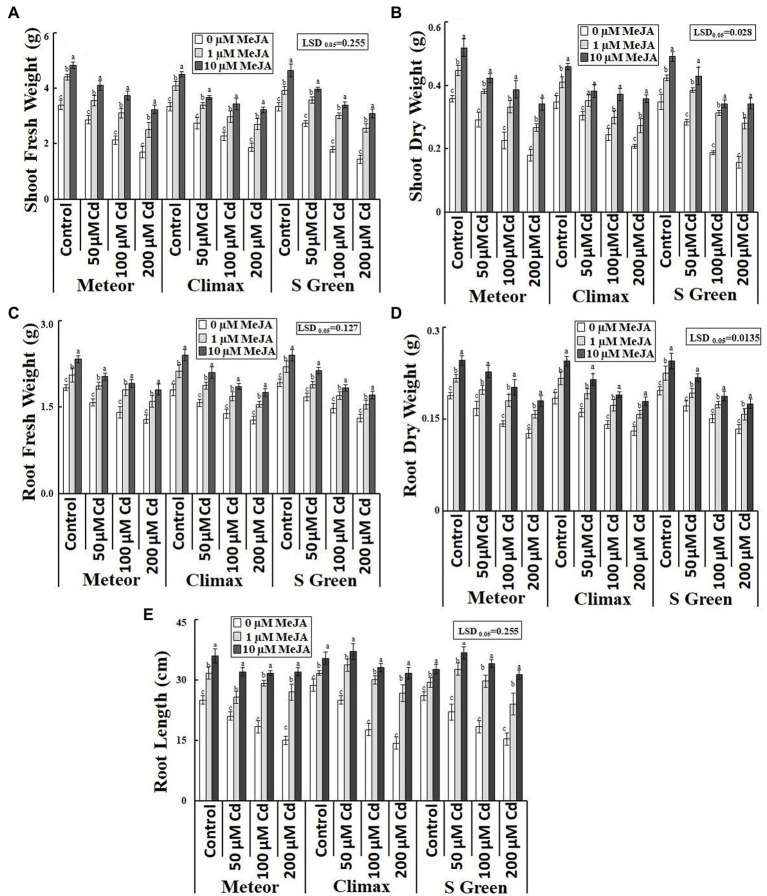
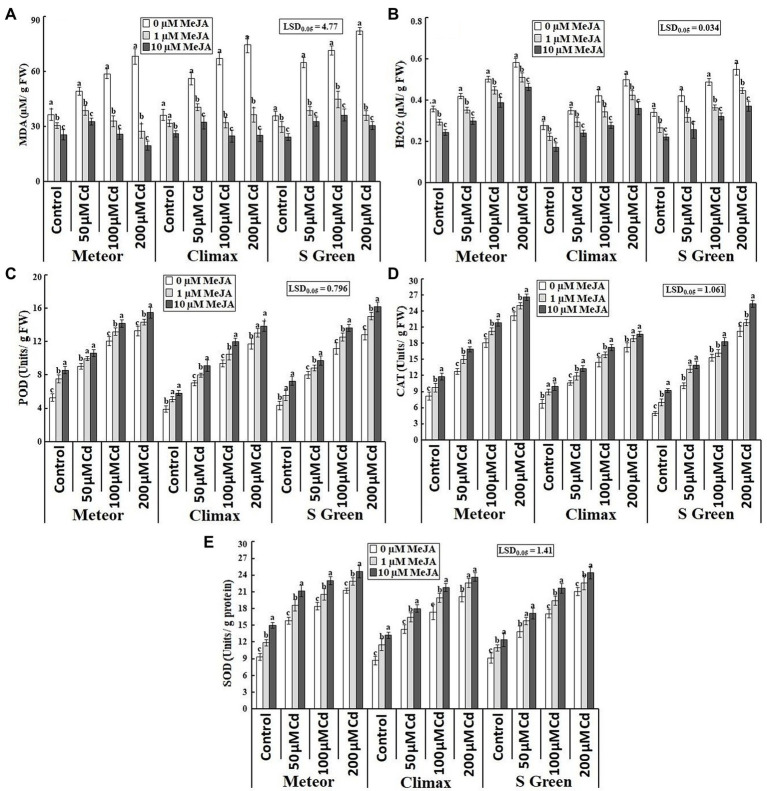
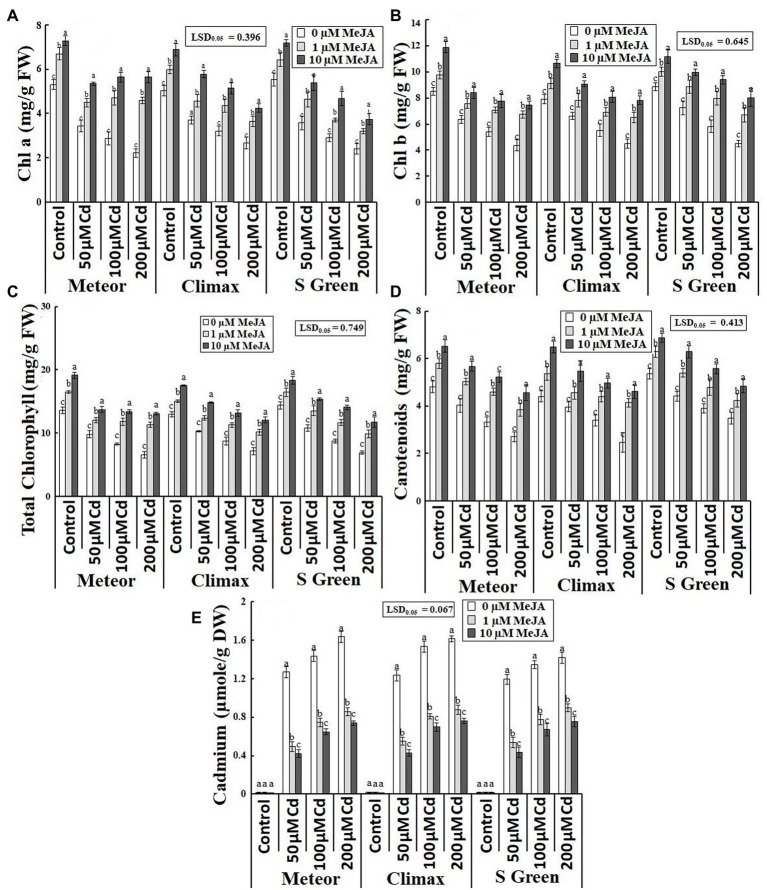
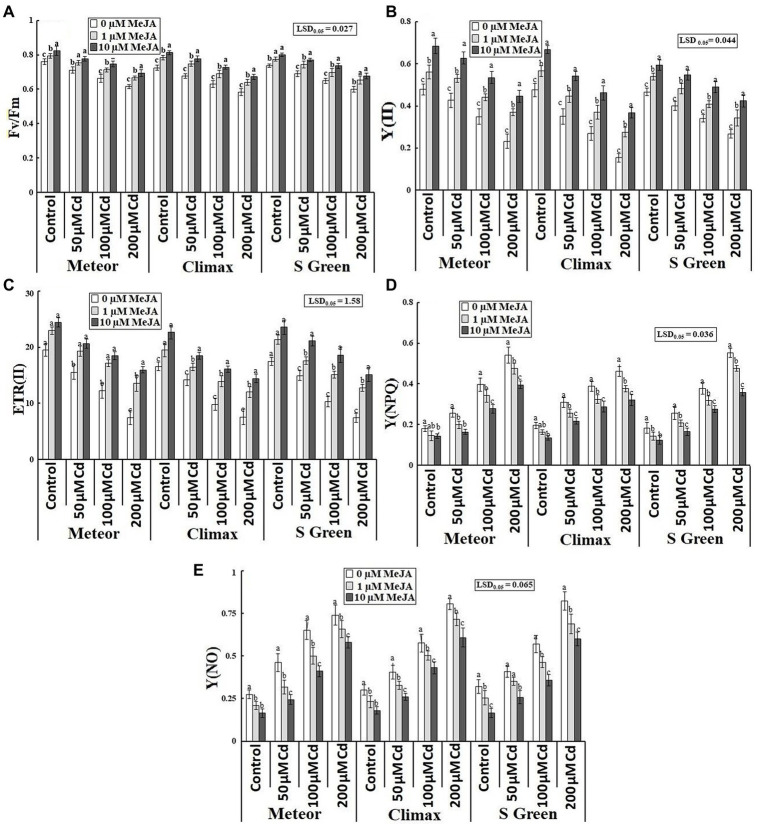
The accumulation of cadmium (Cd) in leaves reduces photosynthetic capacity by degrading photosynthetic pigments, reducing photosystem II activity, and producing reactive oxygen species (ROS). Though it was demonstrated that the application of Methyl Jasmonate (MeJA) induces heavy metal (HM) stress tolerance in plants, its role in adjusting redox balance and photosynthetic machinery is unclear. In this study, the role of MeJA in modulating photosystem II (PSII) activity and antioxidant defense system was investigated to reduce the toxic effects of Cd on the growth of pea ( L.) cultivars. One-week-old seedlings of three pea varieties were subjected to Cd stress (0, 50, 100 μm), and MeJA (0, 1, 5, 10 μm) was applied as a foliar spray for 2 weeks. Cadmium stress reduced the growth of all three pea varieties. Cadmium stress decreased photosynthetic pigments [Chl a (58.15%), Chl b (48.97%), total Chl (51.9%) and carotenoids (44.01%)] and efficiency of photosystem II [Fv/Fm (19.52%) and Y(II; 67.67%)], while it substantially increased Cd accumulation along with an increase in ROS (79.09%) and lipid peroxidation (129.28%). However, such adverse effects of Cd stress varied in different pea varieties. Exogenous application of MeJA increased the activity of a battery of antioxidant enzymes [superoxide dismutase (33.68%), peroxidase (29.75%), and catalase (38.86%)], improved photosynthetic pigments and PSII efficiency. This led to improved growth of pea varieties under Cd stress, such as increased fresh and dry weights of shoots and roots. In addition, improvement in root biomass by MeJA was more significant than that of shoot biomass. Thus, the mitigating effect of MeJA was attributed to its role in cellular redox balance and photosynthetic machinery of pea plants when exposed to Cd stress.
镉(Cd)在叶片中的积累通过降解光合色素、降低光系统II活性和产生活性氧(ROS)来降低光合能力。尽管已证明茉莉酸甲酯(MeJA)的施用可诱导植物对重金属(HM)胁迫的耐受性,但其在调节氧化还原平衡和光合机制中的作用尚不清楚。在本研究中,研究了MeJA在调节光系统II(PSII)活性和抗氧化防御系统中的作用,以降低Cd对豌豆(L.)品种生长的毒性作用。将三个豌豆品种一周龄的幼苗置于Cd胁迫(0、50、100 μM)下,并以叶面喷施的方式施用MeJA(0、1、5、10 μM),持续2周。Cd胁迫降低了所有三个豌豆品种的生长。Cd胁迫降低了光合色素[叶绿素a(58.15%)、叶绿素b(48.97%)、总叶绿素(51.9%)和类胡萝卜素(44.01%)]以及光系统II的效率[Fv/Fm(19.52%)和Y(II;67.67%)],同时随着ROS(79.09%)和脂质过氧化(129.28%)的增加,Cd积累也显著增加。然而,Cd胁迫的这种不利影响在不同豌豆品种中有所不同。外源施用MeJA增加了一系列抗氧化酶的活性[超氧化物歧化酶(33.68%)、过氧化物酶(29.75%)和过氧化氢酶(38.86%)],改善了光合色素和PSII效率。这导致了Cd胁迫下豌豆品种生长的改善,如地上部和根部鲜重和干重的增加。此外,MeJA对根生物量的改善比对地上部生物量的改善更显著。因此,MeJA的缓解作用归因于其在豌豆植株暴露于Cd胁迫时对细胞氧化还原平衡和光合机制的作用。