Liu Yang, Zhang Yu, Zheng Yi, Nie Xinghua, Wang Yafeng, Yu Wenjie, Su Shuchai, Cao Qingqin, Qin Ling, Xing Yu
Beijing Advanced Innovation Center for Tree Breeding by Molecular Design, College of Plant Science and Technology, Beijing University of Agriculture, Beijing, China.
Key Laboratory for Silviculture and Conservation of Ministry of Education, College of Forestry, Beijing Forestry University, Beijing, China.
Front Plant Sci. 2022 Mar 25;13:828270. doi: 10.3389/fpls.2022.828270. eCollection 2022.
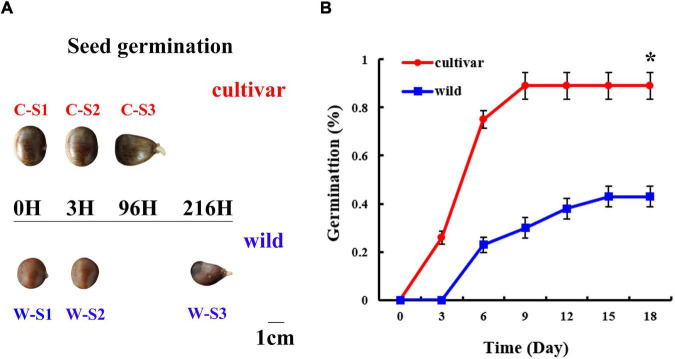
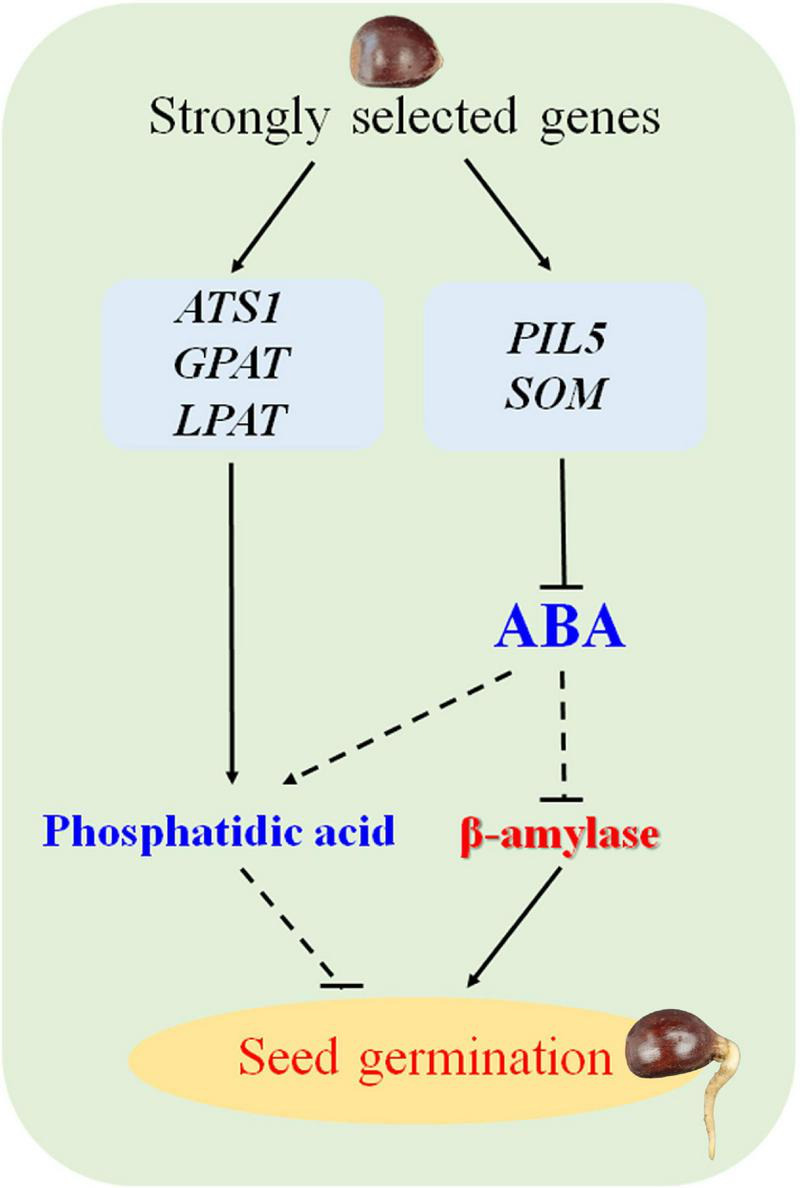
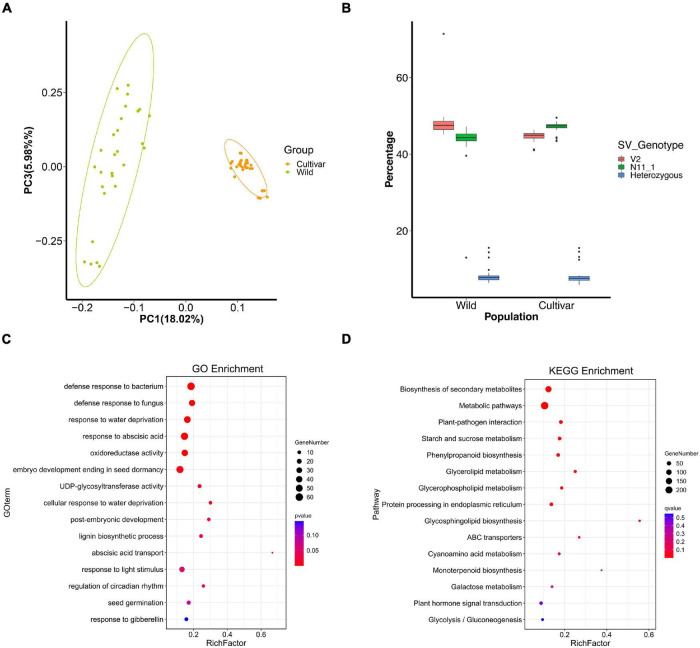
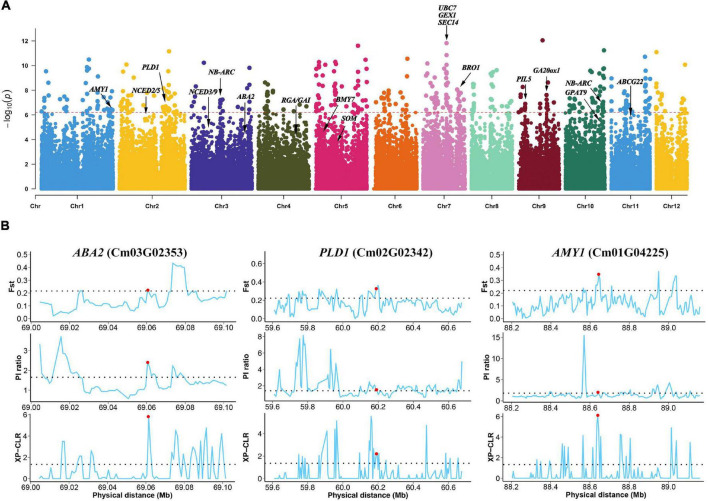
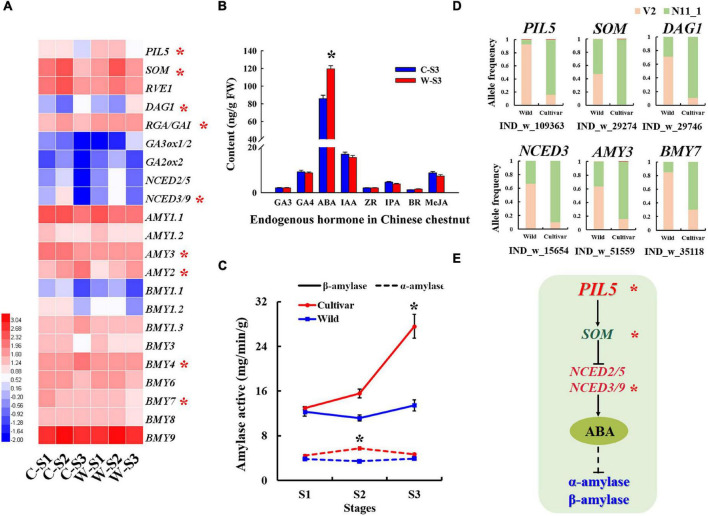
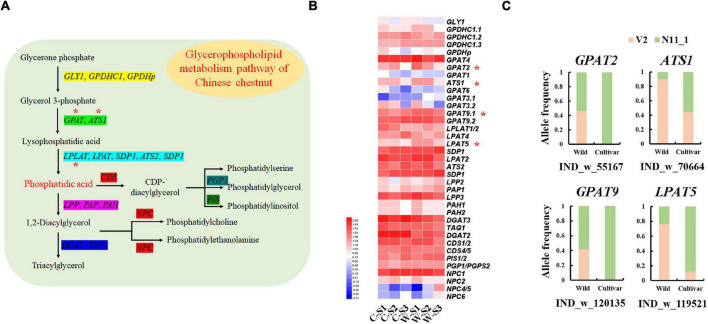
Chinese chestnut (), a species with recalcitrant seeds, is an important source of nuts and forest ecosystem services. The germination rate of recalcitrant seeds is low in natural habitats and decreases under conditions of desiccation and low temperature. The germination rate of cultivated Chinese chestnut seeds is significantly higher than that of wild seeds. To explore the reasons for the higher germination rate of cultivated seeds in Chinese chestnut, 113,524 structural variants (SVs) between the wild and cultivated Chinese chestnut genomes were detected through genome comparison. Genotyping these SVs in 60 Chinese chestnut accessions identified allele frequency changes during Chinese chestnut domestication, and some SVs are overlapping genes for controlling seed germination. Transcriptome analysis revealed downregulation of the abscisic acid synthesis genes and upregulation of the beta-amylase synthesis genes in strongly selected genes of cultivated seeds. On the other hand, hormone and enzyme activity assays indicated a decrease in endogenous ABA level and an increase in beta-amylase activity in cultivated seeds. These results shed light on the higher germination rate of cultivated seeds. Moreover, phosphatidic acid synthesis genes are highly expressed in seed germination stages of wild Chinese chestnut and may play a role in recalcitrant seed germination. These findings provide new insight into the regulation of wild seed germination and promote natural regeneration and succession in forest ecosystems.
板栗()是一种种子顽拗型物种,是坚果的重要来源和森林生态系统服务的提供者。在自然生境中,顽拗型种子的发芽率较低,在干燥和低温条件下会降低。栽培板栗种子的发芽率明显高于野生种子。为了探究板栗栽培种子发芽率较高的原因,通过基因组比较检测了野生和栽培板栗基因组之间的113,524个结构变异(SVs)。对60份板栗种质的这些SVs进行基因分型,确定了板栗驯化过程中的等位基因频率变化,并且一些SVs是控制种子发芽的重叠基因。转录组分析显示,在栽培种子的强选择基因中,脱落酸合成基因下调,β-淀粉酶合成基因上调。另一方面,激素和酶活性测定表明,栽培种子中内源脱落酸水平降低,β-淀粉酶活性增加。这些结果揭示了栽培种子发芽率较高的原因。此外,磷脂酸合成基因在野生板栗种子萌发阶段高表达,可能在顽拗型种子萌发中起作用。这些发现为野生种子萌发调控提供了新的见解,并促进了森林生态系统中的自然更新和演替