Tseng Peng-Wei, Wu Guan-Chung, Kuo Wei-Lun, Tseng Yung-Che, Chang Ching-Fong
Doctoral Degree Program in Marine Biotechnology, National Taiwan Ocean University, Keelung, Taiwan.
Doctoral Degree Program in Marine Biotechnology, Academia Sinica, Taipei, Taiwan.
Front Genet. 2022 Mar 23;13:816955. doi: 10.3389/fgene.2022.816955. eCollection 2022.
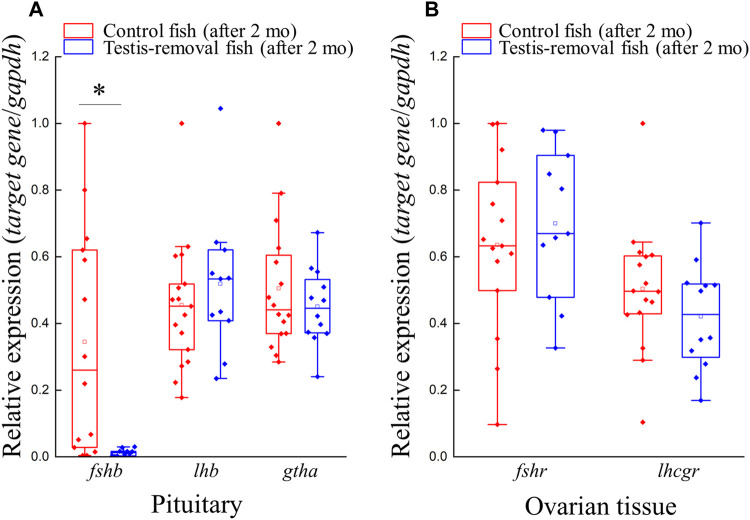
Unlike gonochoristic fishes, sex is fixed after gonadal differentiation (primary sex determination), and sex can be altered in adults (secondary sex determination) of hermaphroditic fish species. The secondary sex determination of hermaphroditic fish has focused on the differences between testicular tissue and ovarian tissue during the sex change process. However, comprehensive studies analyzing ovarian tissue or testicular tissue independently have not been performed. Hermaphroditic black porgy shows a digonic gonad (ovarian tissue with testicular tissue separated by connective tissue). Protandrous black porgy has stable maleness during the first two reproductive cycles (<2 years old), and approximately 50% enter femaleness (natural sex change) during the third reproductive cycle. Precocious femaleness is rarely observed in the estradiol-17β (E)-induced female phase (oocytes maintained at the primary oocyte stage), and a reversible female-to-male sex change is found after E is withdrawn in <2-year-old fish. However, precocious femaleness (oocytes entering the vitellogenic oocyte stage) is observed in testis-removed fish in <2-year-old fish. We used this characteristic to study secondary sex determination (femaleness) in ovarian tissue transcriptomic analysis. Cell proliferation analysis showed that BrdU (5-bromo-2'-deoxyuridine)-incorporated germline cells were significantly increased in the testis-removed fish (female) compared to the control (sham) fish (male) during the nonspawning season (2 months after surgery). qPCR analysis showed that there were no differences in pituitary-releasing hormones ( and ) in pituitary and ovarian steroidogenesis-related factors (, , , and ) or female-related genes (, , , , and ) in ovarian tissues between intact and testis-removed fish (2 months after surgery). Low expression of pituitary and ovarian was found after 2 months of surgery. However, we did find small numbers of genes (289 genes) showing sexual fate dimorphic expression in both groups by transcriptomic analysis (1 month after surgery). The expression profiles of these differentially expressed genes were further examined by qPCR. Our present work identified several candidate genes in ovarian tissue that may be involved in the early period of secondary sex determination (femaleness) in black porgy. The data confirmed our previous suggestion that testicular tissue plays an important role in secondary sex determination in protandrous black porgy.
与雌雄异体的鱼类不同,雌雄同体鱼类在性腺分化后性别就已确定(初级性别决定),而成体的性别仍可改变(次级性别决定)。雌雄同体鱼类的次级性别决定主要聚焦于性别转换过程中睾丸组织和卵巢组织之间的差异。然而,尚未有独立分析卵巢组织或睾丸组织的全面研究。雌雄同体的黑鲷具有两性性腺(卵巢组织与睾丸组织由结缔组织分隔)。雄性先熟的黑鲷在前两个繁殖周期(<2岁)具有稳定的雄性特征,大约50%在第三个繁殖周期进入雌性阶段(自然性别转换)。在雌二醇-17β(E)诱导的雌性阶段(卵母细胞维持在初级卵母细胞阶段)很少观察到早熟雌性,在<2岁的鱼中撤去E后会出现可逆的雌向雄性别转换。然而,在<2岁的去睾丸鱼中观察到早熟雌性(卵母细胞进入卵黄生成卵母细胞阶段)。我们利用这一特性通过转录组分析研究卵巢组织中的次级性别决定(雌性)。细胞增殖分析表明,在非产卵季节(手术后2个月),与对照(假手术)鱼(雄性)相比脱睾鱼(雌性)中掺入5-溴-2'-脱氧尿苷(BrdU)的生殖细胞显著增加。qPCR分析表明,完整鱼和脱睾鱼(手术后2个月)垂体中的垂体释放激素(和)、卵巢类固醇生成相关因子(、、、和)或卵巢组织中的雌性相关基因(、、、、和)没有差异。手术后2个月发现垂体和卵巢的表达较低。然而,通过转录组分析(手术后1个月)我们确实发现两组中有少量基因(289个基因)表现出性命运双态表达。通过qPCR进一步检测了这些差异表达基因的表达谱。我们目前的工作在卵巢组织中鉴定出了几个可能参与黑鲷次级性别决定(雌性)早期阶段的候选基因。数据证实了我们之前的推测,即睾丸组织在雄性先熟黑鲷的次级性别决定中起重要作用。