Hu Jian, Chen Yajun, Gao Liang, Ge Chengguo, Xie Xiaodu, Lei Pan, Zhang Yuanfeng, Liang Peihe
Department of Urology, The Second Affiliated Hospital of Chongqing Medical University, Chongqing, China.
Department of Hepatobiliary Surgery, The Second Affiliated Hospital of Chongqing Medical University, Chongqing, China.
Front Genet. 2022 Mar 23;13:851384. doi: 10.3389/fgene.2022.851384. eCollection 2022.
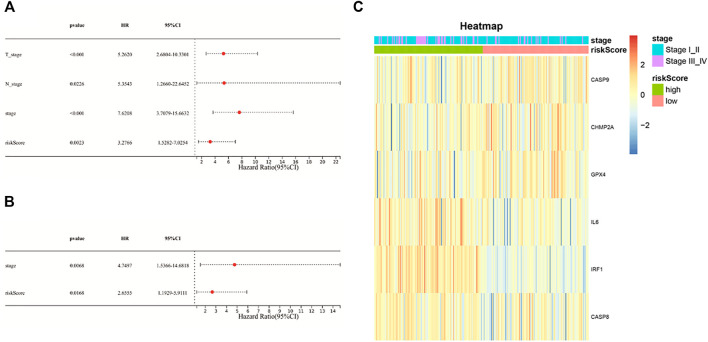
Pyroptosis is defined as an inflammatory form of programmed cell death. Increasing studies have demonstrated that pyroptosis is closely related to tumor development and antitumor process. However, the role of pyroptosis in kidney renal papillary cell carcinoma (KIRP) remains obscure. In this study, we analyzed the expression of 52 pyroptosis-related genes (PRGs) in KIRP, of which 20 differentially expressed PRGs were identified between tumor and normal tissues. Consensus clustering analysis based on these PRGs was used to divided patients into two clusters, from which a significant difference in survival was found ( = 0.0041). The prognostic risk model based on six PRGs (, , , , , and ) was built using univariate Cox regression and LASSO-Cox regression analysis, with good performance in predicting one-, three-, and five-year overall survival. Kaplan-Meier survival analysis showed that the high-risk group had a poor survival outcome ( < 0.001) and risk score was an independent prognostic factor (HR: 2.655, 95% CI 1.192-5.911, = 0.016). Immune profiling revealed differences in immune cell infiltration between the two groups, and the infiltration of M2 macrophages was significantly upregulated in the tumor immune microenvironment, implying that tumor immunity participated in the KIRP progression. Finally, we identified two hub genes in tumor tissues ( and ), which were validated In conclusion, we conducted a comprehensive analysis of PRGs in KIRP and tried to provide a pyroptosis-related signature for predicting the prognosis.
细胞焦亡被定义为一种程序性细胞死亡的炎症形式。越来越多的研究表明,细胞焦亡与肿瘤发展和抗肿瘤过程密切相关。然而,细胞焦亡在肾肾乳头状细胞癌(KIRP)中的作用仍不清楚。在本研究中,我们分析了KIRP中52个细胞焦亡相关基因(PRGs)的表达,其中在肿瘤组织和正常组织之间鉴定出20个差异表达的PRGs。基于这些PRGs的一致性聚类分析用于将患者分为两个簇,从中发现生存率存在显著差异(P = 0.0041)。使用单变量Cox回归和LASSO-Cox回归分析构建了基于6个PRGs(……此处原文缺失基因名称)的预后风险模型,在预测1年、3年和5年总生存率方面表现良好。Kaplan-Meier生存分析表明,高危组的生存结果较差(P < 0.001),风险评分是一个独立的预后因素(HR:2.655,95%CI 1.192 - 5.911,P = 0.016)。免疫图谱揭示了两组之间免疫细胞浸润的差异,并且M2巨噬细胞的浸润在肿瘤免疫微环境中显著上调,这意味着肿瘤免疫参与了KIRP的进展。最后,我们在肿瘤组织中鉴定出两个枢纽基因(……此处原文缺失基因名称),并进行了验证。总之,我们对KIRP中的PRGs进行了全面分析,并试图提供一个与细胞焦亡相关的特征来预测预后。