Yang Guang, Lu Song-Bo, Li Chong, Chen Feng, Ni Jen-Shyang, Zha Menglei, Li Yaxi, Gao Ji, Kang Tianyi, Liu Chao, Li Kai
Shenzhen Key Laboratory of Smart Healthcare Engineering, Department of Biomedical Engineering, Southern University of Science and Technology (SUSTech) Shenzhen 518055 China
Chem Sci. 2021 Oct 20;12(44):14773-14780. doi: 10.1039/d1sc04124j. eCollection 2021 Nov 17.
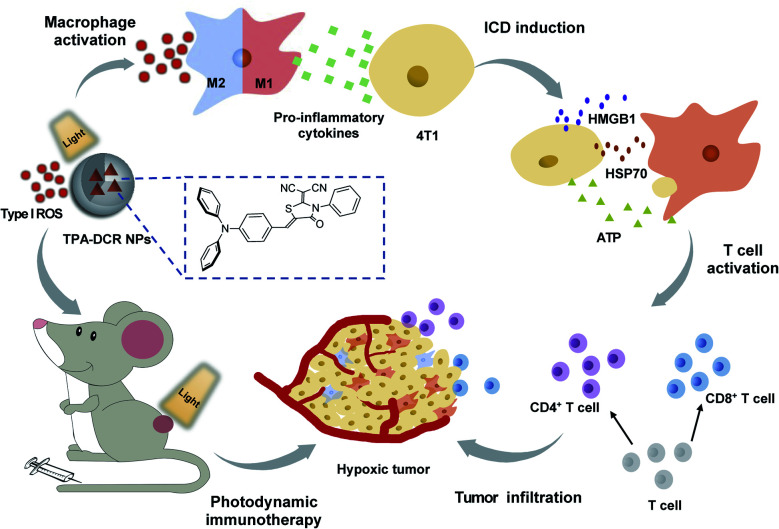
Photodynamic immunotherapy has emerged as a promising strategy to treat cancer. However, the hypoxic nature of most solid tumors and notoriously immunosuppressive tumor microenvironment could greatly compromise the efficacy of photodynamic immunotherapy. To address this challenge, we rationally synthesized a type I photosensitizer of TPA-DCR nanoparticles (NPs) with aggregation-enhanced reactive oxygen species generation an oxygen-independent pathway. We demonstrated that the free radicals produced by TPA-DCR NPs could reprogram M0 and M2 macrophages into an anti-tumor state, which is not restricted by the hypoxic conditions. The activated M1 macrophages could further induce the immunogenic cell death of cancer cells by secreting pro-inflammatory cytokines and phagocytosis. In addition, anti-tumor experiments revealed that the TPA-DCR NPs could further trigger tumor immune response by re-educating tumor-associated macrophages toward M1 phenotype and promoting T cell infiltration. Overall, this work demonstrates the design of type I organic photosensitizers and mechanistic investigation of their superior anti-tumor efficacy. The results will benefit the exploration of advanced strategies to regulate the tumor microenvironment for effective photodynamic immunotherapy against hypoxic tumors.
光动力免疫疗法已成为一种有前景的癌症治疗策略。然而,大多数实体瘤的缺氧特性以及众所周知的免疫抑制性肿瘤微环境可能会极大地损害光动力免疫疗法的疗效。为应对这一挑战,我们合理合成了一种具有聚集增强活性氧生成的I型光敏剂TPA-DCR纳米颗粒(NPs),这是一种不依赖氧气的途径。我们证明,TPA-DCR NPs产生的自由基可将M0和M2巨噬细胞重编程为抗肿瘤状态,且不受缺氧条件的限制。活化的M1巨噬细胞可通过分泌促炎细胞因子和吞噬作用进一步诱导癌细胞发生免疫原性细胞死亡。此外,抗肿瘤实验表明,TPA-DCR NPs可通过将肿瘤相关巨噬细胞重编程为M1表型并促进T细胞浸润,进一步触发肿瘤免疫反应。总体而言,这项工作展示了I型有机光敏剂的设计及其卓越抗肿瘤疗效的机制研究。这些结果将有助于探索调节肿瘤微环境的先进策略,以实现针对缺氧肿瘤的有效光动力免疫治疗。