Matsunami Masatoshi, Suzuki Tomo, Fukuda Junko, Terao Toshiki, Ukai Kohei, Sugihara Shinnosuke, Toishi Takumi, Nagaoka Kanako, Nakata Mayumi, Ohara Mamiko, Yashima Jun, Kuji Hiroshi, Matsue Kosei
Department of Nephrology, Kameda Medical Center, 929 Higashi-cho, Kamogawa, Chiba 296-8602 Japan.
Renal Transplant Center, Kameda Medical Center, Chiba, Japan.
Ren Replace Ther. 2022;8(1):13. doi: 10.1186/s41100-022-00402-x. Epub 2022 Apr 5.
Currently, it is unclear whether the progression of chronic kidney disease (CKD) could be an independent predictor of antibody response after administration of a COVID-19 vaccine. This study aimed to investigate the immune response to COVID-19 vaccination in patients with CKD stage G4 to G5 without renal replacement therapy and G5D using the recommended dose and schedule.
This retrospective single-center cohort study evaluated immunogenicity regarding antibody response after COVID-19 vaccination in our hospital for late-stage CKD patients aged ≥ 60 years. We evaluated antibody responses in 48 patients with CKD G4, 35 patients with CKD G5, and 70 patients undergoing hemodialysis (HD; CKD G5D).
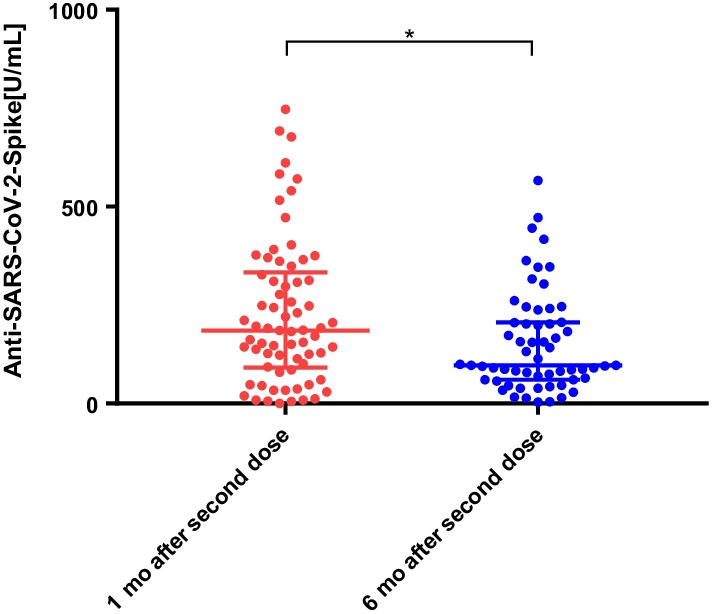
After the second vaccination, anti-SARS-CoV-2-S (Spike) IgG levels were found to be positive (> 0.8 U/mL) in all CKD G4 and G5 patients (100%), and 69 of 70 HD patients (98.5%). The median (interquartile range [IQR] S-IgG level (Ab titers) was 358 [130.2-639.2], 218 [117-377], and 185.5 [95.1-323.5] U/mL in the CKD G4, G5, and HD groups, respectively. The median S-IgG levels were significantly lower in the HD group than in the CKD G4 group ( < 0.01). However, there was no significant difference in the antibody titers between the CKD G4 and G5 groups. To further analyze the decline in S-IgG levels after 6 months, we additionally assessed and compared antibody titers at 1 month and 6 months after the second vaccination in the HD group. Compared with the median S-IgG levels of 185.5 [95.1-323.5] U/mL 1 month after the second dose, the median S-IgG level 6 months thereafter was significantly decreased at 97.4 [62.5-205.5] U/mL ( < 0.05).
We highlight two major factors of variability in the vaccine response. First, in elderly patients with late-stage CKD, antibody titers tended to be lower in the G5D group than in the G4 and G5 groups despite the shorter time since vaccination; therefore, CKD stage progression might cause a decline in antibody titers. Second, waning immune responses were observed 6 months after second dose administration in HD patients advocating a potential need for a third booster dose vaccine after 6 months.
目前,尚不清楚慢性肾脏病(CKD)的进展是否可能是接种2019冠状病毒病(COVID-19)疫苗后抗体反应的独立预测因素。本研究旨在调查未接受肾脏替代治疗的G4至G5期CKD患者和G5D期患者按照推荐剂量和程序接种COVID-19疫苗后的免疫反应。
这项回顾性单中心队列研究评估了我院≥60岁晚期CKD患者接种COVID-19疫苗后抗体反应的免疫原性。我们评估了48例G4期CKD患者、35例G5期CKD患者和70例接受血液透析(HD;G5D期CKD)患者的抗体反应。
第二次接种后,所有G4和G5期CKD患者(100%)以及70例HD患者中的69例(98.5%)的抗严重急性呼吸综合征冠状病毒2刺突蛋白(SARS-CoV-2-S)IgG水平呈阳性(>0.8 U/mL)。G4期CKD组、G5期CKD组和HD组的S-IgG水平(抗体滴度)中位数(四分位间距[IQR])分别为358[130.2-639.2]、218[117-377]和185.5[95.1-323.5]U/mL。HD组的S-IgG水平中位数显著低于G4期CKD组(<0.01)。然而,G4和G5期CKD组之间的抗体滴度没有显著差异。为了进一步分析6个月后S-IgG水平的下降情况,我们额外评估并比较了HD组第二次接种后1个月和6个月时的抗体滴度。与第二次接种后1个月时S-IgG水平中位数185.5[95.1-323.5]U/mL相比,6个月后的S-IgG水平中位数显著下降至97.4[62.5-205.5]U/mL(<0.05)。
我们强调了疫苗反应变异性的两个主要因素。第一,在晚期CKD老年患者中,尽管接种疫苗后的时间较短,但G5D组的抗体滴度往往低于G4和G5期组;因此,CKD分期进展可能导致抗体滴度下降。第二,在HD患者中,第二次接种后6个月观察到免疫反应减弱,这表明可能需要在6个月后接种第三剂加强疫苗。