Quiñones Ana R, Chen Siting, Nagel Corey L, Botoseneanu Anda, Allore Heather G, Newsom Jason T, Thielke Stephen, Kaye Jeffrey
Department of Family Medicine, Oregon Health & Science University, USA.
OHSU-PSU School of Public Health, Portland, OR, USA.
SSM Popul Health. 2022 Apr 4;18:101084. doi: 10.1016/j.ssmph.2022.101084. eCollection 2022 Jun.
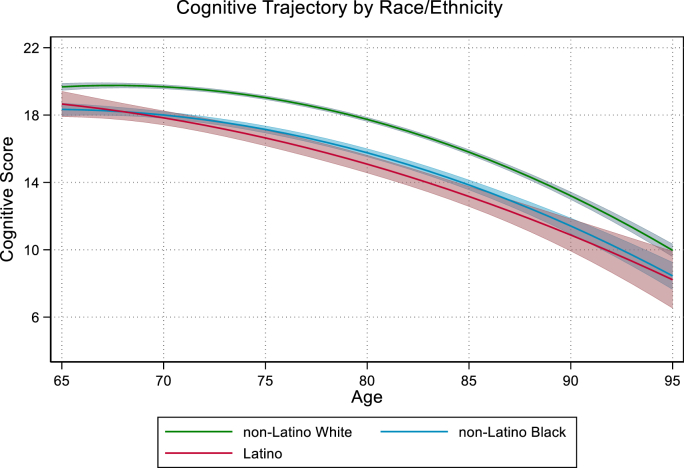
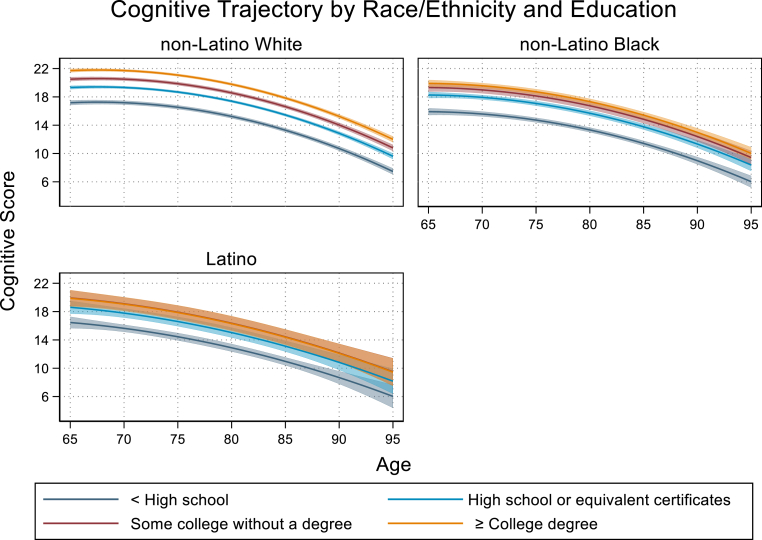
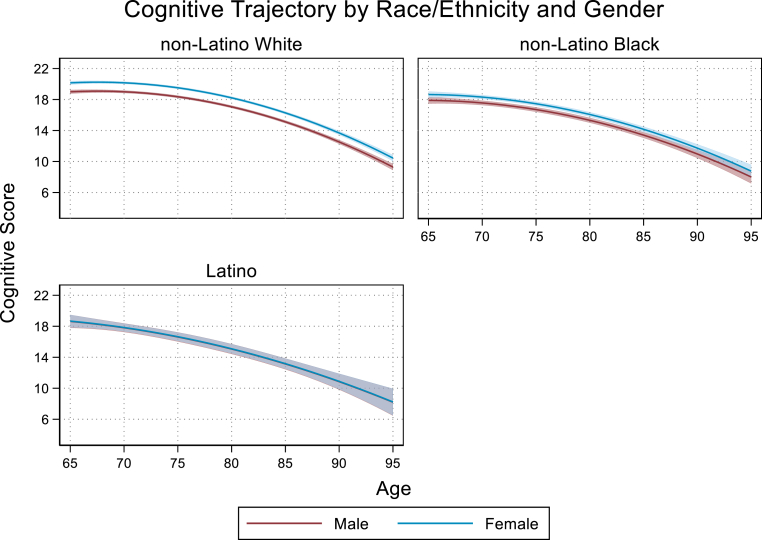
Evaluating multimorbidity combinations, racial/ethnic background, educational attainment, and sex associations with age-related cognitive changes is critical to clarifying the health, sociodemographic, and socioeconomic mechanisms associated with cognitive function in later life. Data from the 2011-2018 National Health and Aging Trends Study for respondents aged 65 years and older (N = 10,548, mean age = 77.5) were analyzed using linear mixed effect models. Racial/ethnic differences (mutually-exclusive groups: non-Latino White, non-Latino Black, and Latino) in cognitive trajectories and significant interactions with sex and education (<high school, high school, some college, and ≥ college degree) were evaluated. Models included sex, education, ever covered by Medicaid, coupled status, waist-height ratio, study cohort, and chronic disease category (no diseases; one disease; multimorbidity; multimorbidity; multimorbidity; and multimorbidity). In covariate-adjusted models, Black (b = -1.31, 95% CI: 1.74,-0.89) and Latino (b = -0.83, 95% CI: 1.58,-0.07) respondents had lower cognitive scores at age 65 and steeper declines with age (b = -0.08, 95% CI: -0.15,-0.01; b = -0.20, 95% CI: 0.34,-0.05, respectively) compared with White respondents. Cognitive scores were lower among respondents with (b = -0.28, 95% CI: 0.54,-0.01) and (b = -0.56, 95% CI: 0.86,-0.27) multimorbidity compared with respondents with none of the chronic diseases of interest. In interaction models, protective associations by female sex and higher education were not observed among minority racial/ethnic groups. It is important to develop interventions to postpone cognitive decline among older Black and Latino adults.
评估多种疾病组合、种族/族裔背景、教育程度以及性别与年龄相关认知变化之间的关联,对于阐明与晚年认知功能相关的健康、社会人口统计学和社会经济机制至关重要。使用线性混合效应模型分析了2011 - 2018年国家健康与老龄化趋势研究中65岁及以上受访者的数据(N = 10,548,平均年龄 = 77.5)。评估了认知轨迹中的种族/族裔差异(相互排斥的群体:非拉丁裔白人、非拉丁裔黑人、拉丁裔)以及与性别和教育程度(高中以下、高中、大专、本科及以上)的显著交互作用。模型包括性别、教育程度、是否曾享受医疗补助、婚姻状况、腰高比、研究队列以及慢性病类别(无疾病;一种疾病;多种疾病;多种疾病;多种疾病;多种疾病)。在协变量调整模型中,与白人受访者相比,黑人(b = -1.31,95% CI:1.74,-0.89)和拉丁裔受访者(b = -0.83,95% CI:1.58,-0.07)在65岁时认知得分较低,且随年龄增长下降幅度更大(分别为b = -0.08,95% CI:-0.15,-0.01;b = -0.20,95% CI:0.34,-0.05)。与未患所关注慢性病的受访者相比,患有多种疾病(b = -0.28,95% CI:0.54,-0.01)和多种疾病(b = -0.56,95% CI:0.86,-0.27)的受访者认知得分较低。在交互作用模型中,未在少数种族/族裔群体中观察到女性性别和高等教育的保护作用。制定干预措施以延缓老年黑人和拉丁裔成年人的认知衰退非常重要。