Center of Multiple Sclerosis and Related Disorders, Peking Union Medical College Hospital, Beijing, People's Republic of China.
Department of Neurology, Peking Union Medical College Hospital, Peking Union Medical College & Chinese Academy of Medical Sciences, Beijing, 100730, People's Republic of China.
J Neurol. 2022 Sep;269(9):4808-4816. doi: 10.1007/s00415-022-11118-7. Epub 2022 Apr 11.
To explore efficacy, risk factors, safety, and persistence of teriflunomide in relapsing-remitting multiple sclerosis (RRMS) cohort.
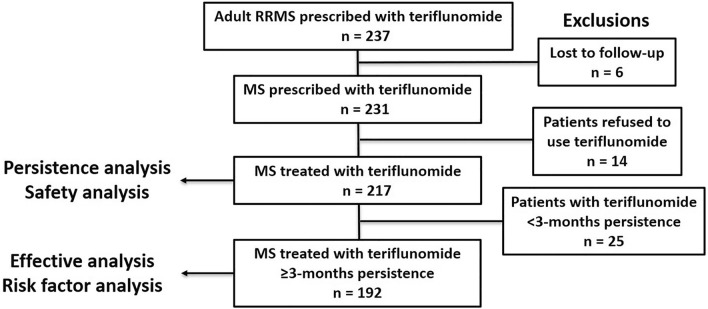
This prospective, observational cohort study included 217 consecutive teriflunomide treated RRMS patients, 192 of which with at least 3-month persistence on teriflunomide were included in effectiveness and risk factor analyses. Multivariate Cox proportional regression analysis was performed to identify factors associated with failure of no evidence of disease activity (NEDA) 3.
At baseline 82% patients were treatment naïve while 18.0% interferon-β1b treated patients had stopped treatments for more than 1 year. After treatment, 79.0% patients achieved NEDA 3 at 12-month, mean annualized relapse rate (ARR) reduced significantly (0.79 ± 0.80 vs 0.16 ± 0.70; P < 0.001), and mean expanded disability status score (EDSS) remained stable (1.40 ± 1.67 vs 1.56 ± 1.88; P > 0.05). Male sex (hazard ratio [HR] 1.856; 95% confidence interval [CI] 1.118-3.082, P < 0.05), baseline EDSS score ≥ 4 (HR 2.682; 95% CI 1.375-5.231, P < 0.01), and frequent relapses before treatment (HR 3.056; 95% CI 1.737-5.377, P < 0.01) were independent factors significantly associated with failure of NEDA 3. The most frequent adverse events (AEs) were hair thinning, alanine aminotransferase (ALT) elevation, and leukopenia, the latter two most commonly lead to teriflunomide discontinuation during the first 3 months. Persistence rates at 6, 12, and 24 months after teriflunomide initiation were 86.9%, 72.4%, and 52.8%, respectively.
Our results support efficacy and tolerability of teriflunomide for treatment-naïve RRMS patients in real-world practice. Female patients, patients with less relapses and less disability before treatment are most likely to benefit from teriflunomide treatment.
探索特立氟胺在复发缓解型多发性硬化症(RRMS)患者中的疗效、风险因素、安全性和持续性。
这是一项前瞻性、观察性队列研究,纳入了 217 例连续接受特立氟胺治疗的 RRMS 患者,其中 192 例至少有 3 个月的特立氟胺持续性治疗,纳入有效性和风险因素分析。采用多变量 Cox 比例风险回归分析识别与无疾病活动证据(NEDA)3 失败相关的因素。
基线时,82%的患者为初治患者,18.0%的干扰素-β1b 治疗患者已停药超过 1 年。治疗后,79.0%的患者在 12 个月时达到 NEDA 3,年平均复发率(ARR)显著降低(0.79±0.80 比 0.16±0.70;P<0.001),扩展残疾状况评分(EDSS)均值保持稳定(1.40±1.67 比 1.56±1.88;P>0.05)。男性(风险比 [HR] 1.856;95%置信区间 [CI] 1.118-3.082,P<0.05)、基线 EDSS 评分≥4(HR 2.682;95%CI 1.375-5.231,P<0.01)和治疗前频繁复发(HR 3.056;95%CI 1.737-5.377,P<0.01)是与 NEDA 3 失败显著相关的独立因素。最常见的不良事件(AE)是头发稀疏、丙氨酸氨基转移酶(ALT)升高和白细胞减少,后两者在治疗的前 3 个月最常导致特立氟胺停药。特立氟胺治疗开始后 6、12 和 24 个月的持续率分别为 86.9%、72.4%和 52.8%。
我们的研究结果支持特立氟胺在真实世界实践中治疗初治 RRMS 患者的有效性和耐受性。女性患者、治疗前复发次数较少和残疾程度较轻的患者最有可能从特立氟胺治疗中获益。