School of Population Health, Faculty of Medicine, University of New South Wales, Sydney, Australia.
School of Health and Society, Faculty of Arts, Social Sciences, and Humanities, University of Wollongong, Wollongong, Australia.
Soc Psychiatry Psychiatr Epidemiol. 2022 Sep;57(9):1917-1923. doi: 10.1007/s00127-022-02266-2. Epub 2022 Apr 11.
Momentum for urban densification is increasing opportunities for apartment-living, but can result in reduced green space availability that negatively influences mental health. However, in contexts where apartment-living is atypical and commonly viewed as secondary to house-ownership, it may be a stressful antecedent condition (or marker of selective processes aligned with psychological distress) wherein occupants could benefit disproportionately from green space.
Data were extracted from the Sax Institute's 45 and Up Study baseline (2006-2009, n = 267,153). The focus was on subsets of 13,196 people living in apartments and 66,453 people living in households within the cities of Sydney, Newcastle and Wollongong. Multilevel models adjusted for confounders tested associations between psychological distress (Kessler 10 scale) with percentage total green space, tree canopy and open grass within 1.6 km road network buffers.
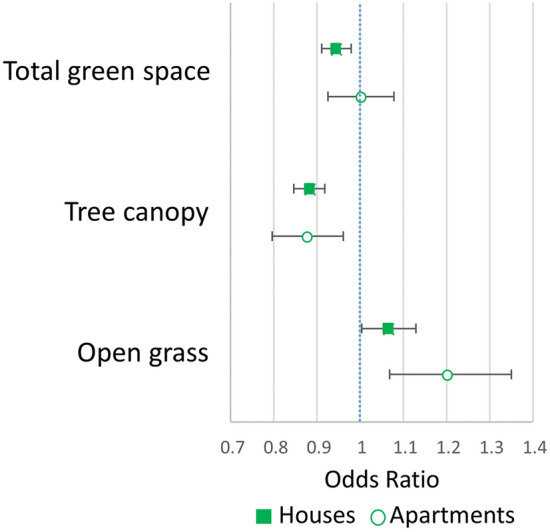
Psychological distress was higher in occupants of apartments (11.3%) compared with houses (7.9%). More green space was associated with less psychological distress for house-dwellers (OR = 0.94, 95% CI = 0.91-0.98), but there was no association for apartment-dwellers. More tree canopy was associated with lower psychological distress for house-dwellers (OR = 0.88, 95% CI = 0.85-0.92) and apartment-dwellers (OR = 0.87, 95% CI = 0.79-0.96). Open grass was associated with more psychological distress among house-dwellers (OR = 1.06, 95% CI = 1.00-1.13) and also for apartment-dwellers (OR = 1.20, 95% CI = 1.07-1.35).
Overall, investments in tree canopy may benefit the mental health of house and apartment residents relatively equally. Urban tree canopy in densely populated areas where apartments are common needs to be protected. Further work is needed to understand factors constraining the prevention potential of open grass, to unlock its benefits for mental health.
城市人口密度的增加为公寓生活提供了更多机会,但可能导致绿色空间的减少,从而对心理健康产生负面影响。然而,在公寓生活不常见且通常被视为拥有房屋的次要选择的背景下,它可能是一种有压力的先行条件(或与心理困扰相一致的选择性过程的标志),在这种条件下,居民可能会从绿色空间中获得不成比例的收益。
数据来自萨克研究所的 45 岁及以上研究的基线(2006-2009 年,n=267153)。研究重点是悉尼、纽卡斯尔和卧龙岗三个城市中居住在公寓和居住在家庭中的 13196 人和 66453 人的子集。多水平模型调整了混杂因素,以测试心理困扰(Kessler 10 量表)与 1.6 公里道路网络缓冲区中的总绿色空间百分比、树冠和开阔草地之间的关联。
与居住在房屋中的人(7.9%)相比,居住在公寓中的人心理困扰更高(11.3%)。对于居住在房屋中的人来说,更多的绿色空间与较少的心理困扰相关(OR=0.94,95%CI=0.91-0.98),但对于居住在公寓中的人则没有关联。更多的树冠与居住在房屋中的人(OR=0.88,95%CI=0.85-0.92)和居住在公寓中的人(OR=0.87,95%CI=0.79-0.96)的较低心理困扰相关。开阔草地与居住在房屋中的人(OR=1.06,95%CI=1.00-1.13)和居住在公寓中的人(OR=1.20,95%CI=1.07-1.35)的心理困扰增加相关。
总的来说,树冠的投资可能会相对平等地使房屋和公寓居民的心理健康受益。在公寓普遍存在的人口密集地区,需要保护城市树冠。需要进一步研究来了解限制开阔草地预防潜力的因素,以释放其对心理健康的益处。