Core Jason Q, Pistilli Maxwell, Hua Peiying, Daniel Ebenezer, Grunwald Juan E, Toth Cynthia A, Jaffe Glenn J, Martin Daniel F, Maguire Maureen G, Ying Gui-Shuang
Sidney Kimmel Medical College, Thomas Jefferson University, Philadelphia, Pennsylvania.
Department of Ophthalmology, Perelman School of Medicine, University of Pennsylvania, Philadelphia, Pennsylvania.
Ophthalmol Retina. 2022 Sep;6(9):771-785. doi: 10.1016/j.oret.2022.03.024. Epub 2022 Apr 9.
To describe predominantly persistent intraretinal fluid (PP-IRF) and its association with visual acuity (VA) and retinal anatomic findings at long-term follow-up in eyes treated with pro re nata (PRN) ranibizumab or bevacizumab for neovascular age-related macular degeneration.
Cohort within a randomized clinical trial.
Participants in the Comparison of Age-related Macular Degeneration Treatments Trials (CATT) assigned to PRN treatment.
The presence of intraretinal fluid (IRF) on OCT scans was assessed at baseline and monthly follow-up visits by Duke OCT Reading Center. Predominantly persistent intraretinal fluid through week 12, year 1, and year 2 was defined as the presence of IRF at the baseline and in ≥ 80% of follow-up visits. Among eyes with baseline IRF, the mean VA scores (letters) and changes from the baseline were compared between eyes with and those without PP-IRF. Adjusted mean VA scores and changes from the baseline were also calculated using the linear regression analysis to account for baseline patient features identified as predictors of VA in previous CATT studies. Furthermore, outcomes were adjusted for concomitant predominantly persistent subretinal fluid.
Predominantly persistent intraretinal fluid through week 12, year 1, and year 2; VA score and VA change; and scar development at year 2.
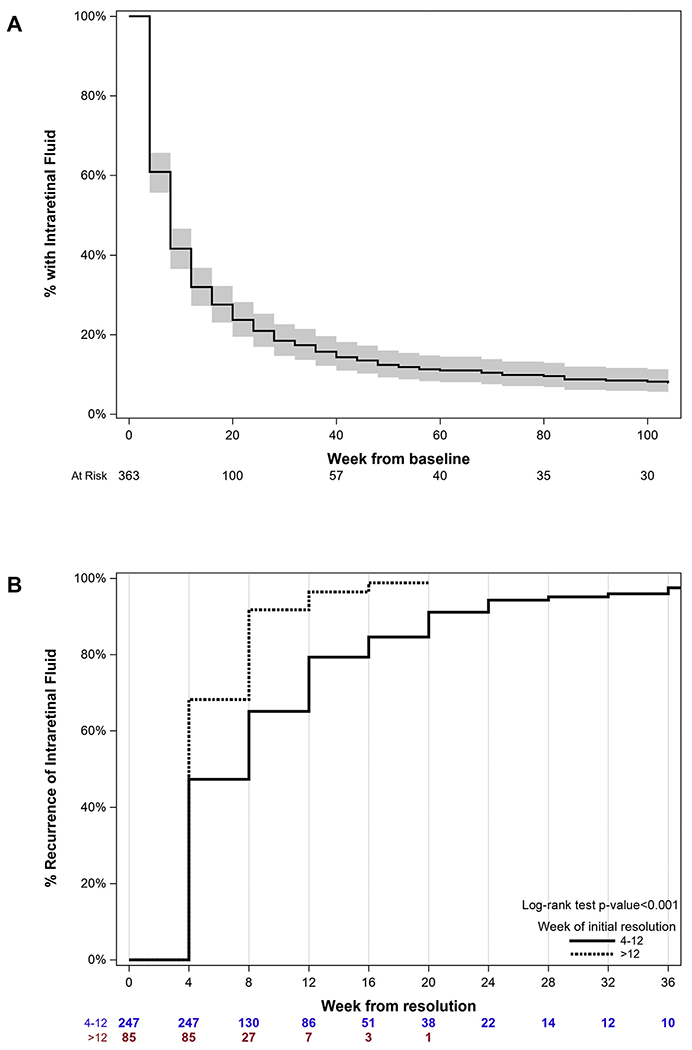
Among 363 eyes with baseline IRF, 108 (29.8%) had PP-IRF through year 1 and 95 (26.1%) had PP-IRF through year 2. When eyes with PP-IRF through year 1 were compared with those without PP-IRF, the mean 1-year VA score was 62.4 and 68.5, respectively (P = 0.002), and was 65.0 and 67.4, respectively (P = 0.13), after adjustment. Predominantly persistent intraretinal fluid through year 2 was associated with worse adjusted 1-year mean VA scores (64.8 vs. 69.2; P = 0.006) and change (4.3 vs. 8.1; P = 0.01) as well as worse adjusted 2-year mean VA scores (63.0 vs. 68.3; P = 0.004) and changes (2.4 vs. 7.1; P = 0.009). Predominantly persistent intraretinal fluid through year 2 was associated with a higher 2-year risk of scar development (adjusted hazard ratio = 1.49; P = 0.03).
Approximately one quarter of eyes had PP-IRF through year 2. Predominantly persistent intraretinal fluid through year 1 was associated with worse long-term VA, but the relationship disappeared after adjustment for baseline predictors of VA. Predominantly persistent intraretinal fluid through year 2 was independently associated with worse long-term VA and scar development.
描述主要持续性视网膜内液(PP - IRF)及其与接受按需(PRN)雷珠单抗或贝伐单抗治疗的新生血管性年龄相关性黄斑变性患者长期随访时的视力(VA)和视网膜解剖学结果的关联。
随机临床试验中的队列研究。
年龄相关性黄斑变性治疗试验比较(CATT)中分配接受PRN治疗的参与者。
杜克大学光学相干断层扫描(OCT)阅读中心在基线和每月随访时评估OCT扫描上视网膜内液(IRF)的存在情况。将第12周、第1年和第2年主要持续性视网膜内液定义为基线时以及≥80%的随访时存在IRF。在有基线IRF的眼中,比较有和没有PP - IRF的眼之间的平均VA评分(字母)以及相对于基线的变化。还使用线性回归分析计算调整后的平均VA评分和相对于基线的变化,以考虑在先前CATT研究中确定为VA预测因素的基线患者特征。此外,对伴随的主要持续性视网膜下液进行了结果调整。
第12周、第1年和第2年主要持续性视网膜内液;VA评分和VA变化;以及第2年的瘢痕形成情况。
在363只基线时有IRF的眼中,108只(29.8%)在第1年有PP - IRF,95只(26.1%)在第2年有PP - IRF。将第1年有PP - IRF的眼与没有PP - IRF的眼进行比较时,1年时的平均VA评分分别为62.4和68.5(P = 0.002),调整后分别为65.0和67.4(P = 0.13)。第2年主要持续性视网膜内液与调整后的较差1年平均VA评分(64.8对69.2;P = 0.006)和变化(4.3对8.1;P = 0.01)以及较差的调整后2年平均VA评分(63.0对68.3;P = 0.004)和变化(2.4对7.1;P = 0.009)相关。第2年主要持续性视网膜内液与较高的2年瘢痕形成风险相关(调整后的风险比 = 1.49;P = 0.03)。
约四分之一的眼在第2年有PP - IRF。第1年主要持续性视网膜内液与较差的长期VA相关,但在调整VA的基线预测因素后这种关系消失。第二年主要持续性视网膜内液与较差的长期VA和瘢痕形成独立相关。