Cho In Rae, Yi Sang-Wook, Choi Ja Sung, Yi Jee-Jeon
Department of Internal Medicine and Liver Research Institute, Seoul National University College of Medicine, 101 Daehak-ro, Jongno-gu, Seoul 03080, Korea.
Department of Preventive Medicine and Public Health, College of Medicine, Catholic Kwandong University, Bumil-ro 579 beon-gil 24, Gangneung 25601, Korea.
Cancers (Basel). 2022 Mar 28;14(7):1709. doi: 10.3390/cancers14071709.
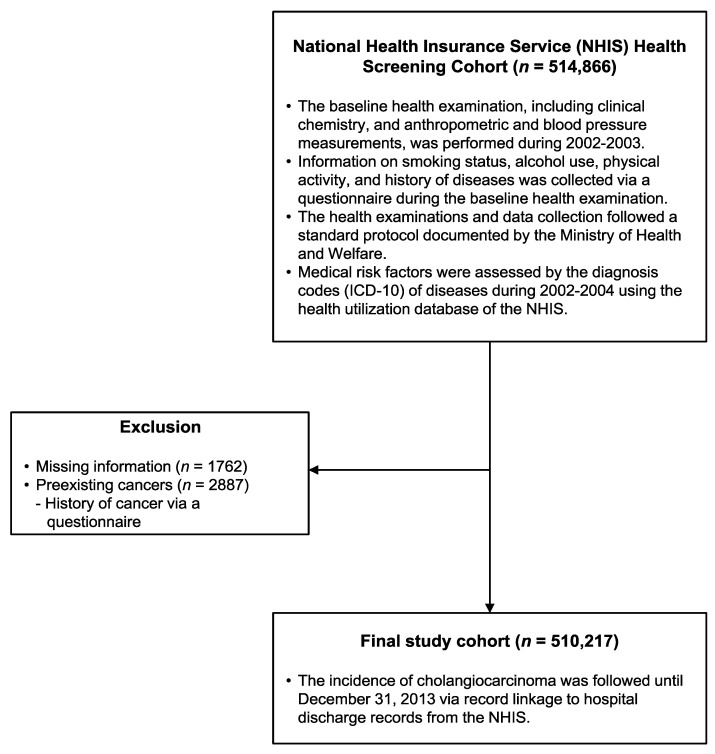
Cholangiocarcinoma (CCA), especially intrahepatic CCA, is known to share several risk factors with hepatocellular carcinoma (HCC) and liver cirrhosis has been proposed as a common pathogenic factor. We aimed to identify the risk factors of CCA and to examine differences in risk factors between CCA and HCC. We followed 510,217 Korean adults who underwent health checkups during 2002−2003 until 2013 via linkage to national hospital discharge records. Hazard ratios (HRs) were calculated after adjustment for confounders. During the mean follow-up of 10.5 years, 1388 and 2920 individuals were diagnosed with CCA and HCC, respectively. Choledocholithiasis (HR = 13.7; 95% confidence interval (CI) = 7.58−24.88) was the strongest risk factor for CCA, followed by cholelithiasis (HR = 2.94) and hepatitis B virus (HBV) infection (HR = 2.71). Two of the strongest risk factors for HCC—liver cirrhosis (HR = 1.29; 95% CI = 0.48−3.45) and hepatitis C virus infection (HR = 1.89; 95% CI = 0.49−7.63)—were not significantly associated with the risk of CCA. HBV infection and diabetes increased the risk of both HCC and CCA, but the HRs were lower for CCA than for HCC (Pheterogeneity < 0.001 for HBV; Pheterogeneity = 0.001 for diabetes). The magnitudes of the effects of age, sex, obesity, alcohol consumption, and smoking on the development of both cancers were different (Pheterogeneity < 0.05 for each variable). In conclusion, choledocholithiasis, cholelithiasis, HBV, older age, male sex, diabetes, smoking, alcohol drinking, and obesity were found to be potential risk factors of CCA. Liver cirrhosis did not increase the risk of CCA. The magnitudes of the potential effects of common risk factors were generally different between CCA and HCC.
胆管癌(CCA),尤其是肝内胆管癌,已知与肝细胞癌(HCC)有若干共同危险因素,并且肝硬化已被提出是一个共同的致病因素。我们旨在确定CCA的危险因素,并检查CCA与HCC之间危险因素的差异。我们通过与国家医院出院记录相链接,对2002年至2003年期间接受健康检查的510217名韩国成年人进行随访,直至2013年。在对混杂因素进行调整后计算风险比(HRs)。在平均10.5年的随访期间,分别有1388人和2920人被诊断为CCA和HCC。胆管结石(HR = 13.7;95%置信区间(CI)= 7.58 - 24.88)是CCA最强的危险因素,其次是胆结石(HR = 2.94)和乙型肝炎病毒(HBV)感染(HR = 2.71)。HCC的两个最强危险因素——肝硬化(HR = 1.29;95% CI = 0.48 - 3.45)和丙型肝炎病毒感染(HR = 1.89;95% CI = 0.49 - 7.63)——与CCA的风险无显著关联。HBV感染和糖尿病会增加HCC和CCA的风险,但CCA的HRs低于HCC(HBV的异质性P < 0.001;糖尿病的异质性P = 0.001)。年龄、性别、肥胖、饮酒和吸烟对两种癌症发生的影响程度不同(每个变量的异质性P < 0.05)。总之,胆管结石、胆结石、HBV、高龄、男性、糖尿病、吸烟、饮酒和肥胖被发现是CCA的潜在危险因素。肝硬化并未增加CCA的风险。CCA和HCC之间常见危险因素的潜在影响程度总体上有所不同。