Staub Alexandre, Scherer Muriel, Zehnder Pascal, Spierings Adriaan Bernardus, Wegener Konrad
Institute of Machine Tools and Manufacturing, ETH Zurich, 8092 Zurich, Switzerland.
Inspire, Innovation Center for Additive Manufacturing Switzerland (Icams), 9014 St Gallen, Switzerland.
Materials (Basel). 2022 Apr 5;15(7):2676. doi: 10.3390/ma15072676.
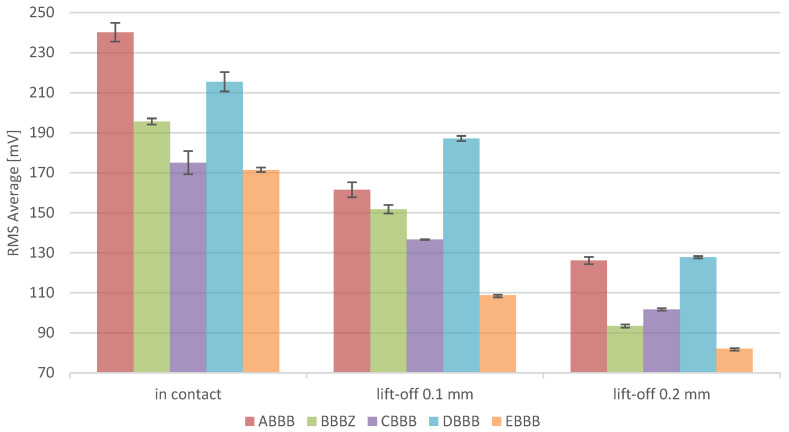
In recent years, the advancement of technology brought the laser powder bed fusion process to its industrialisation step. Despite all the advancements in process repeatability and general quality control, many challenges remain unsolved due to the intrinsic difficulties of the process, notably the residual stresses issue. This work aimed to assess the usability of Barkhausen noise analysis (BNA) for the residual stress in situ monitoring of laser powder bed fusion on Maraging steel 300 (18Ni-300/1.2709). After measuring the evolution of grain size distribution over process parameter changes, two series of experiments were designed. First, a setup with an external force allows to validate the working principle of BNA on the chosen material processed using LPBF. The second experiment uses on-plates samples with different residual stress states. The results show a good stability in microstructure, a prerequisite for BNA. In addition, the external load setup acknowledges that signal variation correlates with the induced stress state. Finally, the on-plate measurement shows a similar signal variation to what has been observed in the literature for residual stress variation. It is shown that BNA is a suitable method for qualitative residual stresses variation monitoring developed during the LPBF process and underlines that BNA is a promising candidate as an in situ measurement method.
近年来,技术的进步使激光粉末床熔融工艺步入了工业化阶段。尽管在工艺可重复性和一般质量控制方面取得了诸多进展,但由于该工艺本身的困难,许多挑战仍未得到解决,尤其是残余应力问题。这项工作旨在评估巴克豪森噪声分析(BNA)用于原位监测马氏体时效钢300(18Ni-300/1.2709)激光粉末床熔融过程中残余应力的适用性。在测量了工艺参数变化时晶粒尺寸分布的演变后,设计了两组实验。首先,通过一个带有外力的装置来验证BNA在使用激光粉末床熔融工艺加工的所选材料上的工作原理。第二个实验使用具有不同残余应力状态的平板试样。结果表明,微观结构具有良好的稳定性,这是BNA的一个前提条件。此外,外部加载装置证实信号变化与所施加的应力状态相关。最后,平板测量显示出与文献中观察到的残余应力变化类似的信号变化。结果表明,BNA是一种适用于监测激光粉末床熔融过程中残余应力定性变化的方法,并强调BNA作为一种原位测量方法是一个有前景的候选方法。