Rezzani Rita, Franco Caterina, Franceschetti Lorenzo, Gianò Marzia, Favero Gaia
Anatomy and Physiopathology Division, Department of Clinical and Experimental Sciences, University of Brescia, 25123 Brescia, Italy.
Interdipartimental University Center of Research "Adaption and Regeneration of Tissues and Organs-(ARTO)", University of Brescia, 25123 Brescia, Italy.
Int J Mol Sci. 2022 Mar 29;23(7):3758. doi: 10.3390/ijms23073758.
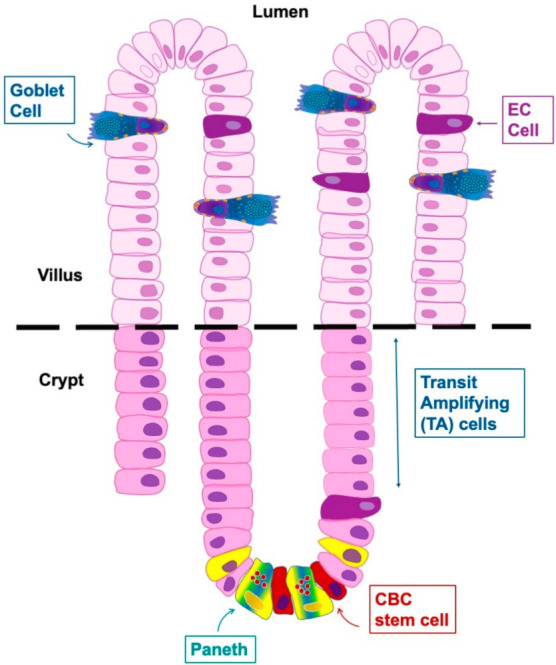
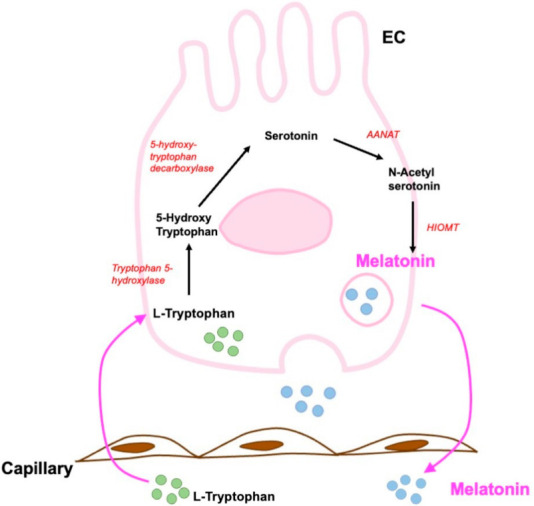
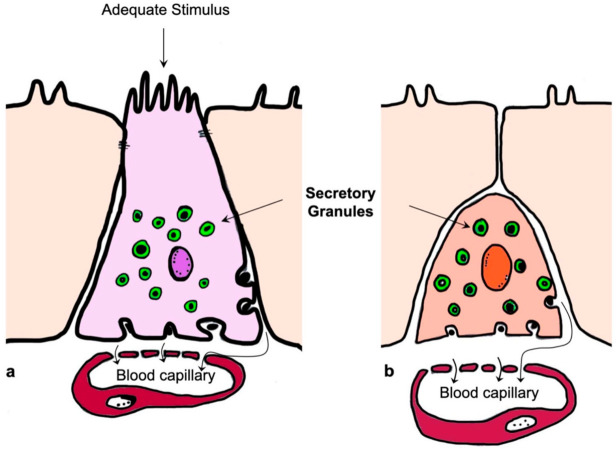
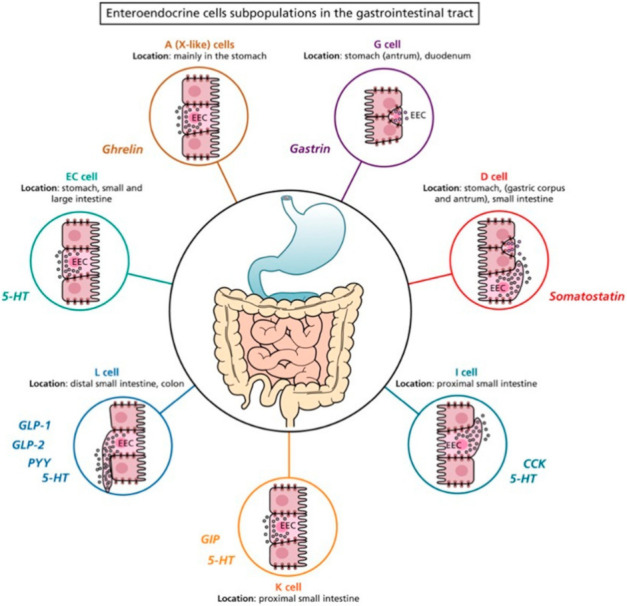
The intestinal epithelium plays a key role in managing the relationship with the environment, the internal and external inputs, and their changes. One percent of the gut epithelium is represented by the enteroendocrine cells. Among the enteroendocrine cells, a group of specific cells characterized by the presence of yellow granules, the enterochromaffin cells, has been identified. These granules contain many secretion products. Studies showed that these cells are involved in gastrointestinal inflammatory conditions and hyperalgesia; their number increases in these conditions both in affected and not-affected zones of the gut. Moreover, they are involved in the preservation and modulation of the intestinal function and motility, and they sense metabolic-nutritional alterations. Sometimes, they are confused or mixed with other enteroendocrine cells, and it is difficult to define their activity. However, it is known that they change their functions during diseases; they increased in number, but their involvement is related mainly to some secretion products (serotonin, melatonin, substance P). The mechanisms linked to these alterations are not well investigated. Herein, we provide an up-to-date highlight of the main findings about these cells, from their discovery to today. We emphasized their origin, morphology, and their link with diet to better evaluate their role for preventing or treating metabolic disorders considering that these diseases are currently a public health burden.
肠上皮在管理与环境、内部和外部输入及其变化的关系中起着关键作用。肠道上皮的1%由肠内分泌细胞构成。在肠内分泌细胞中,已鉴定出一组以存在黄色颗粒为特征的特定细胞,即肠嗜铬细胞。这些颗粒含有许多分泌产物。研究表明,这些细胞参与胃肠道炎症和痛觉过敏;在这些情况下,它们在肠道的受影响和未受影响区域的数量都会增加。此外,它们还参与肠道功能和运动的维持与调节,并感知代谢营养变化。有时,它们会与其他肠内分泌细胞混淆或混合,难以确定它们的活性。然而,已知它们在疾病期间会改变功能;它们的数量增加,但其参与主要与一些分泌产物(血清素、褪黑素、P物质)有关。与这些改变相关的机制尚未得到充分研究。在此,我们提供了关于这些细胞从发现至今的主要研究结果的最新概述。我们强调了它们的起源、形态以及它们与饮食的联系,以便更好地评估它们在预防或治疗代谢紊乱中的作用,因为这些疾病目前是公共卫生负担。