Institute of Physical Performance, The Norwegian School of Sport Sciences, PB 4014, 0807 Oslo, Norway.
National Resource Centre for Late Effects, Department of Oncology, Oslo University Hospital, PB 4950, 4950 Oslo, Norway.
Int J Environ Res Public Health. 2022 Mar 23;19(7):3820. doi: 10.3390/ijerph19073820.
Loss of muscle mass and muscle function is a common side effect from androgen deprivation therapy (ADT) for prostate cancer (PCa). Here, we explored effects of heavy-load resistance training (RT) on lean body mass and muscle strength changes reported in randomized controlled trials (RCTs) among PCa patients on ADT and in healthy elderly men (HEM), by comparison of results in separate meta-analysis.
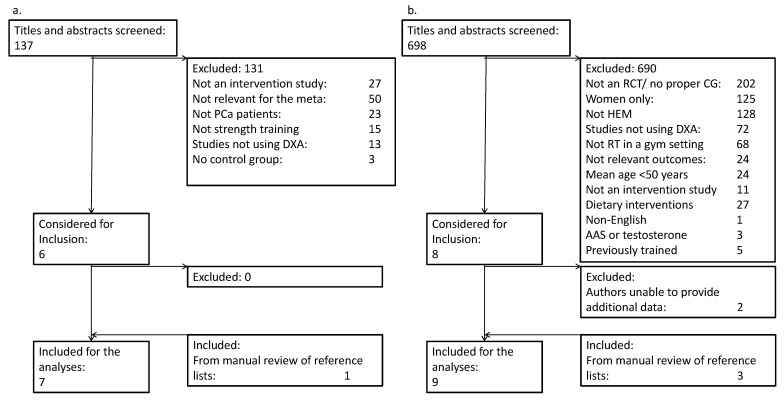
RCTs were identified through databases and reference lists.
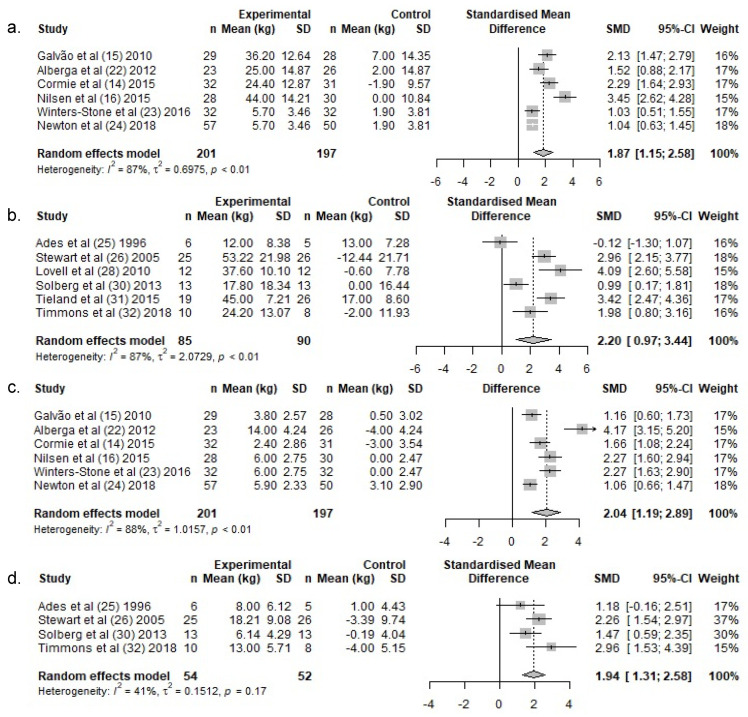
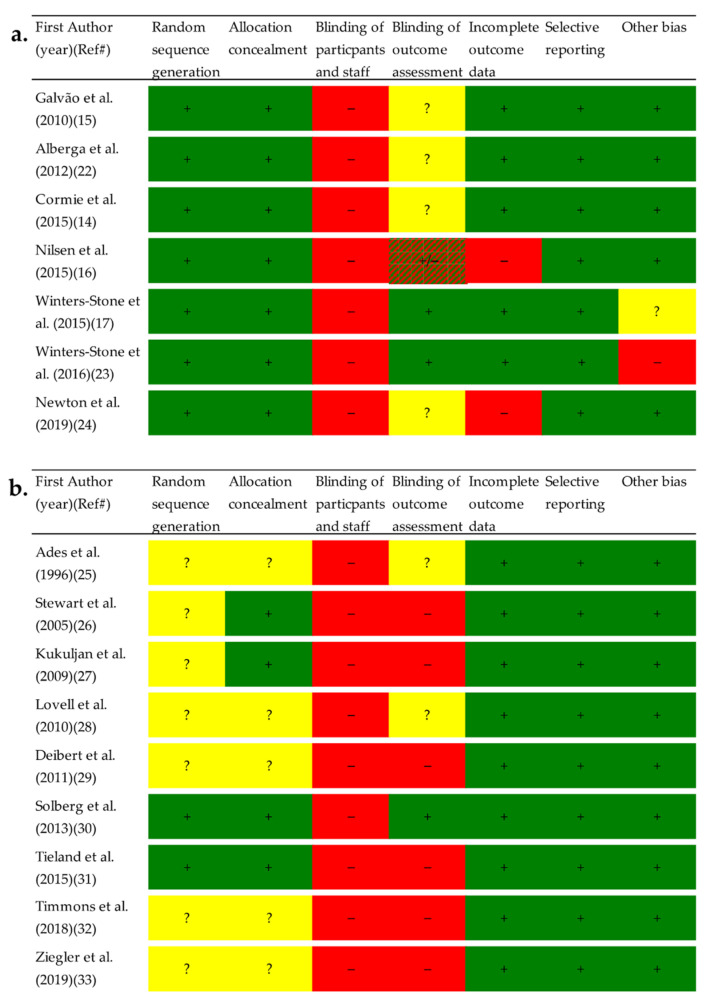
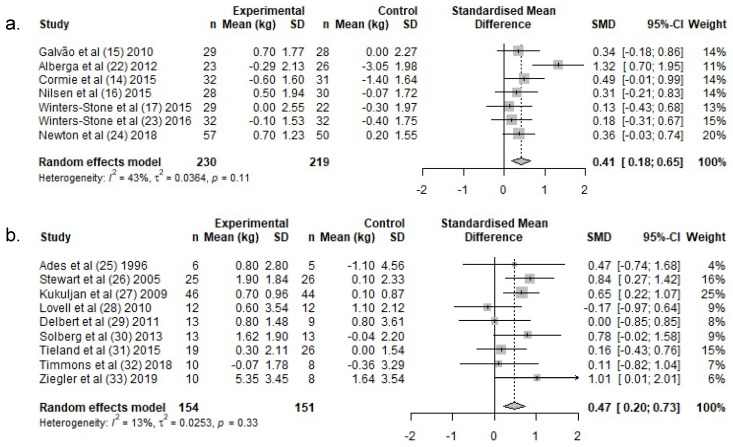
Seven RCTs in PCa patients ( = 449), and nine in HEM ( = 305) were included. The effects of RT in lean body mass change were similar among PCa patients (Standardized mean difference (SMD): 0.4, 95% CI: 0.2, 0.7) and HEM (SMD: 0.5, 95% CI: 0.2, 0.7). It is noteworthy that the within group changes showed different patterns in PCa patients (intervention: 0.2 kg; control: -0.6 kg) and HEM (intervention: 1.2 kg; control: 0.2 kg). The effects of RT on change in muscle strength (measured as 1 RM) were similar between PCa patients and HEM, both for lower body- (PCa: SMD: 1.9, 95% CI: 1.2, 2.5; HEM: SMD: 2.2, 95% CI: 1.0, 3.4), and for upper body exercises (PCa: SMD: 2.0, 95% CI: 1.3, 2.7; HEM: SMD: 1.9, 95% CI: 1.3, 2.6).
The effects of RT on lean body mass and 1 RM were similar in PCa patients on ADT and HEM, but the mechanism for the intervention effect might differ between groups. It seems that RT counteracts loss of lean body mass during ADT in PCa patients, as opposed to increasing lean body mass in HEM.
雄激素剥夺疗法 (ADT) 是治疗前列腺癌 (PCa) 的常用方法,但会导致肌肉质量和功能下降。在这里,我们通过单独的荟萃分析比较了接受 ADT 的 PCa 患者和健康老年男性 (HEM) 中随机对照试验 (RCT) 报告的瘦体重和肌肉力量变化的重负荷阻力训练 (RT) 效果,探索了 RT 的影响。
通过数据库和参考文献列表确定 RCTs。
纳入了 7 项 PCa 患者的 RCT(n=449)和 9 项 HEM 的 RCT(n=305)。RT 对瘦体重变化的影响在 PCa 患者(标准化均数差(SMD):0.4,95%置信区间:0.2,0.7)和 HEM 中相似(SMD:0.5,95%置信区间:0.2,0.7)。值得注意的是,PCa 患者(干预组:0.2kg;对照组:-0.6kg)和 HEM 患者(干预组:1.2kg;对照组:0.2kg)的组内变化模式不同。RT 对肌肉力量(1 RM 测量)变化的影响在 PCa 患者和 HEM 中相似,下半身运动(PCa:SMD:1.9,95%置信区间:1.2,2.5;HEM:SMD:2.2,95%置信区间:1.0,3.4)和上半身运动(PCa:SMD:2.0,95%置信区间:1.3,2.7;HEM:SMD:1.9,95%置信区间:1.3,2.6)。
ADT 治疗的 PCa 患者和 HEM 中,RT 对瘦体重和 1 RM 的影响相似,但干预效果的机制可能不同。RT 似乎可以防止 PCa 患者接受 ADT 时的瘦体重流失,而不是增加 HEM 中的瘦体重。