Hama Amin Bnar J, Kakamad Fahmi H, Ahmed Gasha S, Ahmed Shaho F, Abdulla Berwn A, Mohammed Shvan H, Mikael Tomas M, Salih Rawezh Q, Ali Razhan K, Salh Abdulwahid M, Hussein Dahat A
Smart Health Tower, Madam Mitterrand Street, Sulaimani, Kurdistan, Iraq.
Kscien Organization, Hamdi Str., Azadi Mall, Sulaimani, Kurdistan, Iraq.
Ann Med Surg (Lond). 2022 May;77:103590. doi: 10.1016/j.amsu.2022.103590. Epub 2022 Apr 6.
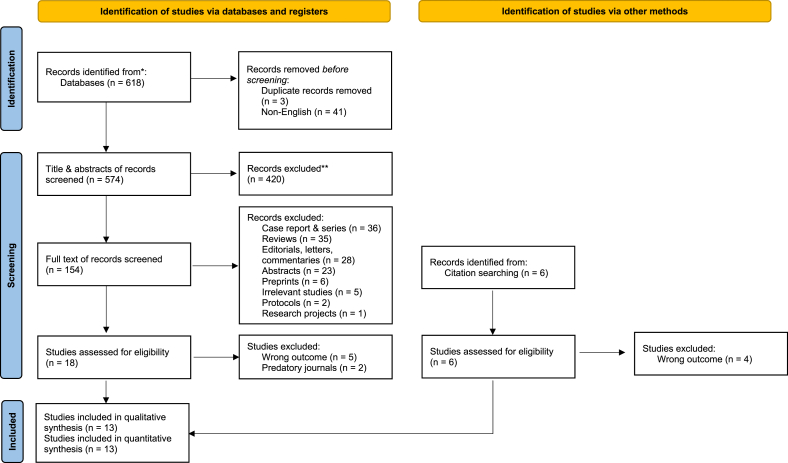
Introduction; Pulmonary fibrosis is a frequently reported COVID-19 sequela in which the exact prevalence and risk factors are yet to be established. This meta-analysis aims to investigate the prevalence of post-COVID-19 pulmonary fibrosis (PCPF) and the potential risk factors. Methods; CINAHL, PubMed/MEDLINE, Cochrane Library, Web of Science, and EMBASE databases were searched to identify English language studies published up to December 3, 2021. Results; The systematic search initially revealed a total of 618 articles - of which only 13 studies reporting 2018 patients were included in this study. Among the patients, 1047 (51.9%) were male and 971 (48.1%) were female. The mean age was 54.5 years (15-94). The prevalence of PCPF was 44.9%. The mean age was 59 years in fibrotic patients and 48.5 years in non-fibrotic patients. Chronic obstructive pulmonary disease was the only comorbidity associated with PCPF. Fibrotic patients more commonly suffered from persistent symptoms of dyspnea, cough, chest pain, fatigue, and myalgia (p-value < 0.05). Factors related to COVID-19 severity that were associated with PCPF development included computed tomography score of ≥18, ICU admission, invasive/non-invasive mechanical ventilation, longer hospitalization period, and steroid, antibiotic and immunoglobulin treatments (p-value < 0.05). Parenchymal bands (284/341), ground-glass opacities (552/753), interlobular septal thickening (220/381), and consolidation (197/319) were the most common lung abnormalities found in fibrotic patients. Conclusion, About 44.9% of COVID-19 survivors appear to have developed pulmonary fibrosis. Factors related to COVID-19 severity were significantly associated with PCPF development.
引言;肺纤维化是新冠病毒病(COVID-19)一种常见的后遗症,其确切患病率和危险因素尚未确定。本荟萃分析旨在调查COVID-19后肺纤维化(PCPF)的患病率及其潜在危险因素。方法;检索了护理及健康领域数据库(CINAHL)、医学期刊数据库(PubMed/MEDLINE)、考克兰图书馆、科学引文索引数据库(Web of Science)和荷兰医学文摘数据库(EMBASE),以识别截至2021年12月3日发表的英文研究。结果;系统检索最初共发现618篇文章,其中本研究仅纳入了13项报告2018例患者的研究。患者中,男性1047例(51.9%),女性971例(48.1%)。平均年龄为54.5岁(15 - 94岁)。PCPF的患病率为44.9%。纤维化患者的平均年龄为59岁,非纤维化患者为48.5岁。慢性阻塞性肺疾病是与PCPF相关的唯一合并症。纤维化患者更常出现持续的呼吸困难、咳嗽、胸痛、疲劳和肌痛症状(p值<0.05)。与PCPF发生相关的COVID-19严重程度相关因素包括计算机断层扫描评分≥18、入住重症监护病房、有创/无创机械通气、住院时间延长以及使用类固醇、抗生素和免疫球蛋白治疗(p值<0.05)。实质带(284/341)、磨玻璃影(552/753)、小叶间隔增厚(220/381)和实变(197/319)是纤维化患者中最常见的肺部异常表现。结论;约44.9%的COVID-19幸存者似乎发生了肺纤维化。与COVID-19严重程度相关的因素与PCPF的发生显著相关。