Habte Mekdes Hailegebreal, Seid Seada Jemal, Alemu Ayinalem, Hailemariam Hanna Abera, Wudneh Birhanu Asrat, Kasa Rahel Nega, Bitew Zebenay Workneh
St. Paul's Hospital Millennium Medical College, Addis Ababa, Ethiopia.
Ethiopian Public Health Institute, Addis Ababa, Ethiopia.
Reprod Health. 2022 Apr 15;19(1):94. doi: 10.1186/s12978-022-01404-y.
Promoting exclusive breastfeeding (EBF) is a major child survival strategy in developing countries like Ethiopia. Studies in EBF are found in a fragmented and inconclusive way in Ethiopia. Therefore, the aim of this study was to examine evidences on the effect of post natal care counseling and maternal employment status on exclusive breastfeeding practice of women in Ethiopia.
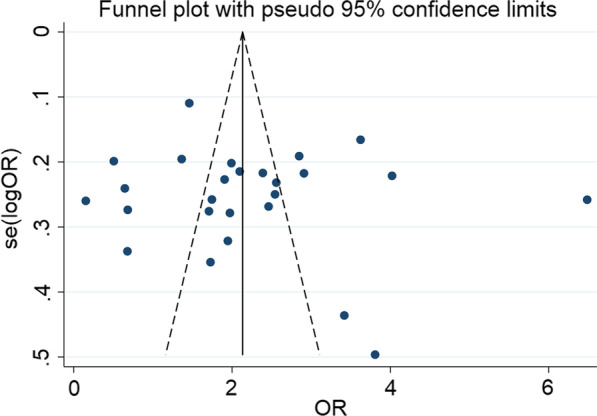
A systematic literature search was conducted from PubMed (contains MEDLINE), CINAHL (EBSCO), Global Health, Food Science and Technology Abstracts (FSTA) (EBSCO) and Grey literature sources such as Google and Google scholar. All primary studies on the effects of employment status and/or post-natal care utilization on EBF practices of women in Ethiopia were included. Data analyses were performed using STATA software. Forest plot, I test and the Cochrane Q statistics were used to detect heterogeneity among studies. Heterogeneity was considered significant when the I value was ≥ 50%, with p-value < 0.05. Publication bias was checked by looking the asymmetry of funnel and confirmed by Egger's regression test at a 5% significant level. The pooled odds ratio (POR) with 95% confidence interval (CI) was used to report the measures of associations.
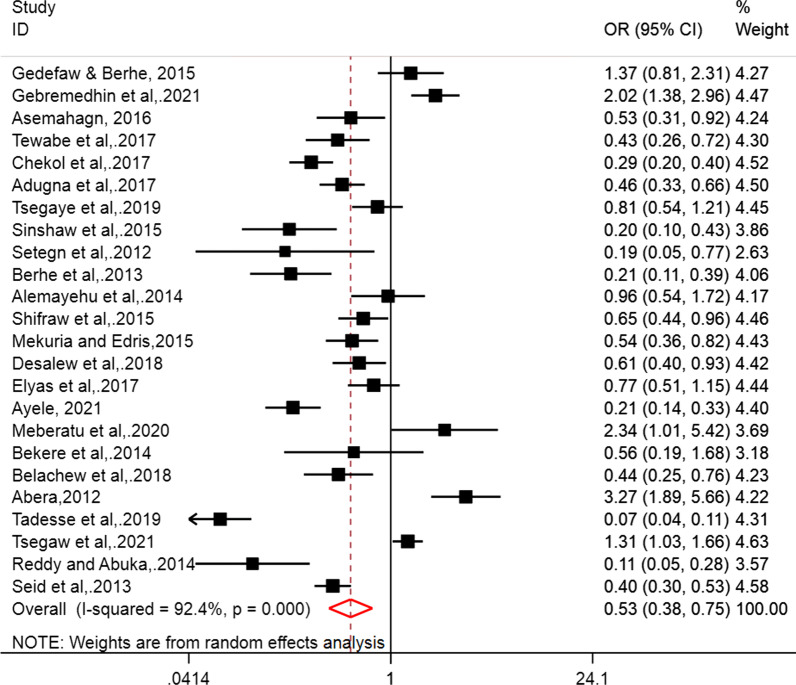
A total of 622 studies were identified in the initial search of which 42 articles were included this systematic review and meta-analysis. A meta-analysis of 24 studies indicated that maternal employment status was significantly associated (POR = 0.51, 95% CI 0.16, 0.86) EBF practice in that employed mother were less likely to practice to practice EBF. Post-natal care service utilization significantly increases (POR = 1.76, 95% CI 1.32, 2.34) the EBF practice in Ethiopia and it was computed using 25 eligible articles. Besides, the pooled estimates of EBF practice was found to be 62.58% (95% CI 56.98, 68.19, I = 96.4%, p < 0.001).
This review found that post-natal care service utilization and maternal employment status has a significant effect on EBF practice. The findings from this review may be used to inform for better supportive and promotive strategies for EBF practice in Ethiopia.
在埃塞俄比亚等发展中国家,推广纯母乳喂养是一项重要的儿童生存策略。在埃塞俄比亚,关于纯母乳喂养的研究较为零散且尚无定论。因此,本研究旨在探讨产后护理咨询和母亲就业状况对埃塞俄比亚妇女纯母乳喂养行为的影响证据。
通过PubMed(包含MEDLINE)、CINAHL(EBSCO)、全球健康、食品科学与技术文摘(FSTA)(EBSCO)以及谷歌和谷歌学术等灰色文献来源进行系统的文献检索。纳入所有关于就业状况和/或产后护理利用对埃塞俄比亚妇女纯母乳喂养行为影响的原发性研究。使用STATA软件进行数据分析。采用森林图、I²检验和Cochrane Q统计量来检测研究间的异质性。当I²值≥50%且p值<0.05时,认为异质性显著。通过观察漏斗图的不对称性来检查发表偏倚,并通过Egger回归检验在5%的显著水平上进行确认。采用合并比值比(POR)及其95%置信区间(CI)来报告关联度指标。
在初步检索中总共识别出622项研究,其中42篇文章纳入了本系统评价和荟萃分析。对24项研究的荟萃分析表明,母亲就业状况与纯母乳喂养行为显著相关(POR = 0.51,95%CI 0.16,0.86),即就业母亲进行纯母乳喂养的可能性较小。产后护理服务的利用显著增加了埃塞俄比亚的纯母乳喂养行为(POR = 1.76,95%CI 1.32,2.34),这是根据25篇符合条件的文章计算得出的。此外,纯母乳喂养行为的合并估计值为62.58%(95%CI 56.98,68.19,I² = 96.4%,p < 0.001)。
本综述发现,产后护理服务的利用和母亲就业状况对纯母乳喂养行为有显著影响。本综述的结果可用于为埃塞俄比亚更好地支持和促进纯母乳喂养行为提供参考策略。