Liu Zeng-Yao, Jia Qing-Chun, Wang Wen, Liu Yu-Xi, Wang Rui-Tao, Li Jia-Yu
Department of Internal Medicine, Harbin Medical University Cancer Hospital, Harbin Medical University, Harbin, Heilongjiang 150081, China.
Department of Interventional Medicine, The First Affiliated Hospital, Harbin Medical University, Harbin, Heilongjiang 150001, China.
Gastroenterol Res Pract. 2022 Apr 7;2022:9012063. doi: 10.1155/2022/9012063. eCollection 2022.
Elevated platelet volume is the risk factor for the development and poor overall survival of colorectal cancer (CRC) patients. Both microsatellite status and platelet glycoprotein Ib (GPIb) are related to platelet volume in CRC patients. This study aimed to investigate platelet GPIb ectodomain (termed glycocalicin) levels among CRC patients and the association between the glycocalicin levels and microsatellite status in CRC.
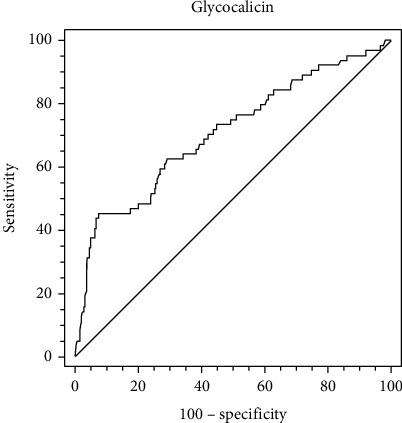
The clinical and laboratory data of 430 CRC patients between January 2018 and December 2018 in Harbin Medical University Cancer Hospital were collected. The microsatellite status was determined with a polymerase chain reaction. The participants were separated into high microsatellite instability (MSI-H) and microsatellite stable (MSS) groups according to microsatellite status. The glycocalicin levels were measured with an enzyme-linked immunosorbent assay, and the cut-off point was determined with the receiver-operating characteristics curve. The clinical and pathological characteristics were collected via electronic medical records. Logistic regression was used to explore the association between glycocalicin and microsatellite status.
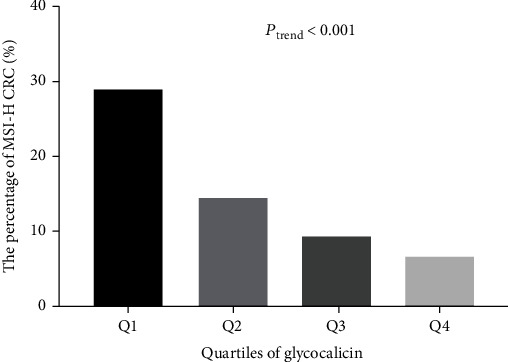
Among the 430 CRC patients enrolled, 64 patients (14.9%) were identified as MSI-H and others as MSS CRC. Glycocalicin levels were significantly reduced in patients with MSI-H than those with MSS. After controlling for potential confounders, logistic regression analysis revealed that glycocalicin levels were independently associated with MSI-H CRC.
Reduced glycocalicin levels are associated with the MSI-H subtype of CRC. Further research is needed to elucidate the mechanisms of the association between glycocalicin and MSI-H in CRC patients.
血小板体积升高是结直肠癌(CRC)患者发生及总体生存不良的危险因素。微卫星状态和血小板糖蛋白Ib(GPIb)均与CRC患者的血小板体积有关。本研究旨在调查CRC患者中血小板GPIb胞外域(称为糖萼蛋白)水平以及CRC中糖萼蛋白水平与微卫星状态之间的关联。
收集2018年1月至2018年12月在哈尔滨医科大学附属肿瘤医院就诊的430例CRC患者的临床和实验室数据。采用聚合酶链反应确定微卫星状态。根据微卫星状态将参与者分为高微卫星不稳定性(MSI-H)组和微卫星稳定(MSS)组。采用酶联免疫吸附测定法测量糖萼蛋白水平,并通过受试者工作特征曲线确定临界值。通过电子病历收集临床和病理特征。采用逻辑回归分析探讨糖萼蛋白与微卫星状态之间的关联。
在纳入的430例CRC患者中,64例(14.9%)被鉴定为MSI-H,其余为MSS CRC。MSI-H患者的糖萼蛋白水平显著低于MSS患者。在控制潜在混杂因素后,逻辑回归分析显示糖萼蛋白水平与MSI-H CRC独立相关。
糖萼蛋白水平降低与CRC的MSI-H亚型有关。需要进一步研究以阐明CRC患者中糖萼蛋白与MSI-H之间关联的机制。