Kang Sanghee, Na Younghyun, Joung Sung Yup, Lee Sun Il, Oh Sang Cheul, Min Byung Wook
Department of Surgery, Korea University Guro Hospital, Gurodong-gil, Guro-gu, Seoul, Korea Division of Oncology/Hematology, Department of Internal Medicine, Korea University College of Medicine, Seoul, Republic of Korea.
Medicine (Baltimore). 2018 Mar;97(9):e0019. doi: 10.1097/MD.0000000000010019.
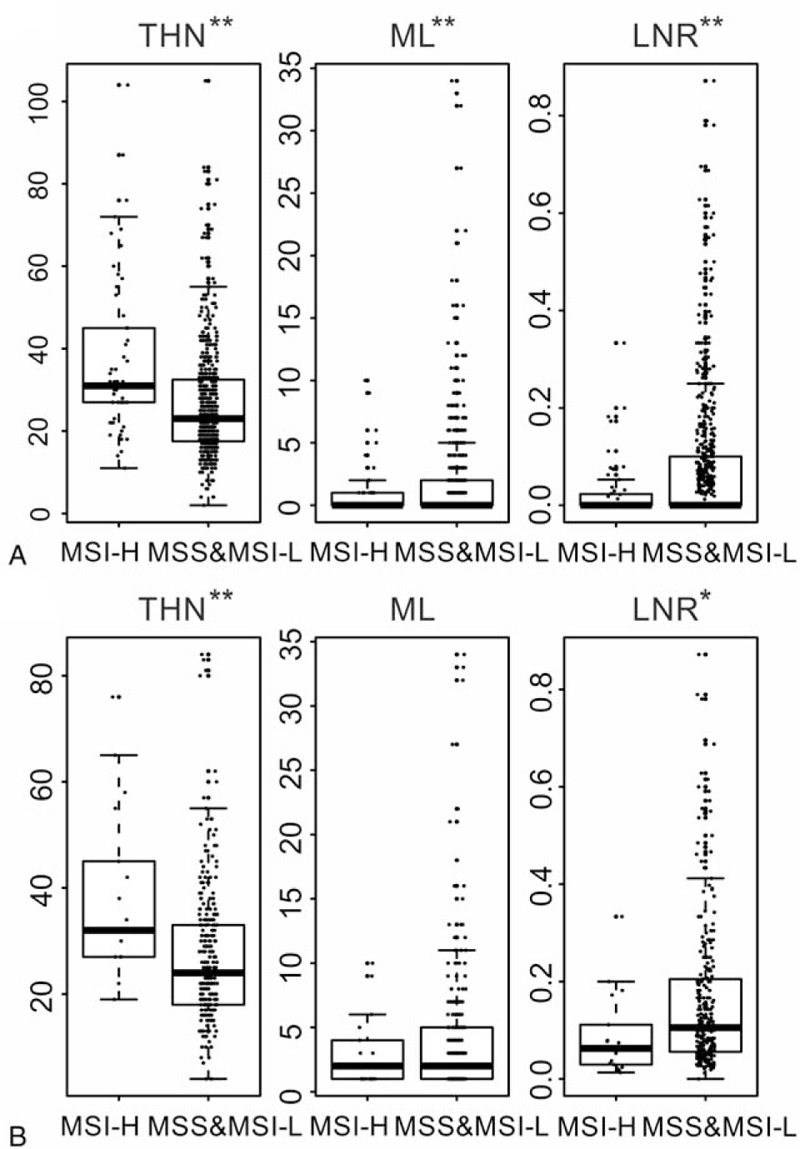
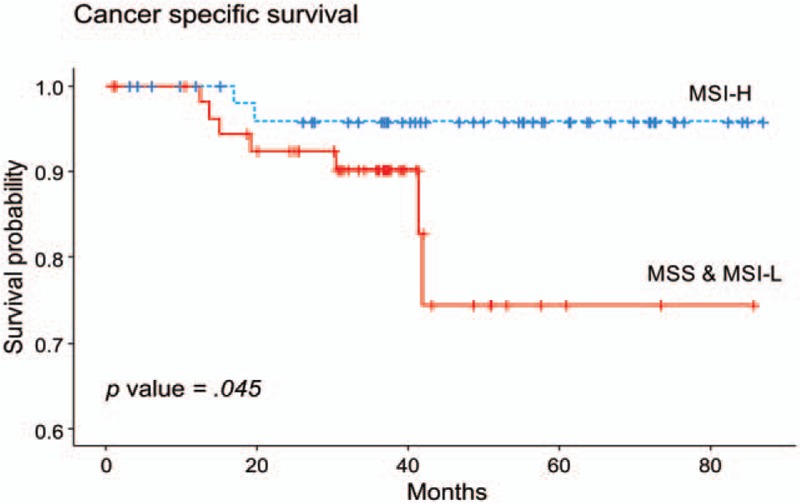
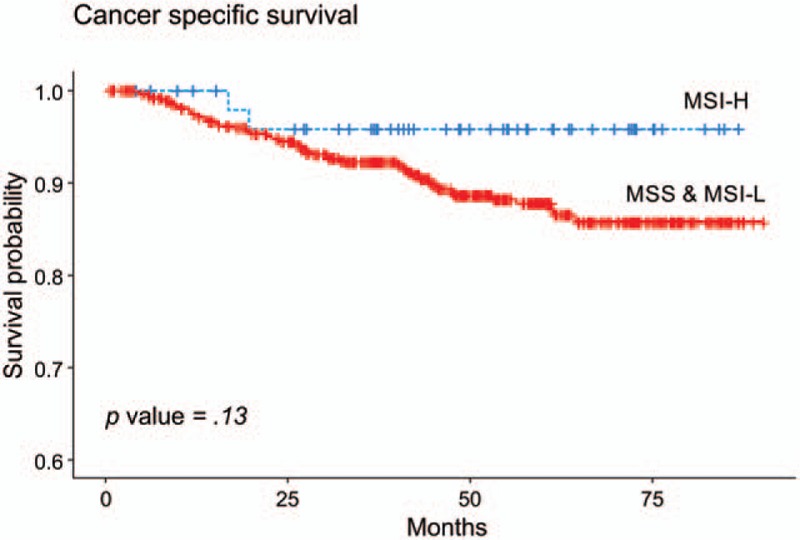
The colorectal cancer (CRC) patients with microsatellite instability (MSI) have distinct clinicopathological characteristics consisting of factors predicting positive and negative outcomes, such as a high lymph node harvest and poor differentiation. In this study, we measured the value of MSI as a prognostic factor after controlling for these discrepant factors. A total of 603 patients who underwent curative surgery for stages I to III colorectal cancer were enrolled. The patients were divided into microsatellite instability high (MSI-H) and microsatellite stable/microsatellite instability low (MSS/MSI-L) groups. Propensity score matching was used to match clinicopathological factors between the 2 groups. MSI-H patients had a high lymph node harvest (median: 31.0 vs 23.0, P < .001), earlier-stage tumors (P < .001), advanced T stage (89.3% vs 74.0%, P = .018), and poor differentiation (19.6% vs 2.0%, P < .001). Survival analysis showed better survival in the MSI-H group, but the difference was not statistically significant (P = .126). Propensity score matching was performed for significant prognostic factors identified by Cox hazard regression. After the matching, the survival difference by MSI status was estimated to be larger than before, and reached statistical significance (P = .045). In conclusion, after controlling for pathological characteristics, MSI-H could be a potent prognostic factor regarding patient survival.
微卫星不稳定(MSI)的结直肠癌(CRC)患者具有独特的临床病理特征,包括预测预后好坏的因素,如高淋巴结清扫率和低分化。在本研究中,我们在控制了这些差异因素后,测量了MSI作为预后因素的价值。共有603例接受I至III期结直肠癌根治性手术的患者入组。患者被分为微卫星高度不稳定(MSI-H)组和微卫星稳定/微卫星低度不稳定(MSS/MSI-L)组。采用倾向评分匹配法对两组之间的临床病理因素进行匹配。MSI-H患者的淋巴结清扫率较高(中位数:31.0对23.0,P<0.001),肿瘤分期较早(P<0.001),T分期较晚(89.3%对74.0%,P=0.018),且分化程度低(19.6%对2.0%,P<0.001)。生存分析显示MSI-H组的生存率较好,但差异无统计学意义(P=0.126)。对Cox风险回归确定的显著预后因素进行倾向评分匹配。匹配后,根据MSI状态估计的生存差异比之前更大,并达到统计学意义(P=0.045)。总之,在控制病理特征后,MSI-H可能是影响患者生存的一个有力预后因素。