Sannathimmappa Mohan Bilikallahalli, Nambiar Vinod, Aravindakshan Rajeev
Department of Microbiology, College of Medicine and Health Sciences, National University of Science and Technology, Sohar Campus, Andhra Pradesh, India.
Department of Microbiology, National University of Science and Technology, Sohar Campus, Sultanate of Oman.
Int J Crit Illn Inj Sci. 2022 Jan-Mar;12(1):38-46. doi: 10.4103/ijciis.ijciis_48_21. Epub 2022 Mar 24.
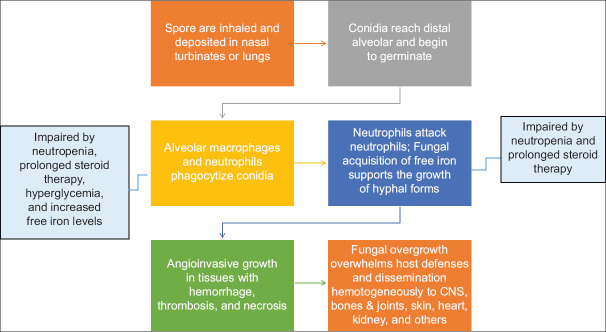
Mucormycosis is a rare but life-threatening opportunistic fungal infection caused by a group of molds that belong to Zygomycetes of the order Mucorales. These fungi are found in the environment such as soil, decaying vegetation, and organic matters. Sporangiospores present in the environment enter the human body through inhalation or direct skin inoculation by trauma or ingestion and result in pulmonary, cutaneous, and gastrointestinal mucormycosis, respectively, in immunocompromised hosts. Patients with uncontrolled diabetes, hematological malignancies, high-dose glucocorticoid therapy, iron overload, and organ transplantation are at high risk of acquiring mucormycosis. The second wave of severe acute respiratory syndrome coronavirus 2 [SARS-CoV-2] affected India severely with the highest number of cases and deaths compared to all other countries. Additionally, the country was affected by emergence of rare but life-threatening mucormycosis. Currently, many coronavirus disease 2019 patients with underlying risk factors such as uncontrolled diabetes, high-dose steroid therapy, and exposure to mechanical ventilation have developed mucormycosis. Inhalation is the most common mode of transmission that results in colonization of sporangiospores in the nose. In immunocompromised host, sporangiospores germinate, and subsequently form hyphae. These hyphae invade into tissues, and produce tissue infarction, necrosis, and thrombosis. Angioinvasion causes hematogenous dissemination to many organs, predominantly to brain, that result in rhino-orbital-cerebral mucormycosis. Clinical characteristics, radio imaging, fungal culture, histopathology, and molecular techniques are the key diagnostic methods. Surgical intervention and aggressive antifungal therapy are the main management strategies. Amphotericin B is the drug of choice for treatment of mucormycosis, whereas posaconazole or isavuconazole is used for step-down therapy and salvage therapy.
毛霉病是一种罕见但危及生命的机会性真菌感染,由一组属于毛霉目接合菌纲的霉菌引起。这些真菌存在于土壤、腐烂植被和有机物等环境中。环境中的孢子囊孢子通过吸入、外伤直接接种皮肤或经口摄入进入人体,分别在免疫功能低下的宿主中导致肺、皮肤和胃肠道毛霉病。患有未控制的糖尿病、血液系统恶性肿瘤、大剂量糖皮质激素治疗、铁过载和器官移植的患者感染毛霉病的风险很高。严重急性呼吸综合征冠状病毒2(SARS-CoV-2)的第二波疫情对印度造成了严重影响,与所有其他国家相比,病例数和死亡人数最多。此外,该国还受到了罕见但危及生命的毛霉病出现的影响。目前,许多患有未控制的糖尿病、大剂量类固醇治疗和接受机械通气等潜在危险因素的2019冠状病毒病患者都患上了毛霉病。吸入是最常见的传播方式,可导致孢子囊孢子在鼻腔定植。在免疫功能低下的宿主中,孢子囊孢子发芽,随后形成菌丝。这些菌丝侵入组织,产生组织梗死、坏死和血栓形成。血管侵袭导致血行播散至许多器官,主要是大脑,从而导致鼻眶脑毛霉病。临床特征、影像学检查、真菌培养、组织病理学和分子技术是关键的诊断方法。手术干预和积极的抗真菌治疗是主要的治疗策略。两性霉素B是治疗毛霉病的首选药物,而泊沙康唑或艾沙康唑用于降阶梯治疗和挽救治疗。