Department of Physiology and Medical Physics, Royal College of Surgeons in Ireland, St Stephens Green, Dublin, Ireland.
National Preclinical Imaging Centre, Royal College of Surgeons in Ireland, St Stephens Green, Dublin, Ireland.
Cancer Med. 2022 Oct;11(20):3820-3836. doi: 10.1002/cam4.4756. Epub 2022 Apr 17.
Prior data suggest pre-diagnostic aspirin use impacts breast tumour biology and patient outcome. Here, we employed faithful surgical resection models of HER2+ and triple-negative breast cancer (TNBC), to study outcome and response mechanisms across breast cancer subtypes.
NOD/SCID mice were implanted with HER2+ MDA-MB-231/LN/2-4/H2N, trastuzumab-resistant HER2+ HCC1954 or a TNBC patient-derived xenograft (PDX). A daily low-dose aspirin regimen commenced until primary tumours reached ~250 mm and subsequently resected. MDA-MB-231/LN/2-4/H2N mice were monitored for metastasis utilising imaging. To interrogate the survival benefit of pre-treatment aspirin, 3 weeks post-resection, HCC1954/TNBC animals received standard-of-care (SOC) chemotherapy for 6 weeks. Primary tumour response to aspirin was interrogated using immunohistochemistry.
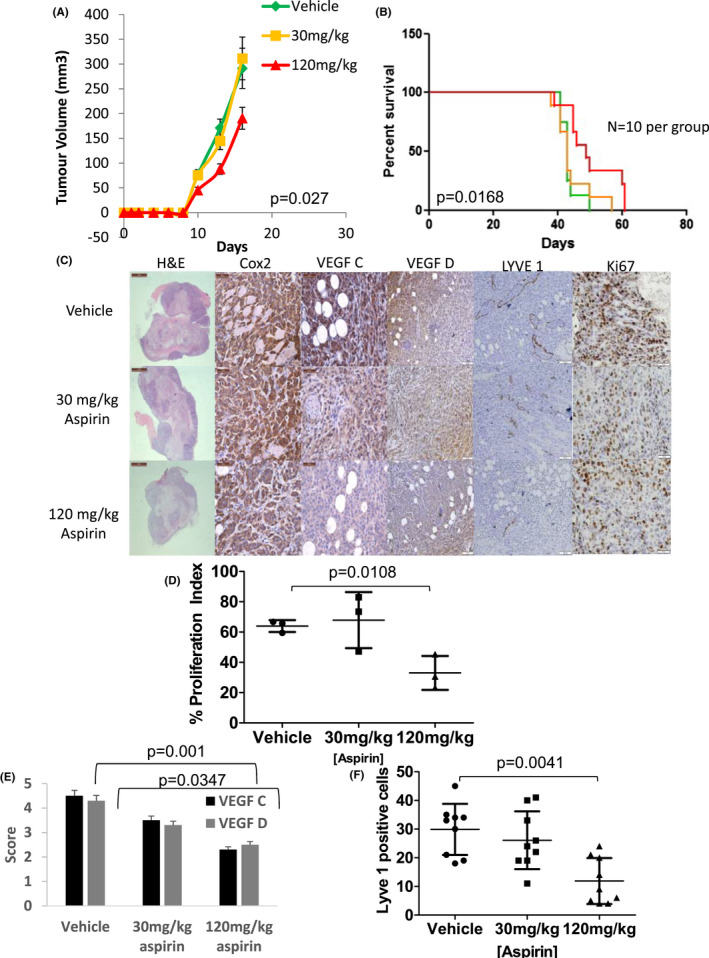
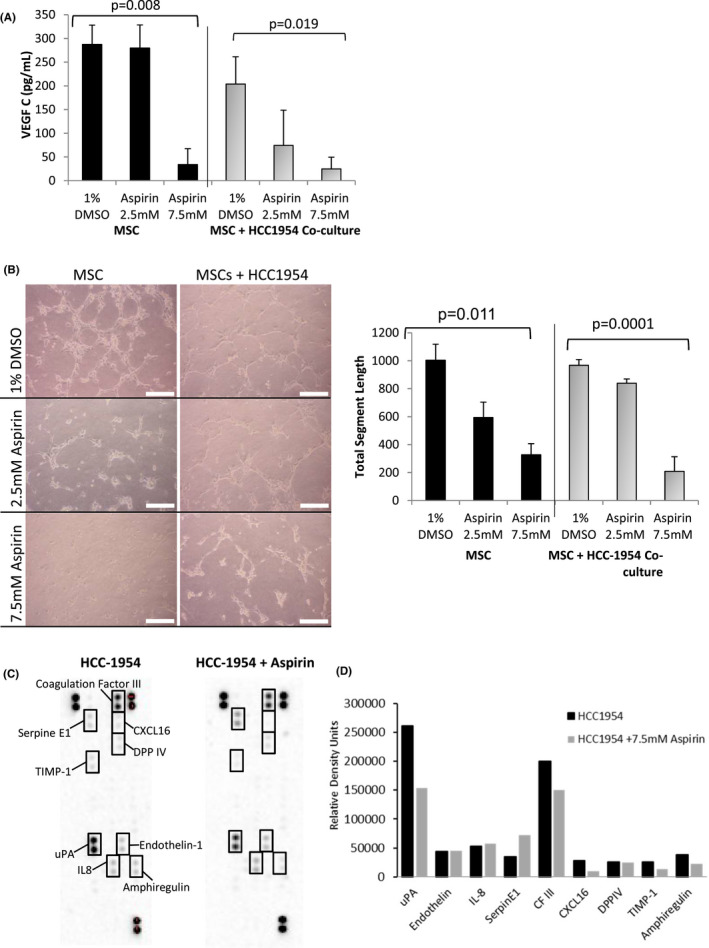
Aspirin delayed time to metastasis in MDA-MB-231/LN/2-4/H2N xenografts and decreased growth of HER2 /TNBC primary tumours. Lymphangiogenic factors and lymph vessels number were decreased in HER2 tumours. However, no survival benefit was seen in aspirin pre-treated animals (HCC1954/TNBC) that further received adjuvant SOC, compared with animals treated with SOC alone. In an effort to study mechanisms responsible for the observed reduction in lymphangiogenesis in HER2 BC we utilised an in vitro co-culture system of HCC1954 tumour cells and mesenchymal stromal cells (MSC). Aspirin abrogated the secretion of VEGF-C in MSCs and also decreased the lymph/angiogenic potential of the MSCs and HCC1954 by tubule formation assay. Furthermore, aspirin decreased the secretion of uPA in HCC1954 cells potentially diminishing its metastatic capability.
Our data employing clinically relevant models demonstrate that aspirin alters breast tumour biology. However, aspirin may not represent a robust chemo-preventative agent in the HER2 or TNBC setting.
先前的数据表明,诊断前使用阿司匹林会影响乳腺癌肿瘤生物学和患者预后。在这里,我们采用了忠实的 HER2+和三阴性乳腺癌(TNBC)手术切除模型,研究了乳腺癌亚型的结果和反应机制。
NOD/SCID 小鼠植入 HER2+ MDA-MB-231/LN/2-4/H2N、曲妥珠单抗耐药 HER2+ HCC1954 或 TNBC 患者来源的异种移植物(PDX)。开始每天低剂量阿司匹林治疗,直到原发肿瘤达到约 250mm,然后进行切除。使用成像监测 MDA-MB-231/LN/2-4/H2N 小鼠的转移情况。为了研究治疗前阿司匹林的生存获益,HCC1954/TNBC 动物在切除后 3 周接受 6 周标准护理(SOC)化疗。使用免疫组织化学检测阿司匹林对原发性肿瘤的反应。
阿司匹林延迟了 MDA-MB-231/LN/2-4/H2N 异种移植物的转移时间,并减少了 HER2/TNBC 原发性肿瘤的生长。HER2 肿瘤中的淋巴管生成因子和淋巴管数量减少。然而,与单独接受 SOC 治疗的动物相比,接受 SOC 辅助治疗的阿司匹林预处理动物(HCC1954/TNBC)并未看到生存获益。为了研究导致 HER2 BC 中观察到的淋巴管生成减少的机制,我们利用 HCC1954 肿瘤细胞和间充质基质细胞(MSC)的体外共培养系统。阿司匹林阻断了 MSC 中 VEGF-C 的分泌,并通过管形成测定降低了 MSC 和 HCC1954 的淋巴/血管生成潜力。此外,阿司匹林减少了 HCC1954 细胞中 uPA 的分泌,可能降低了其转移能力。
我们使用临床相关模型的数据表明,阿司匹林改变了乳腺癌肿瘤生物学。然而,阿司匹林在 HER2 或 TNBC 环境中可能不是一种有效的化学预防剂。