Department of Medicine Solna, Division of Clinical Epidemiology, Karolinska Institutet and Karolinska University Hospital, SE-171 76, Stockholm, Sweden.
Department of Oncology-Pathology, Karolinska Institutet, Stockholm, Sweden.
Breast Cancer Res. 2018 Nov 20;20(1):142. doi: 10.1186/s13058-018-1065-0.
Results from previous studies indicate that use of low-dose aspirin may improve breast cancer prognosis. We evaluated aspirin use and breast cancer outcomes in relation to clinical characteristics as well as dose and duration of aspirin use.
We used information from the Regional Breast Cancer Quality-of-Care Registries in three Swedish regions to identify 21,414 women diagnosed with a first stage I-III breast cancer between 1 April 2006 and 31 December 2012. The cohort was further linked to nationwide registers to retrieve information about dispensing low-dose aspirin before and after breast cancer diagnosis, comorbidity and causes of death. In a separate analysis, we investigated time to breast cancer death among 621 women with stage IV disease at diagnosis. Associations were evaluated using a multivariable Cox proportional hazards model.
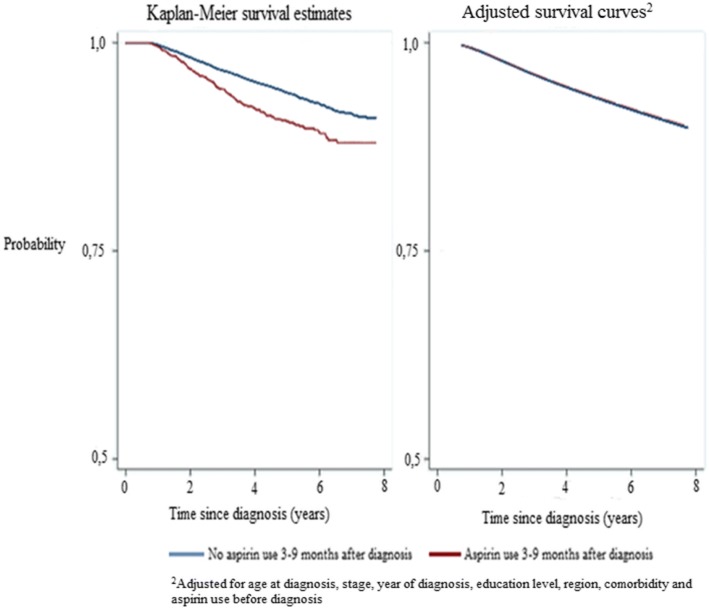
Among women with stage I-III breast cancer, 2660 (12.4%) used low-dose aspirin shortly before breast cancer diagnosis and 4091 (19.1%) were users during follow-up. Women were followed for a median of 3.8 years after diagnosis. There was no association between aspirin use and breast cancer-specific death in multivariable analyses (use before diagnosis: hazard ratio (HR) 0.93, 95% confidence interval (CI) 0.77-1.12; use after diagnosis: HR 1.00, 95% CI 0.74-1.37). Similarly, aspirin use was not associated with risk of first recurrence/metastases in a subgroup of stage I-III breast cancer patients (HR 0.97, 95% CI 0.86-1.10). However, in analyses stratified by stage, an inverse association between low-dose aspirin use after diagnosis and breast cancer death was found for women with stage I tumors (HR 0.53, 95% CI 0.29-0.96). Among women with stage IV disease at diagnosis, aspirin use was not associated with time to breast cancer death (HR 0.91, 95% CI 0.67-1.23).
In this large population-based cohort study there was no evidence that low-dose aspirin use before or after breast cancer diagnosis is associated with a reduced risk of adverse outcomes overall in breast cancer. However, a potential benefit was noted among women with stage I tumors, warranting further investigation.
先前的研究结果表明,低剂量阿司匹林的使用可能改善乳腺癌的预后。我们评估了阿司匹林的使用与乳腺癌结局与临床特征以及阿司匹林的剂量和使用时间的关系。
我们利用瑞典三个地区区域乳腺癌质量护理登记处的信息,确定了 21414 名在 2006 年 4 月 1 日至 2012 年 12 月 31 日期间被诊断为 I 期至 III 期乳腺癌的女性。该队列进一步与全国性登记处相联系,以获取乳腺癌诊断前后、共病和死因方面低剂量阿司匹林的使用信息。在一项单独的分析中,我们调查了 621 名在诊断时患有 IV 期疾病的女性的乳腺癌死亡时间。使用多变量 Cox 比例风险模型评估关联。
在 I 期至 III 期乳腺癌女性中,有 2660 名(12.4%)在乳腺癌诊断前短期使用低剂量阿司匹林,有 4091 名(19.1%)在随访期间使用。女性在诊断后中位随访 3.8 年。多变量分析显示,阿司匹林的使用与乳腺癌特异性死亡之间无关联(诊断前使用:风险比(HR)0.93,95%置信区间(CI)0.77-1.12;诊断后使用:HR 1.00,95% CI 0.74-1.37)。同样,在 I 期至 III 期乳腺癌患者的亚组分析中,阿司匹林的使用与首发复发/转移的风险也无关联(HR 0.97,95% CI 0.86-1.10)。然而,在按分期分层的分析中,对于 I 期肿瘤的女性,诊断后低剂量阿司匹林的使用与乳腺癌死亡之间存在反比关系(HR 0.53,95% CI 0.29-0.96)。在诊断为 IV 期疾病的女性中,阿司匹林的使用与乳腺癌死亡时间无相关性(HR 0.91,95% CI 0.67-1.23)。
在这项大型基于人群的队列研究中,没有证据表明乳腺癌诊断前或后使用低剂量阿司匹林与总体不良结局的风险降低相关。然而,在 I 期肿瘤的女性中注意到了潜在的益处,需要进一步研究。