Department of Molecular, Cellular, and Developmental Biology, University of Michigan, Ann Arbor, MI 48109, USA.
Trends Biochem Sci. 2022 Jun;47(6):506-517. doi: 10.1016/j.tibs.2022.03.013. Epub 2022 Apr 16.
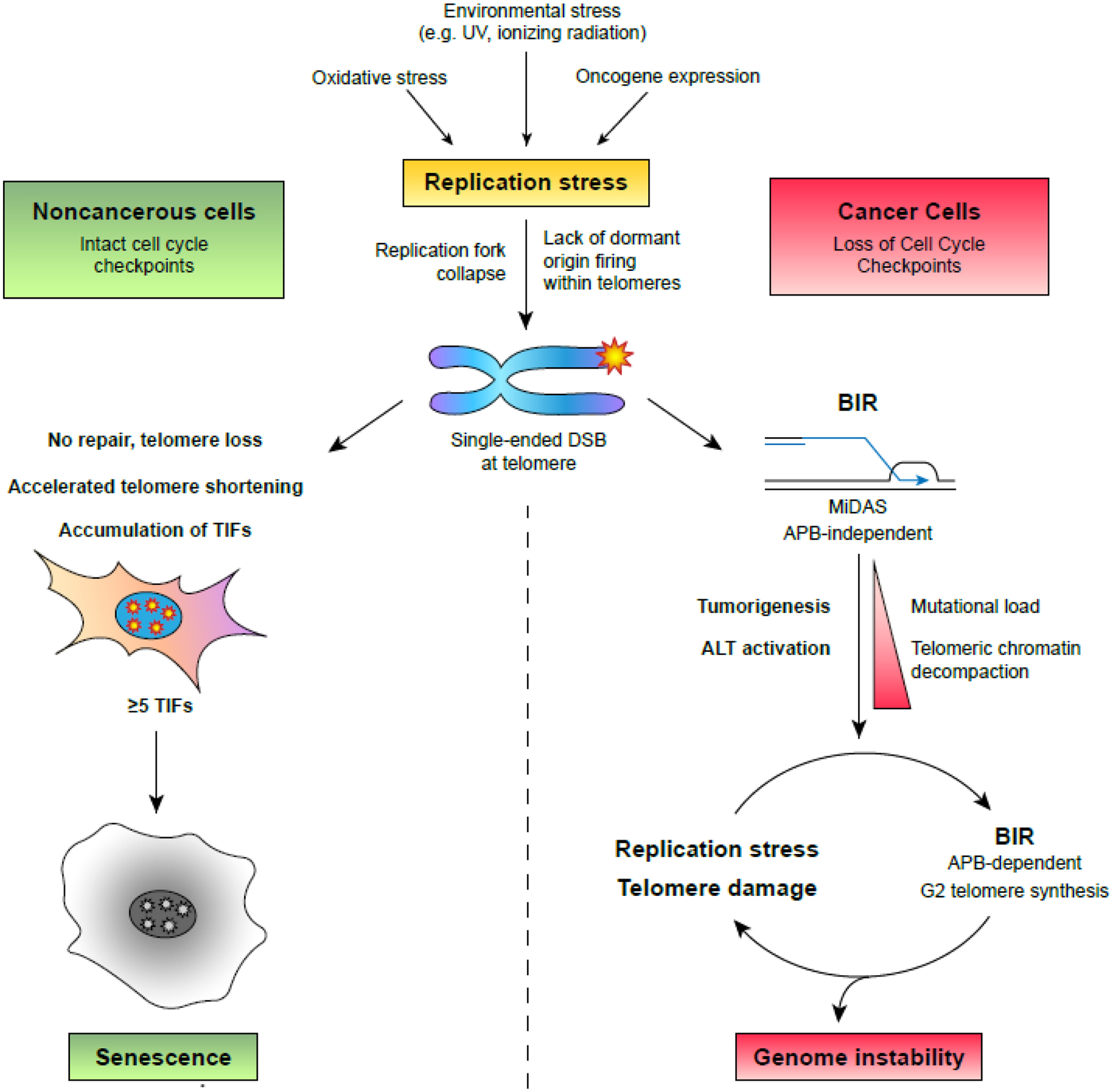
Telomeres are chromosome-capping structures that protect ends of the linear genome from DNA damage sensors. However, these structures present obstacles during DNA replication. Incomplete telomere replication accelerates telomere shortening and limits replicative lifespan. Therefore, continued proliferation under conditions of replication stress requires a means of telomere repair, particularly in the absence of telomerase. It was recently revealed that replication stress triggers break-induced replication (BIR) and mitotic DNA synthesis (MiDAS) at mammalian telomeres; however, these mechanisms are error prone and primarily utilized in tumorigenic contexts. In this review article, we discuss the consequences of replication stress at telomeres and how use of available repair pathways contributes to genomic instability. Current research suggests that fragile telomeres are ultimately tumor-suppressive and thus may be better left unrepaired.
端粒是染色体末端的保护结构,可防止线性基因组的末端被 DNA 损伤传感器识别。然而,这些结构在 DNA 复制过程中会造成阻碍。端粒复制不完全会加速端粒缩短并限制复制寿命。因此,在复制应激条件下持续增殖需要端粒修复的手段,尤其是在缺乏端粒酶的情况下。最近发现,复制应激会在哺乳动物端粒上触发断裂诱导复制(BIR)和有丝分裂 DNA 合成(MiDAS);然而,这些机制容易出错,主要在肿瘤发生的情况下被利用。在这篇综述文章中,我们讨论了端粒复制应激的后果,以及可用的修复途径的使用如何导致基因组不稳定。目前的研究表明,脆弱的端粒最终具有肿瘤抑制作用,因此最好不要修复。