Golan Talia, Brody Jonathan R
Oncology Institute, Chaim Sheba Medical Center and Sackler Faculty of Medicine, Tel Aviv University, Tel Aviv, Israel.
The Jefferson Pancreas, Biliary and Related Cancer Center, Department of Surgery, Thomas Jefferson University, Philadelphia, USA.
Ann Pancreat Cancer. 2020 Jun;3. doi: 10.21037/apc.2020.03.02. Epub 2020 Jun 2.
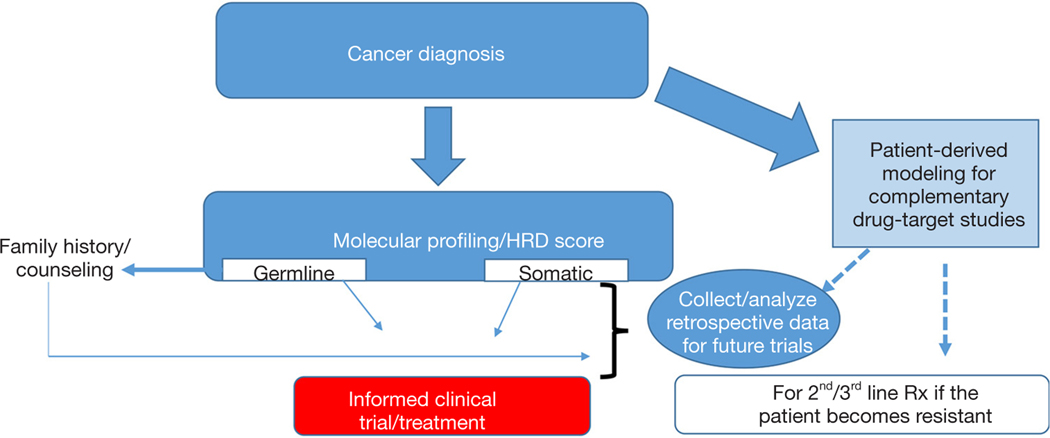
Recent advances in next generation sequencing (NGS) and molecular subtyping of tumors have opened the door to clinically available targeted therapies. Although the treatment of many solid tumors still rely on a steady regimen of non-targeted chemotherapeutic agents, it is becoming increasingly more apparent that certain tumors with defects in DNA damage repair (DDR) genes may be exquisitely sensitive to DNA damaging agents or therapies targeting key elements of this pathway such PARP1, ATR, or ATM. Still, for tumors with DDR defects the challenges are multi-fold including: (I) identifying these tumors in patients in time for a window of opportunity of treatment; (II) ensuring that these tumors are still reliant or addicted to this pathway; and (III) making sure these tumors are matched with the precise treatment option. Herein, we will discuss the opportunities, challenges, and future of targeting a subset of DDR-defective tumors.
新一代测序(NGS)和肿瘤分子亚型分类的最新进展为临床可用的靶向治疗打开了大门。尽管许多实体瘤的治疗仍依赖于非靶向化疗药物的稳定疗程,但越来越明显的是,某些DNA损伤修复(DDR)基因存在缺陷的肿瘤可能对DNA损伤剂或针对该途径关键元件(如PARP1、ATR或ATM)的疗法极为敏感。然而,对于具有DDR缺陷的肿瘤,挑战是多方面的,包括:(I)在患者中及时识别这些肿瘤,以便抓住治疗的机会窗口;(II)确保这些肿瘤仍然依赖或“成瘾”于该途径;以及(III)确保这些肿瘤与精确的治疗方案相匹配。在此,我们将讨论针对DDR缺陷肿瘤子集的机遇、挑战和未来。