Department of Psychiatry and Behavioral Sciences, SUNY Downstate Health Sciences University, Brooklyn, New York.
VA New York Harbor Healthcare System, Brooklyn.
JAMA Psychiatry. 2022 Jun 1;79(6):622-628. doi: 10.1001/jamapsychiatry.2022.0685.
All of Us is a landmark initiative for population-scale research into a variety of health conditions, including psychiatric disorders.
To analyze the prevalence, comorbidity, and sociodemographic covariates of psychiatric disorders in the All of Us biobank.
DESIGN, SETTING, AND PARTICIPANTS: We estimated prevalence, overlap, and sociodemographic correlates for psychiatric disorders as reported in electronic health records for All of Us release 5 (N = 331 380).
Social and demographic covariates.
Psychiatric disorders derived from International Statistical Classification of Diseases, Tenth Revision, Clinical Modification, codes across 6 broad domains: mood disorders, anxiety disorders, substance use disorders, stress-related disorders, schizophrenia, and personality disorders.
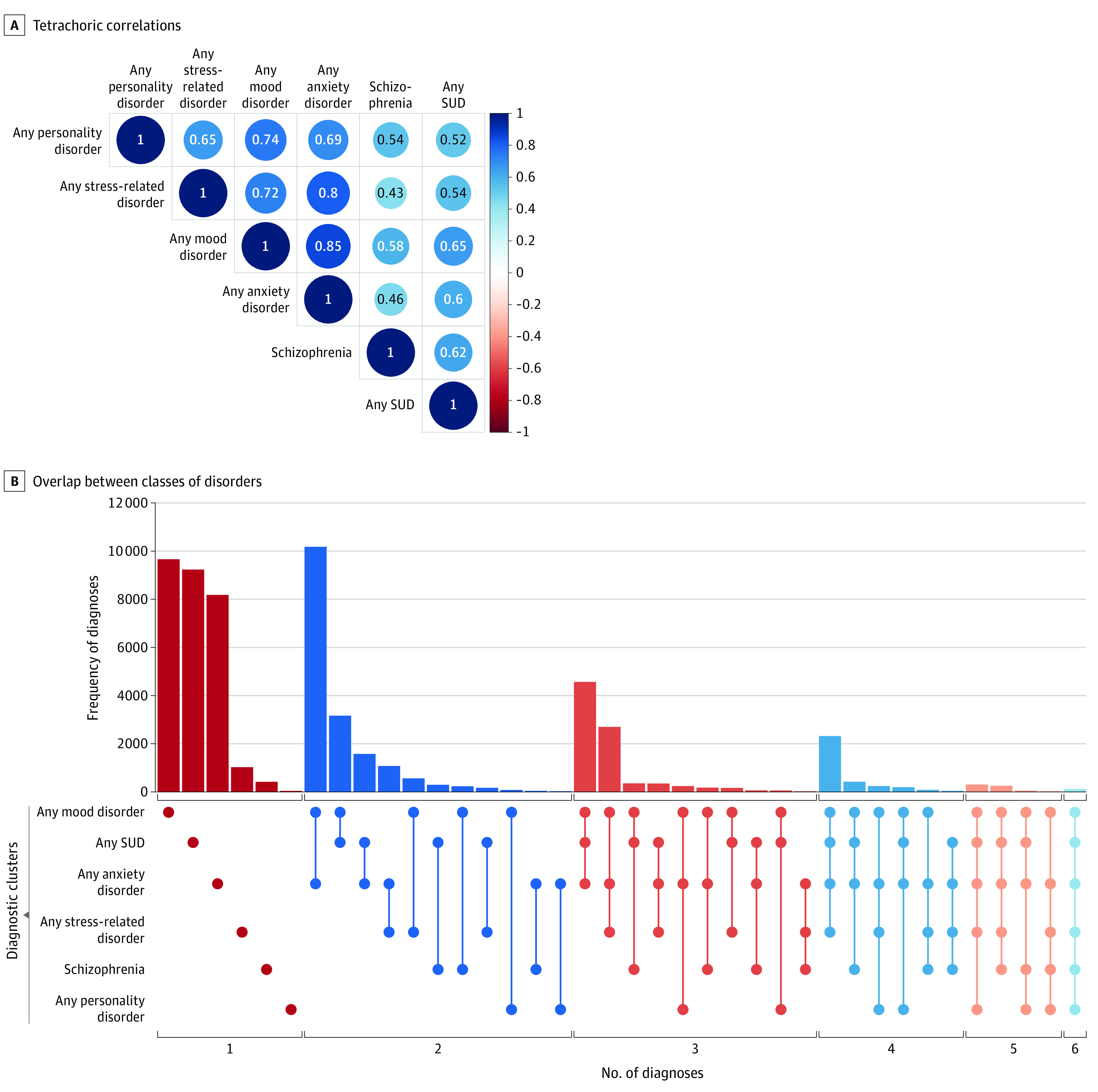
The analytic sample (N = 329 038) was 60.7% female (mean [SD] age, 50.9 [16.8] years). The prevalence of disorders ranged from 11.00% (95% CI, 10.68% to 11.32%) for any mood disorder to less than 1% (eg, obsessive-compulsive disorder, 0.18%; 95% CI, -0.16% to 0.52%), with mood disorders being the most common and personality disorders being the least. There was substantial overlap among disorders, with the majority of participants with a disorder (30 113/58 806, approximately 51%) having 2 or more registered diagnoses and tetrachoric correlations ranging from 0.43 to 0.74. Comparisons of prevalence across demographic categories revealed that non-Hispanic White people, individuals with low socioeconomic status, women and individuals assigned female at birth, and sexual minority individuals are at greatest risk for most disorders.
Although rates of disorders among the All of Us cohort are lower than in the general population, considerable variation, comorbidity, and disparities exist across social groups. To improve the practice of equitable precision medicine, researchers can use comprehensive health data from large-scale resources such as All of Us.
All of Us 是一项具有里程碑意义的倡议,旨在对包括精神障碍在内的各种健康状况进行大规模的人群研究。
分析 All of Us 生物库中精神障碍的流行率、共病和社会人口学协变量。
设计、设置和参与者:我们根据 All of Us 发布 5 版的电子健康记录(N=331380),估计了精神障碍的流行率、重叠和社会人口学相关性。
社会和人口统计学协变量。
从国际疾病分类,第十次修订版,临床修正版中得出的 6 个广泛领域的精神障碍诊断:心境障碍、焦虑障碍、物质使用障碍、应激相关障碍、精神分裂症和人格障碍。
分析样本(N=329038)中 60.7%为女性(平均[标准差]年龄为 50.9[16.8]岁)。疾病的患病率从任何心境障碍的 11.00%(95%CI,10.68%至 11.32%)到不到 1%(例如,强迫症,0.18%;95%CI,-0.16%至 0.52%)不等,心境障碍最常见,人格障碍最不常见。各疾病之间存在大量重叠,大多数患有疾病的患者(30113/58806,约 51%)有 2 个或更多的登记诊断,四分相关系数范围为 0.43 至 0.74。跨人口统计学类别比较患病率显示,非西班牙裔白人、社会经济地位低的人群、女性和出生时被指定为女性的人群以及性少数人群患大多数疾病的风险最高。
尽管 All of Us 队列中的疾病发生率低于一般人群,但在社会群体之间存在相当大的差异、共病和差异。为了提高公平精准医学的实践水平,研究人员可以使用 All of Us 等大规模资源的综合健康数据。