National Institute of Occupational Health and Poison Control, Beijing, China.
Zhejiang Provincial Center for Disease Control and Prevention, Hangzhou, Zhejiang, China.
Ear Hear. 2022;43(6):1881-1892. doi: 10.1097/AUD.0000000000001223. Epub 2022 Apr 21.
Studies have shown that in addition to energy, kurtosis plays an important role in the assessment of hearing loss caused by complex noise. The objective of this study was to investigate how to use noise recordings and audiometry collected from workers in industrial environments to find an optimal kurtosis-adjusted algorithm to better evaluate hearing loss caused by both continuous noise and complex noise.
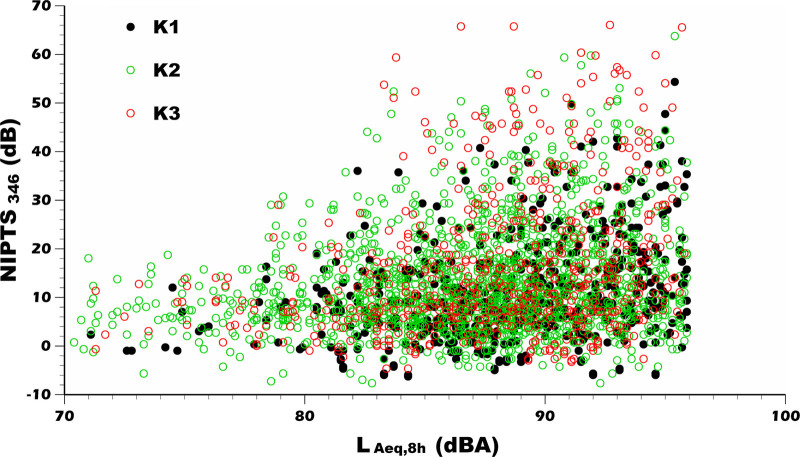
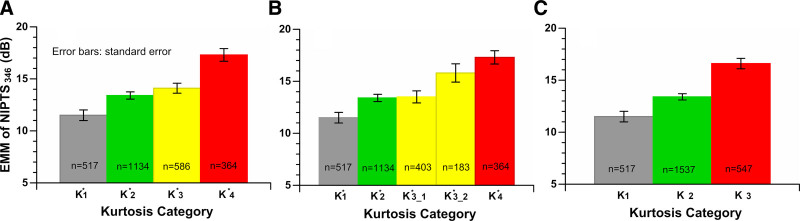
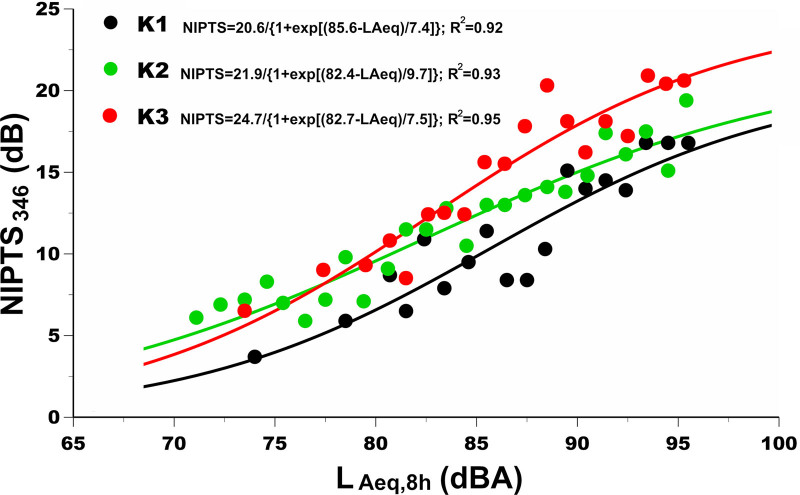
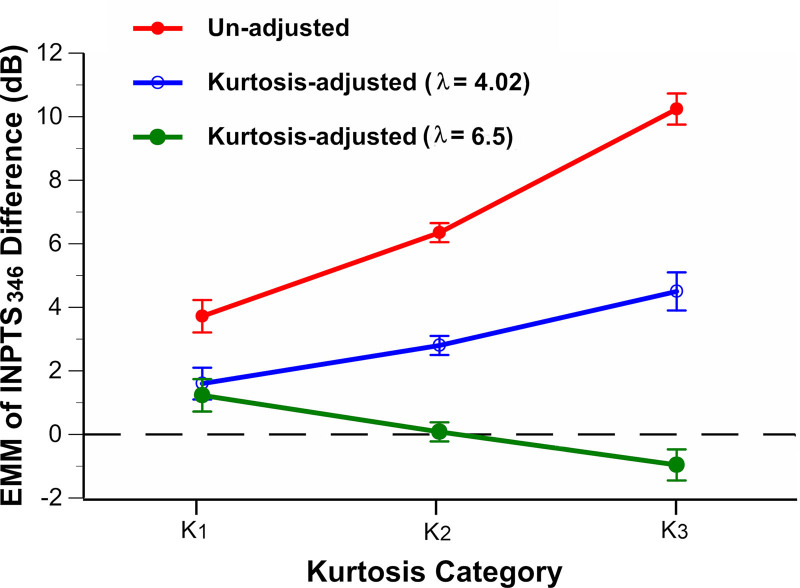
In this study, the combined effects of energy and kurtosis on noise-induced hearing loss (NIHL) were investigated using data collected from 2601 Chinese workers exposed to various industrial noises. The cohort was divided into three subgroups based on three kurtosis (β) levels (K 1 : 3 ≤ β ≤ 10, K 2 : 10 <β ≤ 50, and K 3 : β > 50). Noise-induced permanent threshold shift at test frequencies 3, 4, and 6 kHz (NIPTS 346 ) was used as the indicator of NIHL. Predicted NIPTS 346 was calculated using the ISO 1999 model for each participant, and the actual NIPTS was obtained by correcting for age and sex using non-noise-exposed Chinese workers (n = 1297). A kurtosis-adjusted A-weighted sound pressure level normalized to a nominal 8-hour working day (L Aeq,8h ) was developed based on the kurtosis categorized group data sets using multiple linear regression. Using the NIPTS 346 and the L Aeq.8h metric, a dose-response relationship for three kurtosis groups was constructed, and the combined effect of noise level and kurtosis on NIHL was investigated.
An optimal kurtosis-adjusted L Aeq,8h formula with a kurtosis adjustment coefficient of 6.5 was established by using the worker data. The kurtosis-adjusted L Aeq,8h better estimated hearing loss caused by various complex noises. The analysis of the dose-response relationships among the three kurtosis groups showed that the NIPTS of K 2 and K 3 groups was significantly higher than that of K 1 group in the range of 70 dBA ≤ L Aeq,8h < 85 dBA. For 85 dBA ≤ L Aeq,8h ≤ 95 dBA, the NIPTS 346 of the three groups showed an obvious K 3 > K 2 > K 1 . For L Aeq,8h >95 dBA, the NIPTS 346 of the K 2 group tended to be consistent with that of the K 1 group, while the NIPTS 346 of the K 3 group was significantly larger than that of the K 1 and K 2 groups. When L Aeq,8h is below 70 dBA, neither continuous noise nor complex noise produced significant NIPTS 346 .
Because non-Gaussian complex noise is ubiquitous in many industries, the temporal characteristics of noise (i.e., kurtosis) must be taken into account in evaluating occupational NIHL. A kurtosis-adjusted L Aeq,8h with an adjustment coefficient of 6.5 allows a more accurate prediction of high-frequency NIHL. Relying on a single value (i.e., 85 dBA) as a recommended exposure limit does not appear to be sufficient to protect the hearing of workers exposed to complex noise.
研究表明,除了能量外,峰态在评估复杂噪声引起的听力损失中也起着重要作用。本研究的目的是探讨如何利用工业环境中工人的噪声记录和听力计数据,找到最佳的峰态调整算法,以更好地评估连续噪声和复杂噪声引起的听力损失。
本研究使用来自接触各种工业噪声的 2601 名中国工人的数据,研究了能量和峰态对噪声性听力损失(NIHL)的综合影响。该队列根据三个峰态(β)水平(K 1 :3≤β≤10,K 2 :10<β≤50,K 3 :β>50)分为三组。3、4 和 6 kHz 测试频率的噪声诱导永久性阈移(NIPTS 346 )被用作 NIHL 的指标。为每个参与者使用 ISO 1999 模型预测 NIPTS 346,并使用非噪声暴露的中国工人(n=1297)校正年龄和性别后获得实际的 NIPTS 346。基于峰态分类组数据集,使用多元线性回归开发了一种归一化为名义 8 小时工作日的峰态调整 A 加权声压级(L Aeq,8h )。使用 NIPTS 346 和 L Aeq,8h 指标,构建了三个峰态组的剂量-反应关系,并研究了噪声水平和峰态对 NIHL 的综合影响。
使用工人数据建立了一个最佳的峰态调整 L Aeq,8h 公式,峰态调整系数为 6.5。峰态调整后的 L Aeq,8h 能更好地估计各种复杂噪声引起的听力损失。对三个峰态组的剂量-反应关系进行分析,结果表明,在 70 dBA≤L Aeq,8h <85 dBA 的范围内,K 2 和 K 3 组的 NIPTS 明显高于 K 1 组。对于 85 dBA≤L Aeq,8h ≤95 dBA,三组的 NIPTS 346 表现出明显的 K 3 > K 2 > K 1 。对于 L Aeq,8h >95 dBA,K 2 组的 NIPTS 346 趋于与 K 1 组一致,而 K 3 组的 NIPTS 346 明显大于 K 1 和 K 2 组。当 L Aeq,8h 低于 70 dBA 时,无论是连续噪声还是复杂噪声都不会产生显著的 NIPTS 346 。
由于许多工业中存在非高斯复杂噪声,因此在评估职业性 NIHL 时必须考虑噪声的时间特征(即峰态)。峰态调整系数为 6.5 的 L Aeq,8h 可以更准确地预测高频 NIHL。仅依赖于 85 dBA 这一个单一值(即推荐暴露限值)似乎不足以保护接触复杂噪声的工人的听力。