Xue Panqi, Zhao Wulan, Gao Xiangjing, Wei Fang, Xu Fei, Xie Hongwei, Mao Hangze, Zou Hua, Qiu Wei
Occupational Health and Radiation Protection Institute, Zhejiang Provincial Center for Disease Control and Prevention, Hangzhou, Zhejiang, China.
School of Medical Technology and Information Engineering, Zhejiang Chinese Medical University, Hangzhou, Zhejiang, China.
Ear Hear. 2025;46(3):758-769. doi: 10.1097/AUD.0000000000001618. Epub 2024 Dec 27.
Studies on the relationship between occupational noise exposure and extended high-frequency (EHF) hearing loss are limited. This study investigated the relationship between occupational noise exposure and EHF hearing loss in workers exposed to noise as measured by sound pressure level, exposure duration, and kurtosis to help provide a basis for early detection and prevention of hearing loss in noise-exposed workers.
A cross-sectional survey was conducted among 602 participants with 472 noise-exposed workers and 130 non-noise-exposed controls. General demographic characteristics, noise exposure data, and hearing thresholds at conventional frequencies (0.25 to 8 kHz) and EHF (9 to 16 kHz) were collected and analyzed. Linear mixed-effects model analyses between hearing thresholds of EHF and noise exposure indicators including the 8-h equivalent continuous A-weighted sound pressure level ( LAeq,8h ), cumulative noise exposure (CNE), and kurtosis-adjusted CNE (CNE-K) were conducted.
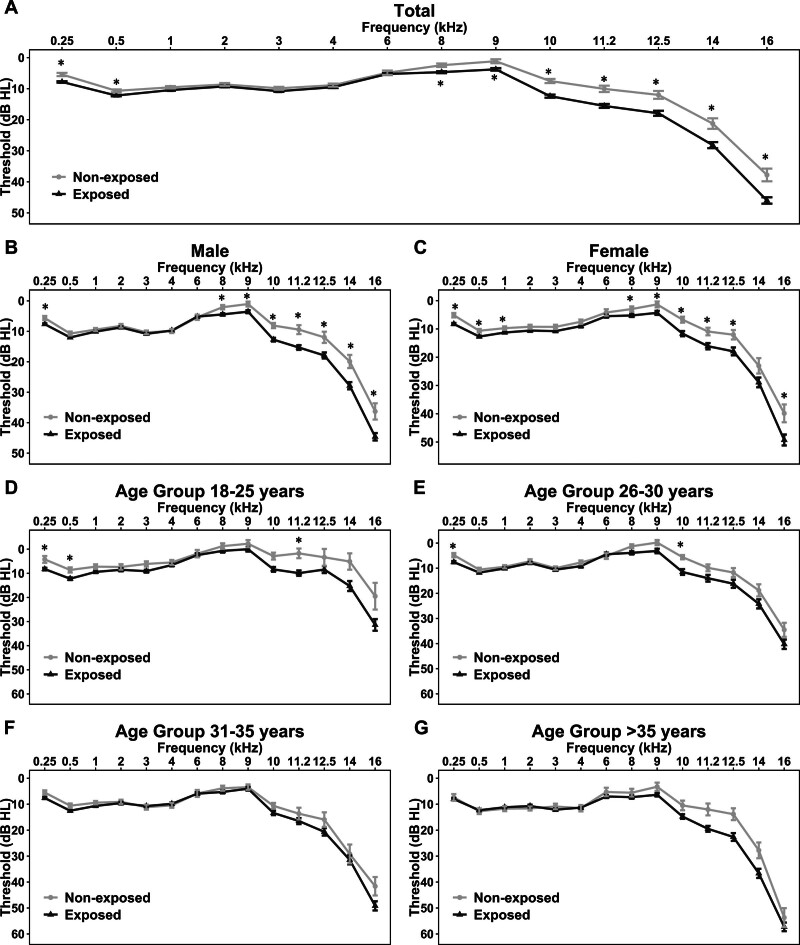
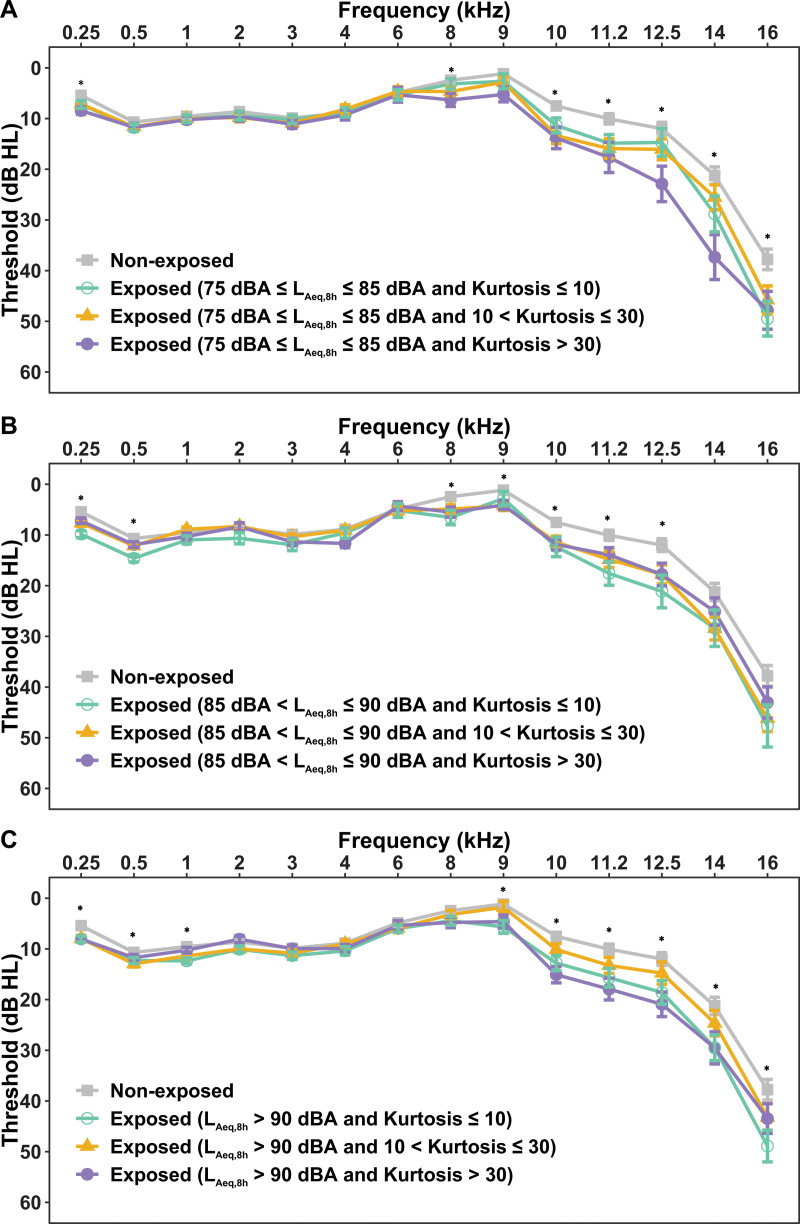
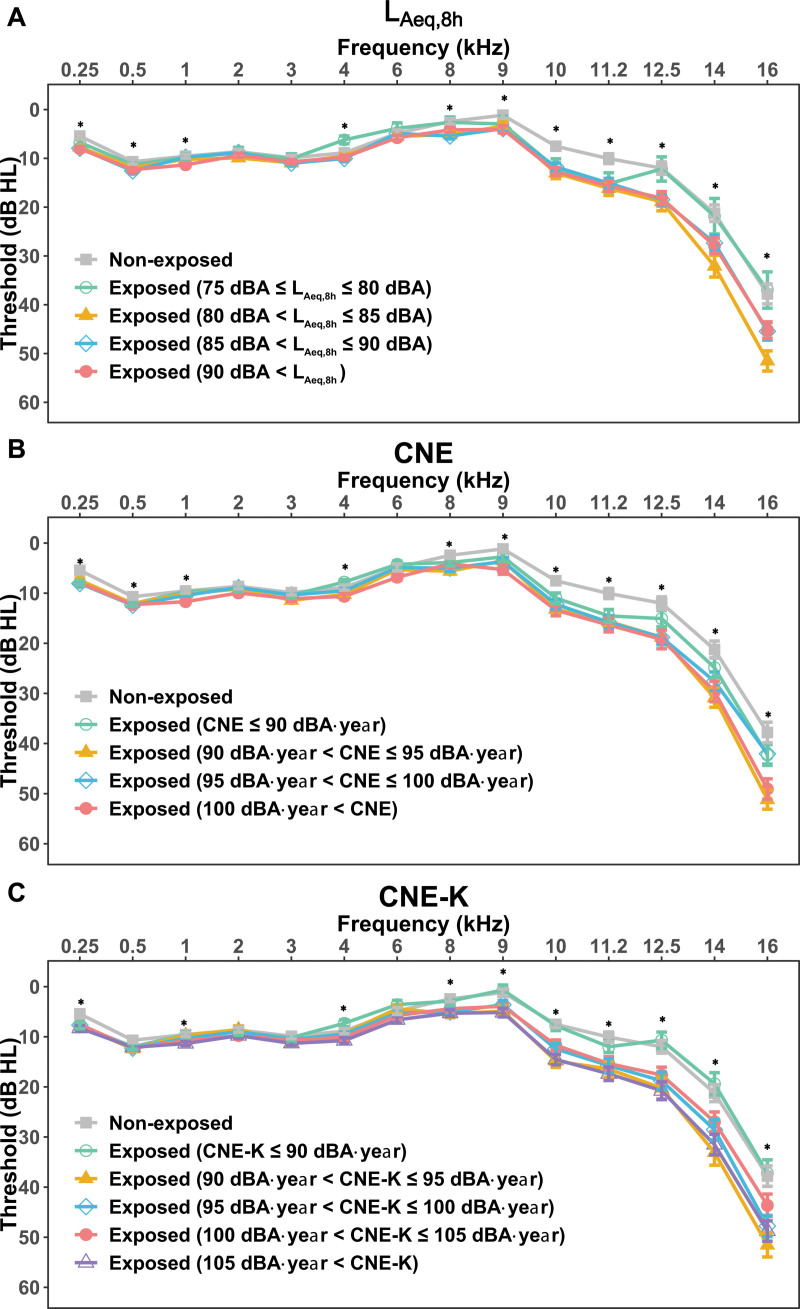
Among the 602 participants included in the analysis, 472 individuals (78.4%) were occupationally exposed to noise exposures ≥75 dBA. Significant differences ( p < 0.05) were observed in sex, exposure duration, LAeq,8h , CNE, and CNE-K between the noise-exposed group and the nonexposed group. The mean hearing thresholds for all tested extended high frequencies ranging from 9 to 16 kHz were significantly higher in the noise-exposed group than in the nonexposed group ( p < 0.05). The mean hearing thresholds of subjects in different groups of LAeq,8h exposures were generally stable with little variance in the conventional frequencies (0.25 to 8 kHz) but differed in the EHF range. Moreover, EHF hearing loss appeared to be most prominent in the subjects exposed to noise with 80 dBA < LAeq,8h ≤ 85 dBA. After the combination of the sound pressure level, exposure duration, and kurtosis by using the noise exposure indicators CNE and CNE-K, the subjects at the different noise exposures showed significant differences in hearing thresholds at EHF ( p < 0.05). Linear mixed-effected model analyses showed that the CNE-K was the best to indicate noise-induced hearing loss among the three noise exposure indicators at EHF.
The results indicate that the EHF hearing threshold testing is more sensitive to identifying early occupational noise-induced hearing loss than conventional audiometry. The CNE-K, an indicator combining noise energy, exposure duration, and kurtosis, is a more comprehensive and effective method for assessing the risk of EHF hearing loss due to occupational noise exposure.
关于职业噪声暴露与扩展高频(EHF)听力损失之间关系的研究有限。本研究调查了职业噪声暴露与噪声暴露工人的EHF听力损失之间的关系,通过声压级、暴露持续时间和峰度来衡量,以帮助为早期发现和预防噪声暴露工人的听力损失提供依据。
对602名参与者进行了横断面调查,其中472名是噪声暴露工人,130名是非噪声暴露对照。收集并分析了一般人口统计学特征、噪声暴露数据以及常规频率(0.25至8kHz)和EHF(9至16kHz)的听力阈值。对EHF听力阈值与噪声暴露指标之间进行了线性混合效应模型分析,这些指标包括8小时等效连续A加权声压级(LAeq,8h)、累积噪声暴露(CNE)和经峰度调整的CNE(CNE-K)。
在纳入分析的602名参与者中,472人(78.4%)职业性暴露于≥75 dBA的噪声。噪声暴露组和非暴露组在性别、暴露持续时间、LAeq,8h、CNE和CNE-K方面存在显著差异(p < 0.05)。噪声暴露组中所有测试的9至16kHz扩展高频的平均听力阈值显著高于非暴露组(p < 0.05)。在不同LAeq,8h暴露组的受试者中,常规频率(0.25至8kHz)的平均听力阈值总体稳定,方差较小,但在EHF范围内有所不同。此外,EHF听力损失在暴露于80 dBA < LAeq,8h ≤ 85 dBA噪声的受试者中似乎最为突出。通过使用噪声暴露指标CNE和CNE-K将声压级、暴露持续时间和峰度相结合后,不同噪声暴露水平的受试者在EHF听力阈值上存在显著差异(p < 0.05)。线性混合效应模型分析表明,在EHF的三个噪声暴露指标中,CNE-K最能表明噪声性听力损失。
结果表明,与传统听力测定相比,EHF听力阈值测试在识别早期职业性噪声性听力损失方面更敏感。CNE-K是一种结合了噪声能量、暴露持续时间和峰度的指标,是评估职业噪声暴露导致EHF听力损失风险的更全面、有效的方法。