Vieira Raquel Andrade Leite, Pickler Thaisa Borim, Segato Talita Cristina Mena, Jozala Angela Faustino, Grotto Denise
LAPETOX - Laboratory of Toxicological Research, University of Sorocaba, Sorocaba, Brazil.
LAMINFE - Laboratory of Industrial Microbiology and Fermentation Process, University of Sorocaba, Sorocaba, Brazil.
Sci Rep. 2022 Apr 20;12(1):6507. doi: 10.1038/s41598-022-10165-4.
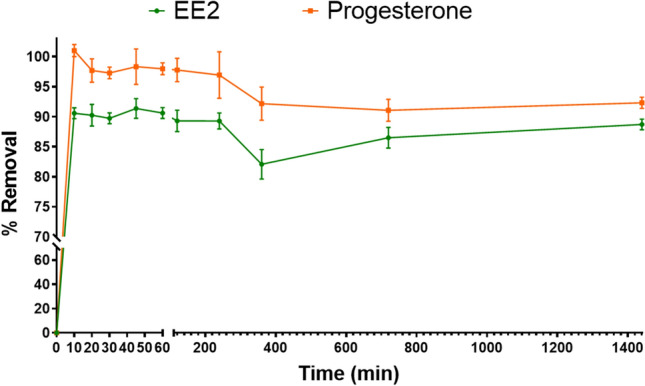
The agricultural residues are ecofriendly alternatives for removing contaminants from water. In this way, a novel biochar from the spent mushroom substrate (SMS) was produced and assessed to remove endocrine disruptor from water in batch and fixed-bed method. SMS were dried, ground, and pyrolyzed. Pyrolysis was carried out in three different conditions at 250 and 450 °C, with a residence time of 1 h, and at 600 °C with a residence time of 20 min. The biochar was firstly tested in a pilot batch with 17α-ethinylestradiol (EE2) and progesterone. The residual concentrations of the endocrine disruptors were determined by HPLC. The biochar obtained at 600 °C showed the best removal efficiency results. Then, adsorption parameters (isotherm and kinetics), fixed bed tests and biochar characterization were carried out. The Langmuir model fits better to progesterone while the Freundlich model fits better to EE2. The Langmuir model isotherm indicated a maximum adsorption capacity of 232.64 mg progesterone/g biochar, and 138.98 mg EE2/g biochar. Images from scanning electrons microscopy showed that the 600 °C biochar presented higher porosity than others. In the fixed bed test the removal capacity was more than 80% for both endocrine disruptors. Thus, the biochar showed a good and viable option for removal of contaminants, such as hormones.
农业残留物是从水中去除污染物的环保替代品。通过这种方式,制备了一种来自废蘑菇基质(SMS)的新型生物炭,并采用分批和固定床方法评估其从水中去除内分泌干扰物的能力。将SMS进行干燥、研磨和热解。热解在三种不同条件下进行,分别是250℃和450℃,停留时间为1小时,以及600℃,停留时间为20分钟。首先在中试批次中用17α-乙炔雌二醇(EE2)和孕酮对生物炭进行测试。通过高效液相色谱法测定内分泌干扰物的残留浓度。在600℃下获得的生物炭显示出最佳的去除效率结果。然后,进行了吸附参数(等温线和动力学)、固定床试验以及生物炭表征。Langmuir模型对孕酮的拟合效果更好,而Freundlich模型对EE2的拟合效果更好。Langmuir模型等温线表明,生物炭对孕酮的最大吸附容量为232.64mg/g,对EE2的最大吸附容量为138.98mg/g。扫描电子显微镜图像显示,600℃的生物炭比其他生物炭具有更高的孔隙率。在固定床试验中,两种内分泌干扰物的去除率均超过80%。因此,生物炭是去除激素等污染物的一种良好且可行的选择。