School of Ecology and Environment, Inner Mongolia University, Hohhot, 010021, China.
Inner Mongolia Key Laboratory of River and Lake Ecology, Hohhot, 010021, China.
Sci Rep. 2022 Apr 20;12(1):6535. doi: 10.1038/s41598-022-10284-y.
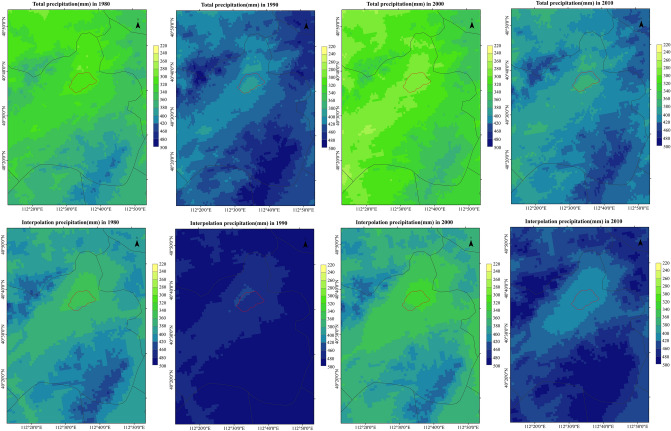
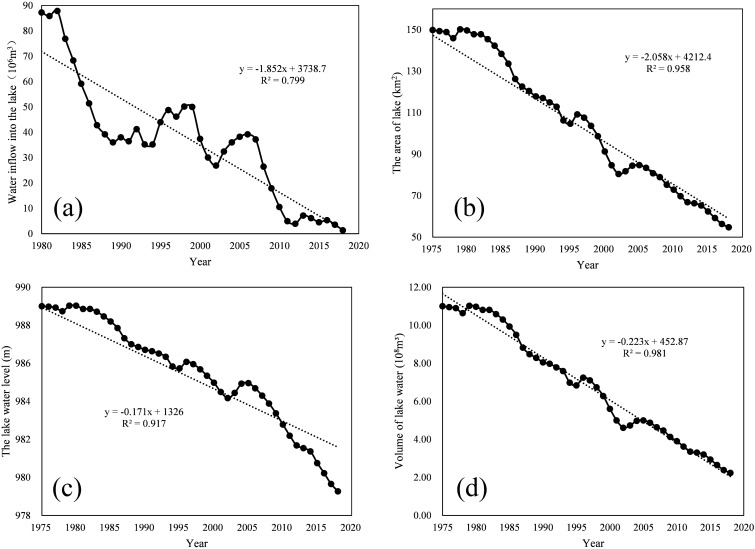
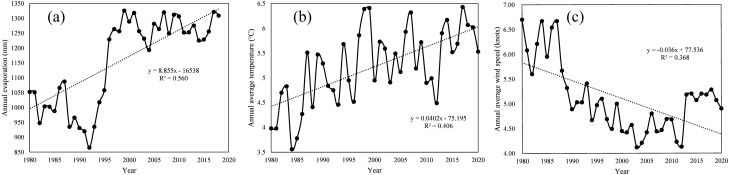
Arid area is very sensitive to global warming and are extremely vulnerable to climate change. Moreover, the water resources system in the arid area is fragile and will undergo tremendous changes with climate change. Therefore, the interaction of climate and hydrology in arid area has an important impact on the formation of regional microclimate and hydrological changes. Daihai Lake is a typical closed inland lake in arid area of China, and a key area for ecological protection in North China. In this paper, WRF-Hydro model is used to simulate the climate hydrological coupling situation of Daihai Basin from 1980 to 2020, and the coupling results are verified and calibrated by meteorological statistics, runoff calculation and remote sensing analysis. Based on the synopsis of climate and hydrology in the past 40 years, the causes and future trends of the hydrological elements in Daihai Basin are analyzed. Through the analysis, it is found that the interannual variation of precipitation in Daihai Basin is sharp, with 401.75 mm as the average from 1980 to 1994; and drastic fluctuations from 1995 to 2011, with a difference of nearly 400 mm between the interannual maximum and minimum; From 2012 to 2020, the fluctuation is small. Although the interannual variation of evaporation fluctuated, it showed an upward trend with a slope of 8.855 mm/year. The annual average temperature showed an obvious upward trend with a slope of 0.040 °C/year. From 1980 to 2020, the inflow of Daihai Lake shows a downward trend; Since 2013, the runoff into the lake has tended to be flat. Climate change and human activities are the decisive factors leading to the change of water quantity in Daihai, among which human activities play a greater role. Cultivated land irrigation and industrial water use are highly correlated with the lake discharge, and these two factors have a great influence on the lake discharge. If the current agricultural and industrial water consumption does not increase, Daihai still has a lifespan of nearly 120 years. If human activities do not change and any protective measures are not taken in time, under the background of global climate change, the flow of the Daihai Lake into the lake will be reduced to zero in 2025, and the Daihai Lake will completely dry up in 2031-2033. The study of climate hydrological coupling of long time series in Daihai Basin can not only make up for the lack of runoff data, but also provide the basis for water resources management, disaster prevention and mitigation.
干旱地区对全球变暖非常敏感,极易受到气候变化的影响。此外,干旱地区的水资源系统脆弱,将随着气候变化发生巨大变化。因此,干旱地区气候与水文的相互作用对区域小气候和水文变化的形成有重要影响。岱海是中国干旱地区的一个典型封闭内陆湖,也是中国华北地区生态保护的重点区域。本文利用 WRF-Hydro 模型模拟了 1980 年至 2020 年岱海流域的气候水文耦合情况,并通过气象统计、径流量计算和遥感分析对耦合结果进行验证和校准。基于过去 40 年的气候和水文综合分析,分析了岱海流域水文要素的成因和未来趋势。通过分析发现,岱海流域的年际降水量变化剧烈,1980 年至 1994 年年平均降水量为 401.75mm;1995 年至 2011 年波动剧烈,年际最大与最小相差近 400mm;2012 年至 2020 年波动较小。尽管蒸发量的年际变化波动较大,但呈上升趋势,斜率为 8.855mm/年。年平均气温呈明显上升趋势,斜率为 0.040°C/年。1980 年至 2020 年,岱海入湖流量呈下降趋势;自 2013 年以来,入湖径流量趋于平稳。气候变化和人类活动是导致岱海水量变化的决定性因素,其中人类活动的作用更大。耕地灌溉和工业用水与湖泊排放量高度相关,这两个因素对湖泊排放量有很大影响。如果当前农业和工业用水量不增加,岱海仍有近 120 年的寿命。如果人类活动不改变,不及时采取任何保护措施,在全球气候变化背景下,岱海入湖流量将在 2025 年减少到零,岱海将在 2031-2033 年完全干涸。对岱海流域长时间序列气候水文耦合的研究不仅可以弥补径流量数据的不足,而且为水资源管理、防灾减灾提供依据。