Alcan Sermin, Ergin Makbule, Keskin Hakan, Erdoğan Abdullah
Department of Thoracic Surgery, Şanlıurfa Mehmet Akif Inan Training and Research Hospital, Şanlıurfa, Turkey.
Department of Thoracic Surgery, Akdeniz University, Faculty of Medicine, Antalya, Turkey.
Turk Gogus Kalp Damar Cerrahisi Derg. 2022 Jan 28;30(1):83-91. doi: 10.5606/tgkdc.dergisi.2022.20969. eCollection 2022 Jan.
This study aims to investigate the prognostic factors affecting survival in patients undergoing surgical treatment for esophageal cancer.
A total of 50 patients (33 males, 17 females; mean age: 57.8±11.8 years; range, 28 to 80 years) who underwent esophagectomy for esophageal cancer in our clinic between January 2008 and March 2018 were retrospectively analyzed. Prognostic factors affecting survival were investigated. Data including age, sex, tumor size, histological and macroscopic type, tumor stage, T and N categories, the total number of resected lymph nodes and metastatic lymph node ratio, differentiation degree, vascular and perineural invasion, proximal surgical margin distance, adjuvant therapy, and the presence of postoperative complications were recorded.
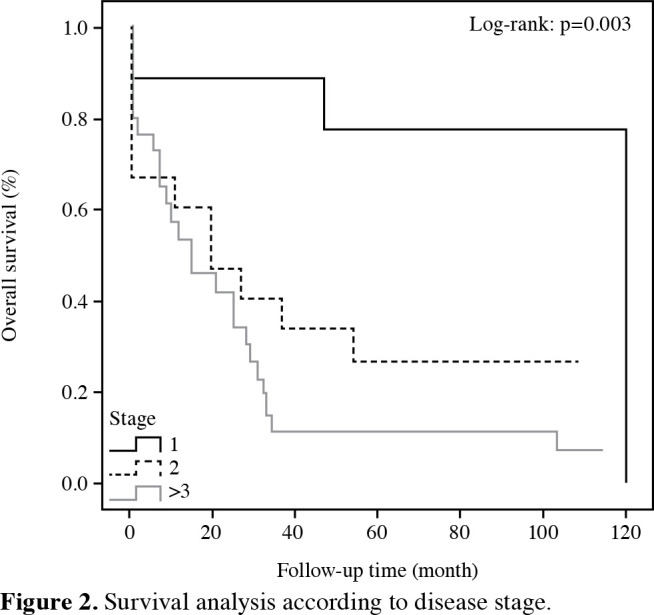
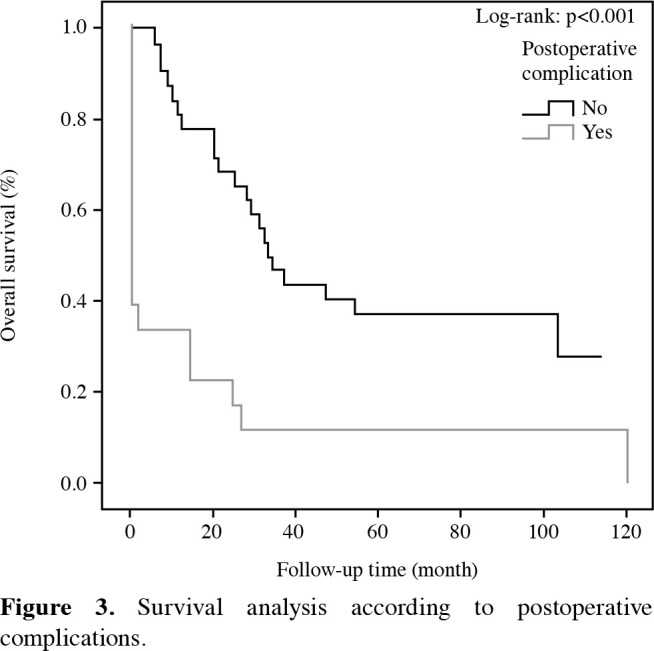
The patients after radical surgery with a tumor size of <3 cm, macroscopic type non-ulcerative-infiltrative squamous cell carcinoma pathology, Stage 1 disease, pT1-2, pN0, well-differentiated groups, no perineural invasion, a metastatic lymph node ratio of <0.2, proximal surgery margin length of 5 to 10 cm, and no postoperative complications had higher five-year survival rates. However, when the effects of these factors on overall survival were examined independently, none of them had a statistically significant effect (p>0.05). The main factors affecting the prognosis were Stage ≥2 disease, postoperative complications, and proximal surgical margin less than 5 cm.
Our study results suggest that Stage 1 disease, a proximal surgical margin length of more than 5 cm, and the absence of complications are associated with longer survival times and these patients are greatly benefited from surgical treatment.
本研究旨在探讨影响食管癌手术治疗患者生存的预后因素。
回顾性分析2008年1月至2018年3月在我院接受食管癌切除术的50例患者(男性33例,女性17例;平均年龄:57.8±11.8岁;范围28至80岁)。研究影响生存的预后因素。记录的数据包括年龄、性别、肿瘤大小、组织学和大体类型、肿瘤分期、T和N分类、切除淋巴结总数和转移淋巴结比例、分化程度、血管和神经周围侵犯、近端手术切缘距离、辅助治疗以及术后并发症的存在情况。
肿瘤大小<3 cm、大体类型为非溃疡性浸润性鳞状细胞癌病理、1期疾病、pT1-2、pN0、高分化组、无神经周围侵犯、转移淋巴结比例<0.2、近端手术切缘长度为5至10 cm且无术后并发症的根治性手术后患者五年生存率较高。然而,当单独检查这些因素对总生存的影响时,它们均无统计学显著影响(p>0.05)。影响预后的主要因素是疾病分期≥2期、术后并发症以及近端手术切缘小于5 cm。
我们的研究结果表明,1期疾病、近端手术切缘长度超过5 cm以及无并发症与更长的生存时间相关,并且这些患者从手术治疗中获益巨大。